Chapter 53: Essays & structured writing
Rédiger un texte argumenté
French schools train every pupil in one way of arguing on paper: a clear question, a plan announced in advance, paragraphs that each prove one point, and a conclusion that opens a new door. DELF and DALF examiners mark exactly this. Learn the architecture once and you can write about any subject — phones at school, remote work, tourism.
- 1What the exams ask you to write
- 2The shape of a French essay
- 3Choose your plan
- 4The introduction in four moves
- 5Paragraphs and an impersonal voice
- 6Transitions and the conclusion
- 7Model essay, annotated
- 8Résumé and synthèse (DALF C1–C2)
The French essay in one line
Introduction (ends with a question and the plan) → 2 or 3 parts linked by transitions → conclusion (answer + ouverture).
53.1 What the exams ask you to write
From B1 upwards, the written test is an argumentative text: you take a position on a general question and defend it. The format changes with the level. Details on scoring and timing are in DELF, DALF & your level; here is the writing side.
| Exam | Typical task | Length |
|---|---|---|
| DELF B1 | essay, article, letter or forum post giving your opinion | 160 words minimum |
| DELF B2 | texte argumenté: formal letter, article, forum contribution, essay | 250 words minimum |
| DALF C1 | ① synthèse of two documents ② essai argumenté | about 220 words; 250 words minimum |
| DALF C2 | a structured text (article, editorial, speech…) built from a file of documents | about 700 words |
The genres and their frames
| Genre | Frame | Key feature |
|---|---|---|
| l’essai | title + intro / parts / conclusion | the purest form of the French plan |
| la lettre au courrier des lecteurs | formal letter frame | you react to an article in a newspaper |
| l’article | title + short chapeau (standfirst) | written for readers; can use subheadings |
| la contribution à un forum | pseudonym, lighter tone | still structured; still argued |
- J’ai lu avec intérêt votre article du 3 mars et je souhaiterais réagir. — I read your article of 3 March with interest and I would like to respond. — the classic first line of a reader’s letter. The letter frame itself is in Messages, letters & emails.
Word counts are rules
Below the minimum you lose marks, and in a DALF synthèse you must stay close to the target. Write the total at the end: Nombre de mots : 262.
53.2 The shape of a French essay
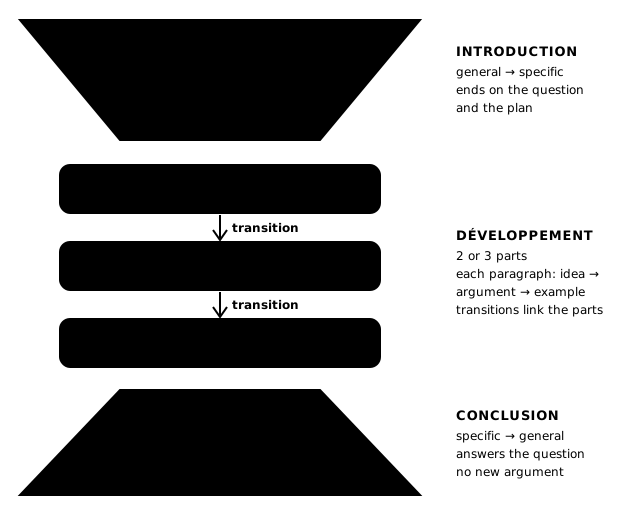
Picture the essay as two funnels with a solid body between them. The introduction goes from the general to the precise question. The development proves your answer step by step. The conclusion goes back from the precise answer to a wider horizon.
53.3 Choose your plan
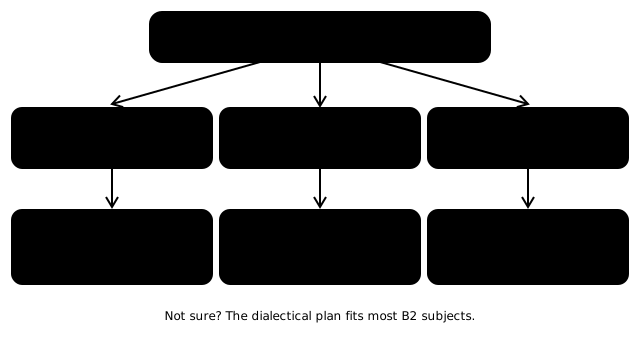
Before writing a single sentence, spend five to ten minutes on the plan. The type of question tells you which plan to use.
| Plan | The parts | Example subject |
|---|---|---|
| dialectique | I. thèse (yes, because…) II. antithèse (but…) III. synthèse (a higher answer) | Faut-il interdire les voitures en ville ? |
| problème – causes – solutions | I. the facts II. causes and consequences III. solutions | Comment lutter contre le gaspillage alimentaire ? |
| thématique | one part per aspect: economic, social, cultural… | Quels sont les effets du tourisme de masse ? |
The synthèse part of a dialectical plan is not a summary of I and II: it goes beyond them, often with a condition or a compromise (“yes, but only if…”). At DELF B2, two parts (for / against) and a conclusion that settles the debate are perfectly acceptable.
Plan first, sentences second
Jot down the question, two or three part titles and one example per paragraph before you write. A good plan saves more marks than good vocabulary.
53.4 The introduction in four moves
A French introduction is one paragraph of four short moves. Here they are on the subject Le télétravail est-il un progrès ? (Is remote work progress?).
- Amorce : Depuis 2020, des millions de salariés travaillent régulièrement depuis chez eux. — Hook: Since 2020, millions of employees have regularly worked from home. — a fact, a figure or a recent event.
- Sujet : Le télétravail, longtemps réservé à quelques professions, est devenu une pratique courante. — Subject: Remote work, long limited to a few professions, has become common practice.
- Problématique : Mais représente-t-il vraiment un progrès pour les salariés ? — Central question: But is it really progress for employees? — always a real question.
- Annonce du plan : Nous examinerons d’abord ses avantages, puis ses limites. — Plan: We will first examine its advantages, then its limits.
Ready-made frames
| Move | French | English |
|---|---|---|
| problématique | Dans quelle mesure… ? | To what extent…? |
| problématique | Peut-on affirmer que… ? | Can we claim that…? |
| annonce | Nous verrons dans un premier temps…, puis dans un second temps… | We will first see…, then… |
| annonce | Après avoir montré que…, nous nous demanderons si… | Having shown that…, we will ask whether… |
Avoid the tired hooks
Depuis la nuit des temps… (since the dawn of time) and a bare De nos jours… (nowadays) make examiners sigh. Start with something precise.
Careful
- Wrong: Dans cette essai, je vais parler des téléphones.
- Right: Nous nous demanderons s’il faut interdire les téléphones à l’école.
- Why: Two problems. Un essai is masculine, so it is cet essai (cet before a vowel). And “I am going to talk about…” is a topic, not a question: the introduction must end on a problématique. We will ask whether phones should be banned at school.
53.5 Paragraphs and an impersonal voice
Each paragraph of the development proves one idea in four steps. Start a new paragraph (with an indent or a blank line) for every new idea — examiners check this.
- Idée : Tout d’abord, le télétravail améliore la qualité de vie des salariés. — Idea: First of all, remote work improves employees’ quality of life.
- Argument : En effet, il supprime les longs trajets et laisse plus de temps pour la famille. — Argument: Indeed, it removes long commutes and leaves more time for family.
- Exemple : Ainsi, un salarié de la banlieue parisienne peut gagner jusqu’à deux heures par jour. — Example: For instance, an employee in the Paris suburbs can save up to two hours a day.
- Mini-conclusion : Sur ce point, le télétravail apparaît donc comme un net progrès. — Mini-conclusion: On this point, remote work therefore looks like clear progress. — it links back to the question.
One paragraph, one idea
Idée → argument → exemple → mini-conclusion. The connectors inside the paragraph (en effet, ainsi, donc) are listed in Linking words.
Giving an opinion without “je”
In a DELF essay you may say je — you are asked for your opinion. But a repeated je pense que sounds childish, and a real French dissertation prefers on, nous or an impersonal phrase. Watch the mood after each one (see The subjunctive).
- Il semble que cette mesure soit efficace. — It seems that this measure is effective. — + subjunctive.
- On peut considérer que l’école a un rôle à jouer. — One may consider that schools have a role to play. — + indicative.
- Force est de constater que les écrans ont envahi notre quotidien. — One has to admit that screens have invaded our daily lives. — + indicative; very C1.
- Il est indéniable que le numérique transforme l’école. — It is undeniable that digital technology is transforming schools.
- Il convient de nuancer ce point de vue. — This point of view should be qualified. — + infinitive.
- Il serait souhaitable que chaque établissement fixe ses propres règles. — It would be desirable for each school to set its own rules. — + subjunctive.
- Nombreux sont ceux qui dénoncent cette réforme. — Many people criticise this reform.
Careful
- Wrong: Je pense que c’est utile. Je pense aussi que c’est dangereux. Je pense que…
- Right: Il est indéniable que c’est utile. Force est de constater cependant que c’est risqué.
- Why: Vary the frames and keep the personal je for one clear moment, usually the conclusion. It is undeniable that it is useful. One must admit, however, that it is risky.
Careful
- Wrong: Il y a beaucoup de gens qui pensent que le télétravail isole.
- Right: Nombreux sont ceux qui estiment que le télétravail isole. / On considère souvent que…
- Why: Il y a beaucoup de gens qui… is spoken French. Written argument uses a tighter, impersonal frame. Many people believe that remote work isolates.
Careful
- Wrong: Il semble que cette mesure est efficace.
- Right: Il semble que cette mesure soit efficace.
- Why: Il semble que normally takes the subjunctive. (With a pronoun, il me semble que, the indicative is used: il me semble que c’est efficace.)
53.6 Transitions and the conclusion
Between two parts you need a transition: one or two sentences that close the previous part and open the next. Connectors inside paragraphs are in Linking words; these are only the bridges between parts.
- Nous avons vu que le télétravail libère du temps. Il convient à présent d’en examiner les limites. — We have seen that remote work frees up time. We should now examine its limits.
- Après avoir examiné ses avantages, intéressons-nous à ses inconvénients. — Having examined its advantages, let us turn to its drawbacks.
- Si le télétravail offre une réelle liberté, il n’en comporte pas moins des risques. — Although remote work offers real freedom, it nonetheless carries risks. — si here means “although”.
- Dès lors, comment concilier liberté et protection des salariés ? — So how can freedom and employee protection be reconciled? — a question that opens part III.
Careful
- Wrong: Premièrement, … Deuxièmement, … Troisièmement, …
- Right: Tout d’abord, … Nous avons vu que… Voyons à présent… … Dès lors, …
- Why: A numbered list is not an argument. Each part must lead logically into the next, so the reader feels the reasoning move forward.
The conclusion: bilan, réponse, ouverture
- Bilan : Au terme de cette réflexion, il apparaît que le télétravail présente autant d’atouts que de risques. — Summary: At the end of this discussion, remote work appears to have as many strengths as risks.
- Réponse : Il constitue donc un progrès, à condition qu’il reste choisi et encadré. — Answer: It is therefore progress, provided it remains a choice and is regulated. — à condition que + subjunctive.
- Ouverture : Reste à savoir si nos villes sauront s’adapter à ce nouveau mode de vie. — Opening: It remains to be seen whether our cities will adapt to this new way of life.
Careful
- Wrong: En conclusion, il faut aussi ajouter que le télétravail coûte cher aux entreprises.
- Right: En conclusion, le télétravail constitue un progrès, à condition qu’il reste encadré.
- Why: The conclusion never brings a new argument. If the idea matters, move it into the development. The conclusion sums up, answers, and opens.
53.7 Model essay, annotated
A B2-level essay of about 290 words, dialectical plan in two parts with a nuanced answer. Read each block, then its note.
Faut-il interdire les téléphones portables à l’école ? Should mobile phones be banned at school?
Introduction
- Aujourd’hui, la plupart des adolescents possèdent un smartphone et le consultent des dizaines de fois par jour. En France, depuis 2018, la loi interdit d’ailleurs son utilisation à l’école et au collège. — Today most teenagers own a smartphone and check it dozens of times a day. In France, since 2018, the law has in fact banned its use in primary and lower secondary schools. — amorce + sujet: a fact, then the precise topic. La plupart des takes a plural verb.
- Cette mesure divise pourtant parents et enseignants. Faut-il vraiment bannir le téléphone des établissements scolaires ? — Yet this measure divides parents and teachers. Should phones really be banished from schools? — the debate, then the problématique, reworded rather than copied from the title.
- Nous verrons d’abord les raisons qui justifient cette interdiction, puis les arguments de ceux qui préfèrent apprendre aux élèves à s’en servir. — We will first look at the reasons for this ban, then at the arguments of those who prefer to teach pupils how to use it. — annonce du plan: two parts.
Part I — thèse
- Tout d’abord, le téléphone est une source de distraction permanente. Les notifications interrompent la concentration, et beaucoup d’enseignants constatent que les élèves ont du mal à rester attentifs. — First, the phone is a constant distraction. Notifications break concentration, and many teachers note that pupils struggle to stay focused. — idée + argument.
- Par ailleurs, au lieu de jouer ou de discuter pendant la récréation, de nombreux élèves restent seuls devant leur écran. Enfin, les réseaux sociaux favorisent parfois le harcèlement, qui ne s’arrête plus à la porte de l’école. — Moreover, instead of playing or chatting at break time, many pupils stay alone in front of their screen. Finally, social networks sometimes encourage bullying, which no longer stops at the school gate. — two more arguments with concrete examples.
- L’interdiction protège donc à la fois l’apprentissage et le bien-être des élèves. — The ban therefore protects both learning and pupils’ well-being. — mini-conclusion.
Transition and Part II — antithèse
- Cependant, interdire n’est pas toujours éduquer. — However, banning is not always educating. — a short, punchy transition.
- En effet, le smartphone peut devenir un véritable outil pédagogique : un dictionnaire, une calculatrice ou une application de langues permettent de travailler autrement. — Indeed, the smartphone can become a real teaching tool: a dictionary, a calculator or a language app make it possible to work differently.
- De plus, c’est à l’école que les jeunes peuvent apprendre à utiliser le numérique de façon responsable. Les priver de téléphone ne leur apprend pas à maîtriser leur temps d’écran à la maison. — What is more, school is where young people can learn to use digital tools responsibly. Depriving them of phones does not teach them to control their screen time at home. — c’est… que highlights the key idea.
Conclusion
- En définitive, l’interdiction du portable semble justifiée pendant les cours, car elle préserve l’attention et les relations entre élèves. Néanmoins, une interdiction totale risque de laisser les jeunes seuls face aux écrans. — All in all, banning phones seems justified during lessons, since it protects attention and relationships between pupils. Nevertheless, a total ban risks leaving young people alone with screens. — bilan of both parts.
- La meilleure solution consisterait sans doute à autoriser un usage encadré, décidé par l’enseignant. — The best solution would probably be to allow supervised use, decided by the teacher. — the answer: a synthesis, not just yes or no.
- Reste à savoir si les adultes, eux-mêmes très connectés, sauront montrer l’exemple. — It remains to be seen whether adults, who are themselves very connected, will set an example. — the ouverture: a wider question.
Steal the skeleton, not the sentences
Reuse the frames — Nous verrons d’abord…, puis…, Cependant…, En définitive…, Reste à savoir si… — on any subject. Examiners recognise memorised paragraphs, but they reward a clear structure.
53.8 Résumé and synthèse (DALF C1–C2)
At C1 you must also condense other people’s ideas. Two exercises exist: the résumé (one text, shortened) and the synthèse de documents (several texts, combined). Both forbid one thing: your own opinion.
| Résumé | Synthèse | |
|---|---|---|
| Source | one text | two or three documents |
| Order | follows the author’s order | your own plan, by themes — never document by document |
| Voice | you write in the author’s place, without “the author says” | neutral: you present and compare the documents |
| Length | usually about a quarter of the text, word count given | DALF C1: about 220 words |
| Title | no | yes — a neutral title |
The synthèse rules
Neutral title · no opinion · no outside ideas · group ideas by theme · reformulate (keywords yes, copied sentences no) · respect the word count and write it at the end.
Neutral frames for a synthèse
- Les deux documents abordent la question du téléphone à l’école. — Both documents deal with the question of phones at school.
- Le premier document souligne les risques de distraction, tandis que le second met l’accent sur l’éducation au numérique. — The first document stresses the risk of distraction, whereas the second emphasises digital education.
- Les deux auteurs s’accordent toutefois sur la nécessité de fixer des règles. — Both authors agree, however, on the need to set rules.
A good neutral title: Le portable à l’école : interdire ou éduquer ? Phones at school: ban or educate? — it names the theme without taking sides.
Careful
- Wrong: À mon avis, le premier document a raison : il faut interdire les portables.
- Right: Le premier document estime qu’il faut interdire les portables, alors que le second privilégie l’éducation.
- Why: In a synthèse you are a neutral reporter. Any je, à mon avis or judgement (“is right”) costs marks. Your opinion belongs in the separate essai argumenté.
À retenir
- Introduction (ends with a question and the plan) → 2 or 3 parts linked by transitions → conclusion (answer + ouverture).
- Jot down the question, two or three part titles and one example per paragraph before you write. A good plan saves more marks than good vocabulary.
- Idée → argument → exemple → mini-conclusion. The connectors inside the paragraph (en effet, ainsi, donc) are listed in Linking words.
- Reuse the frames — Nous verrons d’abord…, puis…, Cependant…, En définitive…, Reste à savoir si… — on any subject. Examiners recognise memorised paragraphs, but they reward a clear structure.
- Neutral title · no opinion · no outside ideas · group ideas by theme · reformulate (keywords yes, copied sentences no) · respect the word count and write it at the end.
- Write one 250-word essay this week on Le télétravail est-il un progrès ? using the four-move introduction and a transition between parts. Then practise saying the same argument aloud in Arguing & presenting, and check the…
53.9 Practice — Essays & structured writing
Exercise 1
Dans ___ essai, nous verrons les avantages du numérique.
- ce
- cet
- cette
- ces
Hint: essai is masculine and starts with a vowel
Answer
cet
Un essai is masculine; before a vowel sound ce becomes cet.
Exercise 2
What must the introduction end with?
- a personal story
- the problématique and the plan
- the final answer
- a list of connectors
Answer
the problématique and the plan
The introduction funnels down to the central question, then announces the plan.
Exercise 3
Which plan suits 'Comment lutter contre le gaspillage alimentaire ?'
- thèse, antithèse, synthèse
- problème, causes, solutions
- a chronological story
- no plan
Answer
problème, causes, solutions
A 'comment lutter contre...' subject is a problem to solve.
Exercise 4
In a synthèse de documents you may...
- give your opinion
- add examples from your own life
- group the ideas by theme
- copy whole sentences
Answer
group the ideas by theme
A synthèse reorganises the documents' ideas by theme, neutrally and in your own words.
Exercise 5
Which sentence does NOT belong in a conclusion?
- En définitive, la mesure semble justifiée.
- Reste à savoir si les adultes montreront l'exemple.
- Il faut aussi ajouter un nouvel argument économique.
- Il constitue donc un progrès, à condition qu'il reste encadré.
Answer
Il faut aussi ajouter un nouvel argument économique.
A conclusion sums up, answers and opens; it never adds a new argument.
Exercise 6
Force est de ___ que les écrans ont envahi notre quotidien.
Hint: to note, to observe
Answer
constater
Force est de constater que = one has to admit that.
Exercise 7
Il semble que cette mesure ___ (être) efficace.
Hint: il semble que + subjunctive
Answer
soit
Il semble que normally takes the subjunctive: soit.
Exercise 8
___ de nombreux enseignants, les élèves sont moins attentifs.
Hint: according to
Answer
Selon / D'après
Selon / D'après introduce a source without giving your own opinion.
Exercise 9
Tap the wrong word.
Dans cette essai, nous verrons les avantages du numérique.
Answer
Wrong word: cette.
Corrected: Dans cet essai, nous verrons les avantages du numérique.
Un essai is masculine: cet essai.
Exercise 10
This is from a synthèse. Tap the word that breaks the rules.
À mon avis, le premier document a raison.
Answer
Wrong word: avis.
Corrected: Le premier document estime que...
No personal opinion in a synthèse.
Exercise 11
Tap the wrong verb.
Il semble que cette mesure est efficace.
Answer
Wrong word: est.
Corrected: Il semble que cette mesure soit efficace.
Il semble que + subjunctive.
Exercise 12
Put the words in order to announce the plan.
Words: puis / avantages / les / les / Nous / verrons / d'abord / limites
Answer
Nous verrons d'abord les avantages puis les limites
Nous verrons d'abord..., puis... is the classic annonce du plan.
Exercise 13
Put the words in order.
Words: vue / convient / Il / de / ce / de / point / nuancer
Answer
Il convient de nuancer ce point de vue
Il convient de + infinitive = it is appropriate to...
Exercise 14
Match the parts to their job.
| A | B |
|---|---|
| l'amorce | the roadmap of the parts |
| la problématique | a wider question at the end |
| l'annonce du plan | the hook at the start |
| l'ouverture | the central question |
Answer
l'amorce — the hook at the start; la problématique — the central question; l'annonce du plan — the roadmap of the parts; l'ouverture — a wider question at the end
These are the moves of the French introduction and conclusion.
Exercise 15
Match the French to the English.
| A | B |
|---|---|
| Nombreux sont ceux qui | One has to admit that |
| Reste à savoir si | It is appropriate to |
| Force est de constater que | Many people |
| Il convient de | It remains to be seen whether |
Answer
Nombreux sont ceux qui — Many people; Reste à savoir si — It remains to be seen whether; Force est de constater que — One has to admit that; Il convient de — It is appropriate to
Impersonal frames make an argument sound written and objective.
Exercise 16
Say it aloud.
Faut-il interdire les téléphones portables à l'école
Answer
Say: Faut-il interdire les téléphones portables à l'école
A model problématique: a real yes/no question.
Exercise 17
Say it aloud.
Reste à savoir si les adultes montreront l'exemple
Answer
Say: Reste à savoir si les adultes montreront l'exemple
Reste à savoir si... is a classic ouverture.
Next step
Write one 250-word essay this week on Le télétravail est-il un progrès ? using the four-move introduction and a transition between parts. Then practise saying the same argument aloud in Arguing & presenting, and check the exam formats in DELF, DALF & your level.