Chapter 32: Gérondif & participles
Gérondif, participe, infinitif
This chapter is about compressing sentences. Instead of pendant que je marchais, j’écoutais de la musique, say j’écoutais de la musique en marchant. Instead of quand j’ai fini, je suis sorti, say *après avoir fini, je suis sorti. These structures make your French sound fluent and precise — and they finish with two power tools: the causative faire faire and emphasis with c’est… qui*.
- 1The gérondif: en + -ant
- 2The participe présent (without en)
- 3Participe présent or adjectif verbal?
- 4Compound participles: ayant fini, étant arrivé
- 5Infinitive constructions
- 6The causative: faire, laisser, se faire
- 7Mise en relief: c’est… qui / que
masculinefeminineplural
Forming the -ant form
Take the nous form of the present, drop -ons, add -ant: nous parlons → parlant, nous finissons → finissant. Only three exceptions: étant (être), ayant (avoir), sachant (savoir).
| Infinitive | nous… | -ant form |
|---|---|---|
| marcher | marchons | marchant |
| manger | mangeons | mangeant |
| commencer | commençons | commençant |
| choisir | choisissons | choisissant |
| prendre | prenons | prenant |
| faire | faisons | faisant |
| être · avoir · savoir | — | étant · ayant · sachant |
32.1 The gérondif: en + -ant
The gérondif is en + the -ant form. It never changes (no agreement) and its subject is always the subject of the main verb. It answers four questions: when? how? on what condition? why?
| Meaning | Example | = |
|---|---|---|
| simultaneity (while) | Il chante en prenant sa douche. | pendant qu’il prend |
| manner, means (by) | Elle a appris en regardant des séries. | grâce au fait de regarder |
| condition (if) | En partant maintenant, tu seras à l’heure. | si tu pars |
| cause (because) | Il s’est blessé en tombant. | parce qu’il est tombé |
- Je fais mes devoirs en écoutant de la musique. — I do my homework while listening to music.
- J’ai rencontré Paul en sortant du métro. — I met Paul as I was coming out of the metro.
- Elle a perdu cinq kilos en faisant du vélo tous les jours. — She lost five kilos by cycling every day.
- En travaillant un peu plus, tu réussirais. — If you worked a little harder, you would succeed.
- C’est en forgeant qu’on devient forgeron. — Practice makes perfect. (proverb: it is by forging that one becomes a blacksmith)
Hindi does something very close with -te hue: gaana gaate hue nahaata hai = il se douche en chantant. Like the gérondif, -te hue normally refers to the subject of the sentence.
tout en — emphasis or contrast
Adding tout before the gérondif either stresses that two things happen at the same time, or marks a contrast (= although).
- Il conduit tout en téléphonant — c’est dangereux ! — He drives while talking on the phone at the same time — it’s dangerous!
- Tout en étant très riche, elle vit simplement. — Although she is very rich, she lives simply.
Careful
- Wrong: En sortant de la maison, la pluie a commencé.
- Right: En sortant de la maison, j’ai vu qu’il pleuvait.
- Why: The gérondif’s subject must be the main subject. In the wrong version, it is "the rain" that leaves the house! Say instead: Quand je suis sorti, il a commencé à pleuvoir.
32.2 The participe présent (without en)
Without en, the -ant form is the participe présent. It is mostly written and formal, and it is invariable. It has two main jobs.
a) Instead of qui + verb
- Les candidats souhaitant participer doivent s’inscrire avant lundi. — Candidates wishing to take part must register before Monday. (= qui souhaitent)
- Nous cherchons une personne parlant hindi et français. — We are looking for someone who speaks Hindi and French.
b) To give a cause
- Étant malade, elle n’est pas venue. — Being ill, she didn’t come.
- Ne sachant pas quoi dire, il s’est tu. — Not knowing what to say, he fell silent.

32.3 Participe présent or adjectif verbal?
Many -ant forms are also adjectives (une histoire amusante). As adjectives they describe a quality and agree; as participles they describe an action and never agree. Some pairs are even spelled differently — a classic trap in written exams.
| Participe (action) | Adjectif (quality) | Spelling change |
|---|---|---|
| fatiguant | fatigant | -guant → -gant |
| intriguant | intrigant | -guant → -gant |
| naviguant | navigant | -guant → -gant |
| convainquant | convaincant | -quant → -cant |
| provoquant | provocant | -quant → -cant |
| communiquant | communicant | -quant → -cant |
| différant | différent | -ant → -ent |
| précédant | précédent | -ant → -ent |
| négligeant | négligent | -geant → -gent |
| excellant | excellent | -ant → -ent |
- Ce voyage était très fatigant. — This journey was very tiring. (adjective)
- En fatiguant ses joueurs à l’entraînement, le coach les a rendus plus forts. — By tiring his players out in training, the coach made them stronger. (participle with an object)
- Ses arguments sont convaincants. — Her arguments are convincing. (adjective, agrees)
- Les jours précédant l’examen, il dormait mal. — In the days before the exam, he slept badly. (participle + object)
The quick test
Can you put très in front? → adjective (agrees, maybe a different spelling). Is it followed by an object or a complement? → participle (invariable, -ant).
32.4 Compound participles: ayant fini, étant arrivé
To show that one action was completed before the main one, use ayant / étant + past participle. With étant, the participle agrees with the subject, as in the passé composé.
- Ayant fini ses devoirs, elle est sortie. — Having finished her homework, she went out.
- Étant arrivée en retard, elle a raté le début. — Having arrived late, she missed the beginning.
- Ayant toujours vécu en ville, il déteste la campagne. — Having always lived in the city, he hates the countryside.
- S’étant trompés de route, ils sont arrivés à minuit. — Having taken the wrong road, they arrived at midnight.
The bare past participle
In writing, étant is often dropped: the past participle alone opens the sentence and agrees with the subject. A noun + participle can also stand alone ("absolute construction").
- Arrivée à la gare, elle a appelé sa mère. — Once she had arrived at the station, she called her mother.
- Le repas terminé, tout le monde est allé se promener. — The meal over, everyone went for a walk.
32.5 Infinitive constructions
After a preposition, French uses the infinitive — never the -ant form (English "before leaving" = avant de partir**). Like the gérondif, these require the same subject.
| Structure | Meaning | Example |
|---|---|---|
| après avoir / être + p.p. | after doing | Après avoir mangé, on est sortis. |
| avant de + inf. | before doing | Réfléchis avant de parler. |
| sans + inf. | without doing | Il est parti sans dire au revoir. |
| au lieu de + inf. | instead of doing | Au lieu de te plaindre, agis. |
| pour + inf. passé | for having done | Il a été puni pour avoir menti. |
- Après avoir lu le contrat, je l’ai signé. — After reading the contract, I signed it.
- Après être rentrée, elle s’est couchée. — After getting home, she went to bed. (être verb → agreement)
- Après nous être reposés, nous sommes repartis. — After resting, we set off again. (reflexive pronoun matches the subject)
- Lave-toi les mains avant de passer à table. — Wash your hands before sitting down to eat.
- Elle a répondu sans hésiter. — She answered without hesitating.
Careful
- Wrong: Après avoir arrivé, il a téléphoné.
- Right: Après être arrivé, il a téléphoné.
- Why: The infinitif passé uses the same auxiliary as the passé composé: arriver → être.
Careful
- Wrong: Avant partant, ferme la fenêtre.
- Right: Avant de partir, ferme la fenêtre.
- Why: English "before leaving" uses -ing; French uses avant de + infinitive. The only preposition that takes the -ant form is en.
32.6 The causative: faire, laisser, se faire
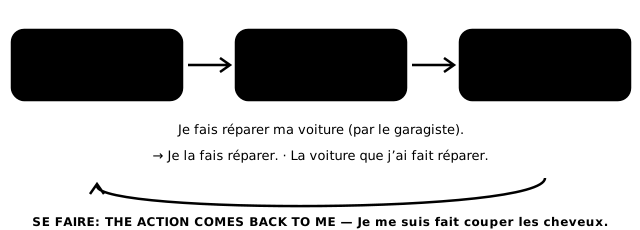
faire + infinitive means "to have something done" or "to make someone do something". You are the cause; someone else does the action. English uses "have / get / make"; Hindi uses the causative verb forms like banwana (to have built) or karwana (to have done).
- Nous faisons construire une maison. — We are having a house built.
- Le professeur fait lire le texte aux élèves. — The teacher has the students read the text. (the doer gets à when there is also an object)
- Ce film m’a fait pleurer. — This film made me cry.
- Je fais faire mes costumes chez un tailleur. — I have my suits made at a tailor’s.
- Fais-les entrer, s’il te plaît. — Show them in, please.
Two causative rules
Object pronouns go before faire, not before the infinitive: je la fais réparer. In compound tenses, fait + infinitive never agrees: la voiture que j’ai fait réparer.
laisser + infinitive — to let
- Laisse-moi parler ! — Let me speak!
- Il a laissé tomber son téléphone. — He dropped his phone. (and in slang: Laisse tomber ! = forget it!)
se faire + infinitive — it happens to me
- Je me suis fait couper les cheveux. — I had my hair cut.
- Elle s’est fait voler son vélo. — She had her bike stolen. (see also Passive & reported speech)
Careful
- Wrong: J’ai coupé mes cheveux chez le coiffeur.
- Right: Je me suis fait couper les cheveux chez le coiffeur.
- Why: "J’ai coupé mes cheveux" means you cut them yourself. When someone else does it for you → se faire + infinitive.
32.7 Mise en relief: c’est… qui / que
French cannot stress a word with the voice as English does ("I paid"). Instead it moves that word into a frame: c’est … qui for the subject, c’est … que for anything else.
- C’est Paul qui a gagné, pas moi. — It’s Paul who won, not me.
- C’est moi qui ai payé. — I’m the one who paid. (the verb agrees with moi → ai)
- C’est à toi que je parle ! — It’s you I’m talking to!
- C’est en 1789 que la Révolution a commencé. — It was in 1789 that the Revolution began.
- Ce sont eux qui ont organisé la fête. — They are the ones who organised the party.
ce qui…, c’est… / ce que…, c’est…
To build suspense, start with ce qui / ce que / ce dont (see Relative pronouns) and reveal the key element after c’est.
- Ce qui me plaît chez elle, c’est son humour. — What I like about her is her sense of humour.
- Ce que je veux, c’est dormir. — What I want is to sleep.
- Ce dont j’ai besoin, c’est de vacances. — What I need is a holiday. (the de comes back after c’est)
Spoken emphasis: dislocation
In conversation, French also "pulls out" a word and repeats it with a pronoun: Moi, je pense que… · Ce film, je l’ai adoré. · Il est où, ton frère ? More in Real spoken French.
Careful
- Wrong: C’est moi qui a raison.
- Right: C’est moi qui ai raison.
- Why: After qui, the verb agrees with the stressed pronoun: moi qui ai, toi qui as, nous qui avons.
Careful
- Wrong: C’est à Paris où je suis né.
- Right: C’est à Paris que je suis né.
- Why: The frame is always c’est … que for non-subjects — even for places and times. (C’est Paris, la ville où je suis né is a different structure.)
À retenir
- Take the nous form of the present, drop -ons, add -ant: nous parlons → parlant, nous finissons → finissant. Only three exceptions: étant (être), ayant (avoir), sachant (savoir).
- Can you put très in front? → adjective (agrees, maybe a different spelling). Is it followed by an object or a complement? → participle (invariable, -ant).
- Object pronouns go before faire, not before the infinitive: je la fais réparer. In compound tenses, fait + infinitive never agrees: la voiture que j’ai fait réparer.
- In conversation, French also "pulls out" a word and repeats it with a pronoun: Moi, je pense que… · Ce film, je l’ai adoré. · Il est où, ton frère ? More in Real spoken French.
- Describe your morning routine in four sentences using en + -ant, après avoir… and avant de…. Then read on: Literary & formal French.
32.8 Practice — Gérondif & participles
Exercise 1
Elle chante ___ la vaisselle.
- en faisant
- faisant
- en fait
- à faire
Hint: while doing
Answer
en faisant
Simultaneity → gérondif: en + faisant.
Exercise 2
___ malade, il est resté au lit.
- Étant
- En étant
- Ayant
- Été
Hint: cause, être
Answer
Étant
The participe présent étant gives the cause: being ill.
Exercise 3
C'est un argument très ___.
- convainquant
- convaincant
- convaincu
- convaincre
Hint: adjective
Answer
convaincant
The adjective is spelled convaincant (-cant); the participle is convainquant.
Exercise 4
Après ___ sortis, nous avons pris un taxi.
- avoir
- être
- étant
- ayant
Answer
être
sortir takes être → après être sortis.
Exercise 5
Je ___ réparer mon ordinateur chez un technicien.
- fais
- répare
- laisse
- suis
Hint: I'm having it repaired
Answer
fais
Causative: faire + infinitive = to have something done.
Exercise 6
C'est nous qui ___ gagné.
- a
- avons
- ont
- avez
Answer
avons
The verb agrees with the pronoun before qui: nous qui avons.
Exercise 7
___ (finir) son travail, elle est partie.
Hint: Having finished…
Answer
Ayant fini / ayant fini
Compound participle: ayant + past participle shows the earlier action.
Exercise 8
Il est parti sans ___ (dire) au revoir.
Answer
dire
After sans, French uses the infinitive.
Exercise 9
Réfléchis ___ parler !
Hint: before
Answer
avant de
before + -ing = avant de + infinitive.
Exercise 10
La maison que nous avons ___ construire est grande.
Hint: causative participle
Answer
fait
fait + infinitive never agrees.
Exercise 11
Tap the wrong word.
Après avoir arrivé à Paris, elle a appelé sa mère.
Answer
Wrong word: avoir.
Corrected: Après être arrivée à Paris, elle a appelé sa mère.
arriver takes être; with être, the participle agrees: arrivée.
Exercise 12
Tap the wrong word.
C'est moi qui a fait le gâteau.
Answer
Wrong word: a.
Corrected: C'est moi qui ai fait le gâteau.
moi qui → first person: ai.
Exercise 13
Tap the wrong word.
Ce travail est vraiment fatiguant.
Answer
Wrong word: fatiguant.
Corrected: Ce travail est vraiment fatigant.
The adjective is fatigant (no u); fatiguant is the participle.
Exercise 14
Match the structure to its meaning.
| A | B |
|---|---|
| en marchant | before walking |
| après avoir marché | without walking |
| avant de marcher | while walking |
| sans marcher | after walking |
Answer
en marchant — while walking; après avoir marché — after walking; avant de marcher — before walking; sans marcher — without walking
Only en takes the -ant form; other prepositions take the infinitive.
Exercise 15
Match the causative.
| A | B |
|---|---|
| faire réparer | to drop |
| laisser tomber | to have one's hair cut |
| se faire couper les cheveux | to have something repaired |
Answer
faire réparer — to have something repaired; laisser tomber — to drop; se faire couper les cheveux — to have one's hair cut
faire / laisser / se faire + infinitive.
Exercise 16
Put the words in order: It's by forging that one becomes a blacksmith.
Words: devient / C'est / en / forgeant / qu'on / forgeron
Answer
C'est en forgeant qu'on devient forgeron
Mise en relief c'est … que around a gérondif.
Exercise 17
Put the words in order: What I need is a holiday.
Words: c'est / Ce / de / j'ai / dont / besoin / vacances
Answer
Ce dont j'ai besoin c'est de vacances
ce dont … c'est de + noun.
Exercise 18
Say it aloud.
Je me suis fait couper les cheveux
Answer
Say: Je me suis fait couper les cheveux
se faire + infinitive: someone else did it for me.
Exercise 19
Say it aloud.
J'apprends le français en écoutant des podcasts
Answer
Say: J'apprends le français en écoutant des podcasts
Gérondif of means: en écoutant.
Next step
Describe your morning routine in four sentences using en + -ant, après avoir… and avant de…. Then read on: Literary & formal French.