Chapter 37: Conversation & opinions
Converser et donner son avis
Ordering a coffee is a transaction. A conversation is a game of catch: you throw, the other person throws back, and the game must not stop. This chapter gives you the moves — how to open, how to keep the ball in the air with questions and reactions, how to say what you think, how to agree or disagree without offending, and how to leave gracefully.
- 1Opening a conversation
- 2Keeping it going — follow-up questions
- 3Reacting — the oil of conversation
- 4Giving your opinion
- 5Agreeing and disagreeing — politely
- 6Buying time and repairing
- 7Closing a conversation
- 8A whole conversation
Answer + add + ask back
Never give a one-word answer. Answer the question, add one detail, then ask something back. That single habit keeps any French conversation alive.
37.1 Opening a conversation
The easiest opener is something you both share right now: the place, the weather, the event, the queue. With a stranger or an older person, use vous. Among young people at a party, tu is normal from the start.
- Il fait beau aujourd’hui, hein ? — Lovely weather today, isn’t it?
- Vous êtes d’ici ? — Are you from around here?
- Tu connais Julie comment ? — How do you know Julie? (at her party)
- C’est la première fois que vous venez ici ? — Is this your first time here?
- Ça a l’air bon, ce que tu manges. C’est quoi ? — What you’re eating looks good. What is it?
- Qu’est-ce que vous faites dans la vie ? — What do you do (for a living)?
| Safe small-talk topics | Better to avoid at first |
|---|---|
| the place, the event, the food | salary and how much things cost |
| travel, holidays, the weekend | religion |
| films, series, music, books | someone’s age or weight |
| where you’re from (India is a great topic!) | politics — until you know the person |
| work, in general terms | "Are you married? Why not?" |
Money is private
Questions like "How much do you earn?" or "How much was your flat?" — common in many Indian conversations — feel very intrusive in France. Talk about what things are like, not what they cost.
37.2 Keeping it going — follow-up questions
A follow-up shows you were listening. Pick up one word from the answer and ask about it. Open questions (comment, pourquoi, qu’est-ce que) work better than yes/no questions.
| Follow-up | Meaning |
|---|---|
| Et vous ? / Et toi ? | And you? |
| Ah bon ? Comment ça ? | Really? What do you mean? |
| C’était comment ? | How was it? |
| Qu’est-ce qui vous a plu ? | What did you like about it? |
| Ça fait longtemps que tu habites ici ? | Have you lived here long? |
| Et alors, qu’est-ce qui s’est passé ? | And then what happened? |
| Pourquoi tu as choisi la France ? | Why did you choose France? |
Careful
- Wrong: — Tu aimes Paris ? — Oui. (silence)
- Right: — Oui, beaucoup ! Surtout les marchés. Et toi, tu es d’où ?
- Why: A bare "oui" ends the game. Answer, add one detail, ask back.
- Oui, beaucoup ! Surtout les marchés. Et toi, tu es d’où ? — Yes, a lot! Especially the markets. And you, where are you from?
37.3 Reacting — the oil of conversation
French listeners react all the time — short sounds and words that say "I’m with you". Silence feels cold. Choose the reaction that matches the news.
| Feeling | Reactions |
|---|---|
| Surprise | C’est vrai ? · Sans blague ! · Pas possible ! · Ah bon ? |
| Joy | Génial ! · Super ! · Trop bien ! · Félicitations ! |
| Sympathy | Oh non ! · Mince ! · C’est dommage. · Le pauvre ! |
| Relief | Tant mieux ! · Ouf ! |
| Shrug | Tant pis. · Bon, ben… · C’est la vie. |
| Listening | Ah oui ? · D’accord. · Je vois. · Ah, intéressant ! |
tant mieux vs tant pis
Tant mieux = "so much the better" (good news). Tant pis = "never mind / too bad" (bad news you accept). Mixing them up sounds sarcastic.
- — J’ai eu mon visa ! — C’est vrai ? Génial ! — — I got my visa! — Really? Brilliant!
- — Le concert est annulé. — Oh non, c’est dommage ! — — The concert is cancelled. — Oh no, what a shame!
- — Il ne pleut plus. — Tant mieux ! — — It’s stopped raining. — Good!
37.4 Giving your opinion
The core frames are short. Learn four and rotate them, so you don’t start every sentence the same way.
| Frame | Meaning |
|---|---|
| Je pense que… | I think that… |
| Je trouve que… | I find that… (personal judgement) |
| À mon avis,… | In my opinion,… |
| D’après moi, / Selon moi,… | As I see it,… |
| Pour moi,… | For me,… |
| Personnellement,… | Personally,… |
Asking for an opinion
- Qu’est-ce que tu en penses ? — What do you think (about it)? — en = about it
- Tu en penses quoi ? — What do you reckon? (relaxed spoken version)
- Quel est votre avis sur la question ? — What is your view on the matter? (more formal)
Careful
- Wrong: À mon avis, je pense que c’est cher.
- Right: À mon avis, c’est cher. / Je pense que c’est cher.
- Why: One opinion frame is enough. Doubling them sounds like "In my opinion, I think…" — heavy in English too.
Careful
- Wrong: Je ne pense pas que c’est vrai.
- Right: Je ne pense pas que ce soit vrai.
- Why: Affirmative je pense que takes the indicative; negative je ne pense pas que takes the subjunctive. See The subjunctive.
37.5 Agreeing and disagreeing — politely
French people enjoy a good disagreement — it is a sign of interest, not hostility. But the way you disagree matters. Soften first, then give your point.
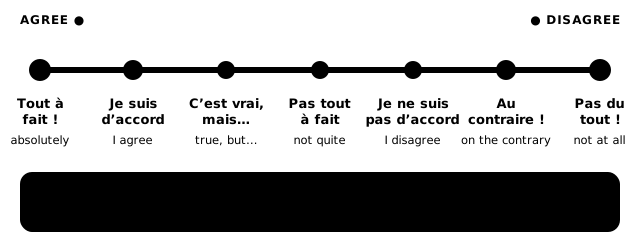
Softeners before a "but"
- Je vois ce que tu veux dire, mais… — I see what you mean, but…
- Tu n’as pas tort, mais il faut aussi dire que… — You’re not wrong, but we should also say that…
- Je comprends ton point de vue. Cela dit, … — I understand your point of view. That said, …
- Je n’en suis pas si sûr. — I’m not so sure about that. (sûre if you’re a woman — same sound)
- Tu as raison. / Vous avez tout à fait raison. — You’re right. / You’re absolutely right.
Agreement traps
- Wrong: J’ai d’accord. / Je suis raison.
- Right: Je suis d’accord. / J’ai raison.
-
Why: être d’accord (to be in agreement) but avoir raison / tort (to be right / wrong).
-
Wrong: — Je n’aime pas le froid. — Moi aussi.
- Right: — Je n’aime pas le froid. — Moi non plus.
-
Why: Agreeing with a negative needs moi non plus (me neither). Moi aussi is only for positives.
-
Wrong: — Tu ne viens pas ? — Oui, je viens !
- Right: — Tu ne viens pas ? — Si, je viens !
- Why: To contradict a negative question, French uses si, not oui.
- — Je n’aime pas le froid. — Moi non plus ! — — I don’t like the cold. — Me neither!
- — Tu ne viens pas ce soir ? — Si, bien sûr ! — — Aren’t you coming tonight? — Yes, of course I am!
37.6 Buying time and repairing
Every learner gets stuck. Fluent speakers get stuck too — they just have words for it. These lines keep you in the conversation while your brain searches.
| Line | Use it to… |
|---|---|
| Comment dire… | search for words |
| Je ne trouve pas le mot. C’est un truc pour… | describe a missing word |
| Comment on dit « … » en français ? | ask for a word |
| Tu veux dire que… ? | check you understood |
| Si j’ai bien compris,… | sum up before you answer |
| Pardon, je n’ai pas compris le dernier mot. | ask for one word again |
| Où en étais-je ? | find your thread again |
Describe, don’t freeze
Missing a word? Describe it: C’est un truc pour… (a thing for…), C’est comme… (it’s like…), le contraire de… (the opposite of…). People will give you the word.
37.7 Closing a conversation
In France, you don’t just walk away. Signal the end, say something nice, and use a good-bye that fits the time of day.
- Bon, je vais vous laisser. — Well, I’ll let you go. (the classic polite exit)
- Il faut que j’y aille, désolé. — I have to go, sorry.
- Ça m’a fait plaisir de discuter avec vous. — It was a pleasure talking to you.
- On reste en contact ? Tu es sur WhatsApp ? — Shall we keep in touch? Are you on WhatsApp?
- Bonne soirée ! À la prochaine ! — Have a nice evening! See you next time!
- Bonne continuation ! — All the best (with what you’re doing)!
37.8 A whole conversation
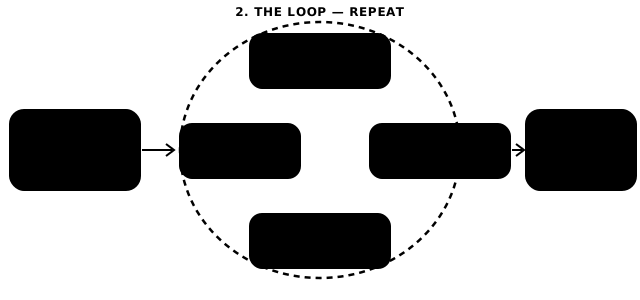
Arjun meets Léa at a friend’s party. They are about the same age, so they use tu. Watch the loop from the figure in action.
Dialogue, part 1 — opening and the loop
- Arjun : Salut ! Tu connais Thomas comment ? — Hi! How do you know Thomas?
- Léa : On travaille ensemble. Et toi ? — We work together. And you?
- Arjun : C’est mon voisin. Je suis arrivé de Bangalore il y a six mois. — He’s my neighbour. I arrived from Bangalore six months ago. (answer + add)
- Léa : Ah bon ? Et alors, ça te plaît, Lyon ? — Really? So, do you like Lyon?
- Arjun : Beaucoup ! Je trouve que la cuisine ici est incroyable. Tu es d’ici ? — A lot! I find the food here amazing. Are you from here? (answer + opinion + ask back)
- Léa : Non, de Bretagne. Mais à mon avis, la cuisine indienne, c’est encore meilleur ! — No, from Brittany. But in my opinion, Indian food is even better!
Dialogue, part 2 — disagreeing nicely and closing
- Arjun : Sans blague ! Mais je ne suis pas tout à fait d’accord : vos fromages sont imbattables. — No way! But I don’t quite agree: your cheeses are unbeatable.
- Léa : Tu n’as pas tort ! Tu as déjà goûté le kouign-amann ? — You’re not wrong! Have you ever tried kouign-amann? (a Breton butter cake)
- Arjun : Non, jamais. C’est quoi exactement ? — No, never. What is it exactly?
- Léa : Un gâteau au beurre… Écoute, il faut que j’y aille, mais on reste en contact ? — A butter cake… Listen, I have to go, but shall we keep in touch?
- Arjun : Avec plaisir ! Ça m’a fait plaisir de discuter avec toi. Bonne soirée ! — Gladly! It was nice talking to you. Have a good evening!
À retenir
- Never give a one-word answer. Answer the question, add one detail, then ask something back. That single habit keeps any French conversation alive.
- Tant mieux = "so much the better" (good news). Tant pis = "never mind / too bad" (bad news you accept). Mixing them up sounds sarcastic.
- Missing a word? Describe it: C’est un truc pour… (a thing for…), C’est comme… (it’s like…), le contraire de… (the opposite of…). People will give you the word.
- Real French conversations will not sound like this book — people drop words, squeeze sounds and sprinkle fillers. Real spoken French trains your ear for chais pas, du coup and friends.
37.9 Practice — Conversation & opinions
Exercise 1
Your friend says: 'Je n'aime pas le café.' You don't either. You say:
- Moi aussi.
- Moi non plus.
- Moi si.
- Tant mieux.
Answer
Moi non plus.
Agreeing with a negative = moi non plus (me neither).
Exercise 2
'Tu ne viens pas ?' — You ARE coming. You answer:
- Oui, je viens.
- Si, je viens !
- Non, je viens.
- Moi non plus.
Answer
Si, je viens !
Si contradicts a negative question.
Exercise 3
Your friend's train was cancelled but there's another in 10 minutes. Best reaction?
- Tant pis !
- Tant mieux !
- Sans blague !
- Félicitations !
Answer
Tant mieux !
Tant mieux = so much the better (relief, good news).
Exercise 4
Which is the softest way to disagree?
- Pas du tout !
- Au contraire !
- Je vois ce que tu veux dire, mais…
- Tu as tort.
Answer
Je vois ce que tu veux dire, mais…
Acknowledge first, then disagree — the polite French way.
Exercise 5
Je suis ___ avec toi. (in agreement)
Answer
d'accord / d’accord
être d'accord = to agree.
Exercise 6
Qu'est-ce que tu ___ penses ? (about it)
Hint: The pronoun for 'about it'.
Answer
en
penser quelque chose de… → en: Qu'est-ce que tu en penses ?
Exercise 7
Tap the wrong word.
J'ai d'accord avec ton idée.
Answer
Wrong word: J'ai.
Corrected: Je suis d'accord avec ton idée.
être d'accord, not avoir d'accord.
Exercise 8
Tap the wrong word.
Je ne pense pas que c'est vrai.
Answer
Wrong word: c'est.
Corrected: Je ne pense pas que ce soit vrai.
Negative opinion + que → subjunctive: ce soit.
Exercise 9
Match the reaction to the situation.
| A | B |
|---|---|
| Félicitations ! | Surprising news. |
| Oh non, c'est dommage ! | Bad news you accept. |
| Sans blague ! | She passed her exam. |
| Tant pis. | The concert is cancelled. |
Answer
Félicitations ! — She passed her exam.; Oh non, c'est dommage ! — The concert is cancelled.; Sans blague ! — Surprising news.; Tant pis. — Bad news you accept.
Matching the reaction to the news shows you are really listening.
Exercise 10
Match the opinion frames.
| A | B |
|---|---|
| À mon avis | As I see it |
| Je trouve que | Personally |
| D'après moi | In my opinion |
| Personnellement | I find that |
Answer
À mon avis — In my opinion; Je trouve que — I find that; D'après moi — As I see it; Personnellement — Personally
Rotate your frames so you don't repeat 'je pense que' every time.
Exercise 11
Put the words in order.
Words: la / vous / que / faites / dans / Qu'est-ce / vie
Answer
Qu'est-ce que vous faites dans la vie
= What do you do for a living?
Exercise 12
Put the words in order.
Words: discuter / de / plaisir / avec / Ça / m'a / fait / vous
Answer
Ça m'a fait plaisir de discuter avec vous
A warm way to end a conversation.
Exercise 13
Ask for their opinion.
Qu'est-ce que tu en penses
Answer
Say: Qu'est-ce que tu en penses
en = about it.
Exercise 14
React with surprise.
C'est vrai Sans blague
Answer
Say: C'est vrai Sans blague
C'est vrai ? Sans blague ! — two classic surprise reactions.
Exercise 15
Disagree politely.
Je ne suis pas tout à fait d'accord
Answer
Say: Je ne suis pas tout à fait d'accord
pas tout à fait = not quite — softer than a flat 'no'.
Exercise 16
Give your opinion.
À mon avis c'est une bonne idée
Answer
Say: À mon avis c'est une bonne idée
À mon avis + statement. No need to add je pense que.
Exercise 17
Leave politely.
Bon je vais vous laisser
Answer
Say: Bon je vais vous laisser
The classic polite exit.
Exercise 18
Open a conversation at a party.
Tu connais Thomas comment
Answer
Say: Tu connais Thomas comment
A shared-context opener: how do you know the host?
Next step
Real French conversations will not sound like this book — people drop words, squeeze sounds and sprinkle fillers. Real spoken French trains your ear for chais pas, du coup and friends.