Chapter 39: Work, phone & interviews
Travail, téléphone, entretien
At work, French becomes more careful again: vous, the full ne… pas, and set phrases that everyone uses. That is good news — set phrases can be learned. This chapter covers the phone, voicemail, video meetings, how to present yourself, a full job interview with model answers, and the small talk around the coffee machine.
- 1Phone calls — both sides of the line
- 2Voicemail — leaving and recording a message
- 3Video meetings — en visio
- 4Introducing yourself professionally
- 5The job interview — questions and model answers
- 6Office small talk
- 7Tu or vous at work?
masculinefeminine
Default to vous at work
With clients, managers and anyone you don’t know, use vous and Monsieur / Madame + surname. Switch to tu only when the other person offers it — or when the whole team clearly uses it.
39.1 Phone calls — both sides of the line
Allô ? is only for the phone: to answer a private call, or to check the line still works. Companies answer with their name and bonjour. The person who answers will use a few fixed lines — learn to recognise them.
| Line | Meaning |
|---|---|
| Société Lumière, bonjour ! | Lumière company, hello! (answering) |
| Bonjour, Priya Nair, de la société Infotech. | Hello, Priya Nair from Infotech. (introducing yourself) |
| Je voudrais parler à Madame Leroy, s’il vous plaît. | I’d like to speak to Ms Leroy, please. |
| C’est de la part de qui ? | Who’s calling, please? |
| Ne quittez pas, je vous la passe. | Hold the line, I’ll put you through to her. |
| Sa ligne est occupée. Vous patientez ? | Her line is busy. Will you hold? |
| Elle est en réunion. Voulez-vous laisser un message ? | She’s in a meeting. Would you like to leave a message? |
| Pouvez-vous lui dire de me rappeler ? | Could you ask her to call me back? |
| Je vous entends mal. Pouvez-vous répéter ? | I can’t hear you well. Could you repeat? |
Spelling and numbers on the phone
Spell with comme + a common name: N comme Nicolas, A comme Anatole… French phone numbers have ten digits, read in pairs.
- Nair : N comme Nicolas, A comme Anatole, I comme Irma, R comme Raoul. — Nair: N for Nicolas, A for Anatole, I for Irma, R for Raoul.
- 06 12 34 56 78 — "zéro six, douze, trente-quatre, cinquante-six, soixante-dix-huit"
Mini-dialogue — calling a client
- Standard : Société Lumière, bonjour ! — Lumière, hello! (the switchboard)
- Vous : Bonjour, Priya Nair, d’Infotech. Je voudrais parler à Monsieur Garnier, s’il vous plaît. — Hello, Priya Nair from Infotech. I’d like to speak to Mr Garnier, please.
- Standard : Je regrette, il est en déplacement aujourd’hui. C’est à quel sujet ? — I’m sorry, he’s away on business today. What is it about?
- Vous : C’est au sujet du devis que je lui ai envoyé lundi. — It’s about the quote I sent him on Monday.
- Standard : Très bien. Il peut vous rappeler à quel numéro ? — Very well. What number can he call you back on?
- Vous : Au 06 12 34 56 78. Merci beaucoup, bonne journée ! — On 06 12 34 56 78. Thank you very much, have a good day!
39.2 Voicemail — leaving and recording a message
A good message has five parts: who you are, why you call, what you want, your number (twice), and a polite close.
- Bonjour Madame Leroy, c’est Priya Nair, d’Infotech. — 1 — Who: Hello Ms Leroy, it’s Priya Nair from Infotech.
- Je vous appelle au sujet de notre réunion de jeudi. — 2 — Why: I’m calling about our meeting on Thursday.
- Est-ce qu’on pourrait la décaler à vendredi matin ? — 3 — What: Could we move it to Friday morning?
- Vous pouvez me rappeler au 06 12 34 56 78. Je répète : 06 12 34 56 78. — 4 — Number, twice: You can call me back on… I repeat…
- Merci d’avance, et bonne journée. — 5 — Close: Thanks in advance, and have a good day.
Your own greeting
Bonjour, vous êtes bien sur la messagerie de Priya Nair. Je ne suis pas disponible pour le moment. Laissez-moi un message et je vous rappellerai dès que possible. Hello, you’ve reached Priya Nair’s voicemail. I’m not available right now. Leave me a message and I’ll call you back as soon as possible.
39.3 Video meetings — en visio
The French say une visio (short for visioconférence) or un call in tech companies. The technical lines are the same in every meeting — and they are the ones you need first.
| Line | Meaning |
|---|---|
| Vous m’entendez ? / Tu m’entends ? | Can you hear me? |
| Je crois que ton micro est coupé. | I think you’re on mute. |
| Ça coupe, je vous entends mal. | You’re breaking up, I can’t hear you well. |
| Je partage mon écran. Vous le voyez ? | I’m sharing my screen. Can you see it? |
| On commence par un petit tour de table ? | Shall we start with a quick round of introductions? |
| Le premier point à l’ordre du jour, c’est… | The first item on the agenda is… |
| Si je peux me permettre, j’aimerais ajouter quelque chose. | If I may, I’d like to add something. |
| Je rebondis sur ce que disait Marc… | Following on from what Marc was saying… |
| On passe au point suivant ? | Shall we move to the next item? |
| Je reviens vers vous d’ici vendredi. | I’ll get back to you by Friday. |
| Je vous envoie le compte rendu. | I’ll send you the minutes. |
Careful
- Wrong: Je vais revenir à vous demain. (from English "get back to you")
- Right: Je reviens vers vous demain.
- Why: The office phrase is revenir vers quelqu’un. (Revenir à = return to a topic: revenons à la question.)
39.4 Introducing yourself professionally
Keep it to three or four sentences: name, role, company, what you actually do, and (if useful) experience or location.
- Je m’appelle Rohan Iyer. Je suis ingénieur logiciel chez Infotech. — My name is Rohan Iyer. I’m a software engineer at Infotech.
- Je m’occupe de la sécurité des paiements en ligne. — I handle online payment security.
- Je suis responsable d’une équipe de six personnes. — I’m in charge of a team of six.
- J’ai cinq ans d’expérience dans le secteur bancaire. — I have five years’ experience in the banking sector.
- Je suis basée à Pune, mais je travaille souvent avec l’équipe de Paris. — I’m based in Pune, but I often work with the Paris team. (basée — a woman speaking)
Two classic errors
- Wrong: Je suis un ingénieur.
- Right: Je suis ingénieur.
-
Why: With être + profession, French uses no article. (But: C’est un excellent ingénieur.)
-
Wrong: Je travaille à Infotech.
- Right: Je travaille chez Infotech.
- Why: For a company, use chez (like "at someone’s place"). À is for cities: je travaille à Lyon.
39.5 The job interview — questions and model answers
French interviews are fairly formal: vous, full negatives, no slang. Answers should be structured and short — about 30 seconds to a minute each. Prepare these seven; they come up almost every time.
- Q : Parlez-moi de vous. — Tell me about yourself.
- R : Je suis ingénieure en informatique, diplômée de l’IIT Bombay. Depuis quatre ans, je développe des applications mobiles pour le secteur bancaire. — I’m a computer engineer, a graduate of IIT Bombay. For four years I have been developing mobile apps for the banking sector. (present + depuis = "have been doing")
- Q : Pourquoi souhaitez-vous rejoindre notre entreprise ? — Why do you want to join our company?
- R : Je suis vos projets depuis longtemps, et votre approche du paiement mobile correspond exactement à ce que j’aime faire. — I’ve been following your projects for a long time, and your approach to mobile payment matches exactly what I love doing. (je suis here = I follow, from suivre)
- Q : Quels sont vos points forts ? — What are your strengths?
- R : Je suis rigoureuse et j’aime travailler en équipe. Par exemple, dans mon dernier poste, j’ai mis en place des revues de code hebdomadaires. — I’m rigorous and I like teamwork. For example, in my last job I set up weekly code reviews. (claim + example)
- Q : Et vos points faibles ? — And your weaknesses?
-
R : J’ai parfois du mal à déléguer. J’y travaille : aujourd’hui, je fais davantage confiance à mon équipe. — I sometimes find it hard to delegate. I’m working on it: today I trust my team more. (a real weakness + what you do about it)
-
Q : Où vous voyez-vous dans cinq ans ? — Where do you see yourself in five years?
- R : J’aimerais avoir pris plus de responsabilités, idéalement en encadrant une petite équipe. — I’d like to have taken on more responsibility, ideally managing a small team.
- Q : Quelles sont vos prétentions salariales ? — What salary are you expecting?
- R : Pour un poste de ce niveau, je vise entre 50 000 et 55 000 euros brut par an. — For a position at this level, I’m aiming for €50,000–55,000 gross per year. (French salaries are quoted gross yearly)
- Q : Avez-vous des questions ? — Do you have any questions?
- R : Oui : comment se passe l’intégration des nouveaux arrivants dans l’équipe ? — Yes: how are new joiners brought into the team? (always have one question ready)
The interview answer formula
Claim → example → link to the job. "I am X. For example, I did Y. That’s why I can bring Z to your team." Short, concrete, relevant.
Careful
- Wrong: Je travaille ici pour quatre ans. (meaning: and I still do)
- Right: Je travaille ici depuis quatre ans.
- Why: An action that started in the past and continues = present tense + depuis. English uses "have been working"; French doesn’t.
39.6 Office small talk
French office life has rituals: greeting everyone in the morning, the coffee break, bon appétit at lunch, and a bonne soirée when you leave. Colleagues of the same level often switch to tu quickly.
- Salut ! Tu as passé un bon week-end ? — Hi! Did you have a good weekend? (the Monday question)
- On prend un café ? — Shall we grab a coffee?
- Tu es en télétravail demain ? — Are you working from home tomorrow?
- Je pose ma journée vendredi. — I’m taking Friday off. (poser un jour de congé)
- Bon courage pour ta présentation ! — Good luck with your presentation! (courage = hang in there)
- Bonne soirée, à demain ! — Have a good evening, see you tomorrow!
- Tu viens au pot de départ de Sophie jeudi ? — Are you coming to Sophie’s leaving drinks on Thursday?
Bon courage vs bonne chance
Bonne chance = good luck (for something that depends on luck). Bon courage = "stay strong" for a task that needs effort — a long day, an exam, a move. At work you will hear bon courage constantly.
39.7 Tu or vous at work?
There is no single rule — it depends on the company. But this tree will keep you safe. When in doubt, use vous and let the other person decide.
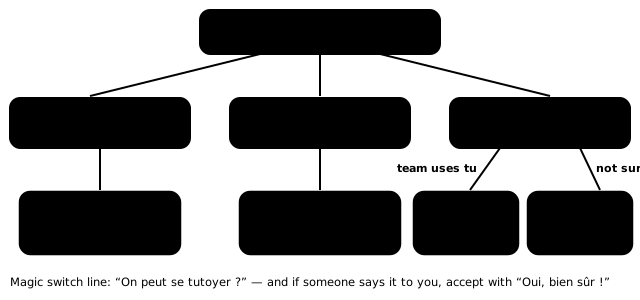
- On peut se tutoyer, si tu veux. — We can use tu, if you like.
- Bonjour Madame Martin, vous avez un moment ? — Hello Ms Martin, do you have a moment?
Careful
- Wrong: Bonjour Monsieur Julien ! (like "Julien sir")
- Right: Bonjour Monsieur Garnier ! / Bonjour Julien !
- Why: Indian English often says "Sir" or "Mr" + first name. In French, Monsieur/Madame goes with the surname; the first name alone goes with tu (or a relaxed vous). Use Madame for all women — Mademoiselle is out of date at work.
À retenir
- With clients, managers and anyone you don’t know, use vous and Monsieur / Madame + surname. Switch to tu only when the other person offers it — or when the whole team clearly uses it.
- Bonjour, vous êtes bien sur la messagerie de Priya Nair. Je ne suis pas disponible pour le moment. Laissez-moi un message et je vous rappellerai dès que possible. *Hello, you’ve reached Priya…
- Claim → example → link to the job. "I am X. For example, I did Y. That’s why I can bring Z to your team." Short, concrete, relevant.
- Bonne chance = good luck (for something that depends on luck). Bon courage = "stay strong" for a task that needs effort — a long day, an exam, a move. At work you will hear bon courage constantly.
- The last step in speaking is to persuade. Arguing & presenting gives you the structure, the connectors and the nuance of B2–C1 — including a model for the DELF B2 oral.
39.8 Practice — Work, phone & interviews
Exercise 1
The receptionist says: 'C'est de la part de qui ?' She wants…
- your phone number
- your name
- the reason for your call
- you to hold
Answer
your name
C'est de la part de qui ? = Who's calling?
Exercise 2
'Ne quittez pas' on the phone means…
- Don't leave the building
- Hold the line
- Don't hang up on me, it's rude
- Leave a message
Answer
Hold the line
Ne quittez pas = please hold.
Exercise 3
How do you say the number 06 45 21 80 17?
- zéro, six, quatre, cinq…
- zéro six, quarante-cinq, vingt et un, quatre-vingts, dix-sept
- six millions…
- zéro six quatre cinq, deux un…
Answer
zéro six, quarante-cinq, vingt et un, quatre-vingts, dix-sept
French phone numbers are read in pairs.
Exercise 4
You meet your client Mr Arnaud Dubois. You say:
- Bonjour Monsieur Arnaud !
- Bonjour Monsieur Dubois !
- Salut Arnaud !
- Bonjour Sir Dubois !
Answer
Bonjour Monsieur Dubois !
Monsieur/Madame + surname, with vous.
Exercise 5
Je travaille ___ Infotech depuis trois ans.
Hint: Preposition for a company.
Answer
chez
chez + company name: je travaille chez Infotech.
Exercise 6
Je travaille ici ___ quatre ans. (and I still do)
Answer
depuis
present + depuis for an action still going on.
Exercise 7
Tap the wrong word.
Je suis un ingénieur chez Infotech.
Answer
Wrong word: un.
Corrected: Je suis ingénieur chez Infotech.
être + profession: no article.
Exercise 8
Tap the wrong word.
Je vais revenir à vous avant vendredi.
Answer
Wrong word: à.
Corrected: Je vais revenir vers vous avant vendredi.
The office phrase is revenir vers quelqu'un (get back to someone).
Exercise 9
Match the meeting line to its meaning.
| A | B |
|---|---|
| Ton micro est coupé. | the agenda |
| Ça coupe. | the minutes |
| l'ordre du jour | You're on mute. |
| le compte rendu | You're breaking up. |
Answer
Ton micro est coupé. — You're on mute.; Ça coupe. — You're breaking up.; l'ordre du jour — the agenda; le compte rendu — the minutes
The technical lines come up in every video meeting.
Exercise 10
Match the office wishes.
| A | B |
|---|---|
| Bon courage ! | Enjoy your meal! |
| Bonne chance ! | Have a good evening! |
| Bon appétit ! | Hang in there! |
| Bonne soirée ! | Good luck! |
Answer
Bon courage ! — Hang in there!; Bonne chance ! — Good luck!; Bon appétit ! — Enjoy your meal!; Bonne soirée ! — Have a good evening!
Bon courage is the everyday office wish for anything that takes effort.
Exercise 11
Put the words in order.
Words: parler / Leroy / Je / Madame / à / voudrais
Answer
Je voudrais parler à Madame Leroy
The standard way to ask for someone on the phone.
Exercise 12
Put the words in order.
Words: dire / me / de / lui / Pouvez-vous / rappeler
Answer
Pouvez-vous lui dire de me rappeler
lui = to him/her; me rappeler = call me back.
Exercise 13
Ask who is calling.
C'est de la part de qui
Answer
Say: C'est de la part de qui
The standard phone question.
Exercise 14
Tell the caller to hold the line.
Ne quittez pas je vous la passe
Answer
Say: Ne quittez pas je vous la passe
je vous la passe = I'll put you through to her.
Exercise 15
Introduce your job.
Je suis ingénieur chez Infotech
Answer
Say: Je suis ingénieur chez Infotech
No article before the profession; chez + company.
Exercise 16
Check that people can hear you.
Vous m'entendez
Answer
Say: Vous m'entendez
The first line of every video call.
Exercise 17
Answer: 'Tell me about yourself' — start.
Je travaille dans le secteur bancaire depuis quatre ans
Answer
Say: Je travaille dans le secteur bancaire depuis quatre ans
present + depuis = have been doing.
Exercise 18
Offer to use tu.
On peut se tutoyer
Answer
Say: On peut se tutoyer
The polite way to switch from vous to tu.
Next step
The last step in speaking is to persuade. Arguing & presenting gives you the structure, the connectors and the nuance of B2–C1 — including a model for the DELF B2 oral.