Chapter 18: Object pronouns
les pronoms COD et COI
“Do you see Marc?” — “Yes, I see him.” Nobody repeats the name; we use a small word like him, her, it or them. French does the same, but with two surprises: the little word goes before the verb, and you must choose between a direct and an indirect pronoun. This chapter makes both easy.
- 1Direct or indirect? The one question to ask
- 2The direct pronouns: le, la, l’, les
- 3The indirect pronouns: lui, leur — and the four “both” pronouns
- 4The verbs that trick English speakers
- 5Where the pronoun goes
- 6In the past: je l’ai vu (a first look at agreement)
- 7Stressed pronouns: moi, toi, lui, elle, eux
- 8In real life: at the office
masculinefeminineplural
In one line
An object pronoun replaces a noun, and in French it goes before the verb: Je vois Marc → Je le vois.
- Tu vois Marc ? — Oui, je le vois. — Do you see Marc? — Yes, I see him. [zhuh luh VWA]
- Tu aimes la pizza ? — Oui, je l’aime. — Do you like pizza? — Yes, I like it. [zhuh LɛM]
- Tu parles à ta mère ? — Oui, je lui parle. — Are you talking to your mother? — Yes, I’m talking to her. [zhuh lwee PARL]
18.1 Direct or indirect? The one question to ask
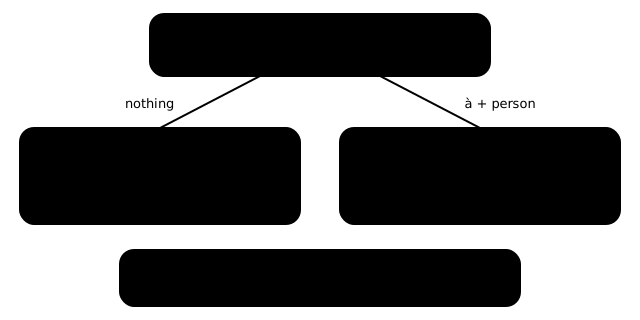
An object is the person or thing that receives the action. French splits objects into two kinds, and each kind has its own pronouns.
| Kind | How to spot it | Example |
|---|---|---|
| COD complément d’objet direct |
Comes straight after the verb, no preposition | Je regarde le film. |
| COI complément d’objet indirect |
Comes after à + a person | Je parle à Julie. |
So the test is simple: look at the French verb. Is there an à between the verb and the person? Then it is indirect. No preposition at all? Then it is direct.
Think French, not English
Decide direct or indirect from the French verb, never from English: écouter is direct (“listen to” is not), téléphoner à is indirect (“phone” is not).
18.2 The direct pronouns: le, la, l’, les
A direct pronoun can replace a person or a thing. It agrees with the noun it replaces: masculine, feminine or plural.
| Pronoun | Replaces | Example |
|---|---|---|
| le [luh] | him / it (masc.) | Je prends le bus → je le prends. |
| la [la] | her / it (fem.) | Il appelle sa sœur → il l’appelle. |
| l’ | le or la before a vowel or mute h | J’aime ce livre → je l’aime. |
| les [lay] | them (people or things) | Je fais les courses → je les fais. |
- Où est ma clé ? Je ne la trouve pas. — Where is my key? I can’t find it. [zhuh nuh la troov PA]
- Tu connais mon frère ? — Oui, je le connais bien. — Do you know my brother? — Yes, I know him well.
- Les enfants ? Je les emmène à l’école. — The children? I take them to school. [zhuh lay‿zãm-MɛN]
- Ce café, je le bois sans sucre. — This coffee, I drink it without sugar.
- Il l’habite depuis dix ans, cette maison. — He has lived in it for ten years, this house.
Liaison with les
Before a vowel, les links with a z sound: je les‿aime [zhuh lay-ZɛM]. Without it, French ears hear “je lé ème” — strange and hard to follow.
18.3 The indirect pronouns: lui, leur — and the four “both” pronouns
Indirect pronouns replace à + a person (or an animal). There are only two third-person forms, and they do not show gender.
| Pronoun | Replaces | Example |
|---|---|---|
| lui [lwee] | à + him or her | Je parle à Paul / à Léa → je lui parle. |
| leur [luhr] | à + them | J’écris à mes parents → je leur écris. |
- Tu as un message pour Léa ? Je lui téléphone ce soir. — Do you have a message for Léa? I’m phoning her tonight.
- Mes grands-parents ? Je leur rends visite le dimanche. — My grandparents? I visit them on Sundays. [zhuh luhr rã vee-ZEET]
- Le prof nous donne trop de devoirs. — The teacher gives us too much homework.
The full set
| Person | Direct (COD) | Indirect (COI) |
|---|---|---|
| je | me (m’) | me (m’) |
| tu | te (t’) | te (t’) |
| il / elle | le / la (l’) | lui |
| nous | nous | nous |
| vous | vous | vous |
| ils / elles | les | leur |
- Tu m’entends ? — Can you hear me? (direct) [tew mã-TÃ]
- Tu me donnes ton numéro ? — Will you give me your number? (indirect: donner à)
- Je t’aime. — I love you. [zhuh TɛM]
- Je vous écoute. — I’m listening (to you). — what a shop assistant says when it’s your turn [zhuh voo‿zay-KOOT]
lui and leur
lui = to him or to her; leur = to them. Only people, and never an -s on the pronoun leur.
Careful
- Wrong: Je leurs parle souvent.
- Right: Je leur parle souvent.
- Why: The pronoun leur (“to them”) never takes -s. Only the possessive does: leurs enfants (their children).
18.4 The verbs that trick English speakers
Here is the real difficulty. Many verbs are direct in French but need a preposition in English — and the other way round. Learn each verb with its construction.
Direct in French (no à!) — but not in English
| French | English | With a pronoun |
|---|---|---|
| écouter qqn | listen to sb | Je l’écoute. |
| regarder qqn | look at sb | Il la regarde. |
| attendre qqn | wait for sb | On les attend. |
| chercher qqn | look for sb | Je le cherche. |
| payer qqch | pay for sth | Je le paie. |
| aider qqn | help sb | Je t’aide. |
Indirect in French (with à) — but direct in English
| French | English | With a pronoun |
|---|---|---|
| téléphoner à qqn | phone sb | Je lui téléphone. |
| répondre à qqn | answer sb | Elle leur répond. |
| parler à qqn | talk to sb | Tu lui parles ? |
| ressembler à qqn | look like sb | Il lui ressemble. |
| obéir à qqn | obey sb | Ils ne leur obéissent pas. |
| plaire à qqn | please sb (be liked by) | Ça me plaît. |
| sourire à qqn | smile at sb | Le bébé nous sourit. |
Giving and telling: something to someone
Verbs of giving and communicating take both: a direct thing and an indirect person — donner, envoyer, dire, demander, montrer, prêter, écrire, expliquer + quelque chose à quelqu’un.
- Je lui envoie un message. — I’m sending him/her a message.
- Tu leur dis la vérité ? — Are you telling them the truth?
- Elle m’explique la règle. — She explains the rule to me.
- Je lui demande l’heure. — I ask him/her the time. (demander qqch à qqn)
Two pronouns together (je le lui donne) follow a fixed order — see Y, en & pronoun order.
Translating the English preposition
- Wrong: Je lui écoute.
- Right: Je l’écoute.
-
Why: Écouter is direct: écouter quelqu’un. The “to” of “listen to” does not exist in French.
-
Wrong: Je la téléphone demain.
- Right: Je lui téléphone demain.
-
Why: Téléphoner à quelqu’un is indirect, so the pronoun is lui, even for a woman.
-
Wrong: J’attends pour le bus.
- Right: J’attends le bus. → Je l’attends.
- Why: Attendre already means “wait for”. Adding pour is a direct copy of English.
One exception group: penser à, s’intéresser à
A few verbs with à refuse lui/leur for people. They keep à + a stressed pronoun (section 7): penser à, tenir à, faire attention à, s’intéresser à, s’habituer à.
- Je pense à elle. — I’m thinking of her. (not *je lui pense)
- Fais attention à lui, il est fragile. — Be careful with him, he is fragile.
And for things after à, French uses y: Tu penses à ton examen ? — Oui, j’y pense. More in Y, en & pronoun order.
18.5 Where the pronoun goes
English puts the pronoun after the verb (“I see him”). French puts it directly in front of the verb it belongs to. Think of the pronoun as glued to the front of that verb.
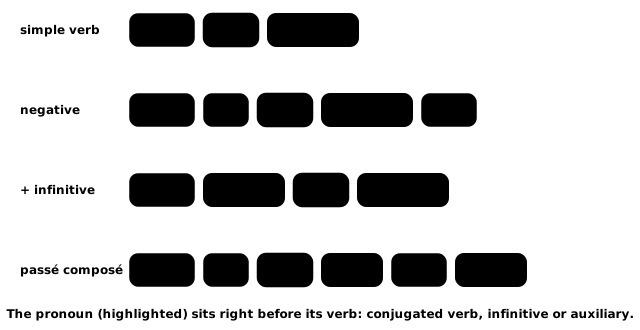
Negative: ne + pronoun + verb + pas
- Je ne le connais pas. — I don’t know him. [zhuhn luh ko-nɛ PA]
- Elle ne leur répond jamais. — She never answers them.
Questions
- Tu la vois ? / Est-ce que tu la vois ? — Do you see her? (everyday)
- La voyez-vous ? — Do you see her? (formal inversion: pronoun + verb-subject)
Verb + infinitive: before the infinitive
With aller, vouloir, pouvoir, devoir, aimer… + infinitive, the pronoun belongs to the infinitive, because that is the verb whose object it is.
- Je vais l’appeler. — I’m going to call him/her.
- Tu peux m’aider ? — Can you help me? [tew puh may-DAY]
- Je ne veux pas leur parler. — I don’t want to talk to them.
Careful
- Wrong: Je le vais acheter.
- Right: Je vais l’acheter.
- Why: You buy it, you don’t “go it”. The pronoun goes in front of acheter. (The old order je le vais acheter survives only in classic literature.)
Position
Pronoun before the verb it belongs to: before the conjugated verb (je le vois), before an infinitive (je vais le voir), before the auxiliary (je l’ai vu).
One exception: in a positive command the pronoun goes after the verb — Regarde-le ! Aide-moi ! See Giving instructions.
18.6 In the past: je l’ai vu (a first look at agreement)
In the passé composé there are two verb pieces: the auxiliary (ai, as, a…) and the past participle (vu, mangé, pris…). The pronoun goes in front of the auxiliary.
- Le film ? Je l’ai vu hier. — The film? I saw it yesterday. [zhuh lay vew YɛR]
- Ton père ? Je ne lui ai pas encore parlé. — Your father? I haven’t talked to him yet.
The surprise: the participle can agree
When a direct pronoun (la, les, me, te, nous, vous) stands before avoir, the past participle agrees with it — like an adjective. Usually you only see it in writing; with some verbs (pris → prise, fait → faite, mis → mise) you also hear it.
- Ta sœur ? Je l’ai vue ce matin. — Your sister? I saw her this morning. (vue: feminine)
- Les clés ? Je les ai prises. — The keys? I took them. (prises — you hear the z) [zhuh lay‿zay PREEZ]
- Ma mère ? Je lui ai téléphoné. — My mother? I phoned her. (lui is indirect → no agreement)
Agreement in one sentence
After avoir, the participle agrees only with a direct object placed before it — never with lui or leur. Full rules in The past: passé composé.
18.7 Stressed pronouns: moi, toi, lui, elle, eux
French has a third set of pronouns, the stressed (or “disjunctive”) pronouns. They stand on their own, outside the verb block, and they carry emphasis.
| Subject | Stressed | Example |
|---|---|---|
| je | moi [mwa] | C’est moi. |
| tu | toi [twa] | Et toi ? |
| il / elle | lui / elle | avec lui / chez elle |
| nous / vous | nous / vous | Nous, on reste. |
| ils / elles | eux [uh] / elles | sans eux / pour elles |
Note that lui has two jobs: the indirect “to him/her” (before the verb), and the stressed “him” (after a preposition).
When to use them
- Tu viens avec moi ? — Are you coming with me? — after a preposition (avec, pour, chez, sans…)
- Moi, je préfère le thé. — Me, I prefer tea. — for emphasis or contrast
- J’ai faim. — Moi aussi ! / Pas moi. — I’m hungry. — Me too! / Not me. — short answers with no verb
- Qui a fait ça ? — C’est lui ! — Who did that? — It was him! — after c’est
- Ils sont plus grands que nous. — They are taller than us. — after que in comparisons
- On mange chez eux ce soir. — We’re eating at their place tonight. [shay ZUH]
Hindi helps here
“Main to chai peeunga” — that stressed “main to” is exactly French Moi, je bois du thé. Emphasis goes in a separate word, the normal pronoun stays.
Careful
- Wrong: Il vient avec je. / C’est il.
- Right: Il vient avec moi. / C’est lui.
- Why: Subject pronouns (je, tu, il) can only stand right before a verb. Anywhere else, use the stressed form.
Careful
- Wrong: Moi suis indien.
- Right: Moi, je suis indien.
- Why: Moi adds emphasis but cannot replace je as the subject. Keep both.
18.8 In real life: at the office
Spot every object pronoun, then say which noun it replaces.
- — Tu as vu le rapport de Sophie ? — — Have you seen Sophie’s report?
- — Oui, je l’ai lu ce matin. Je lui ai envoyé mes remarques. — — Yes, I read it this morning. I sent her my comments.
- — Et les clients ? Tu leur as répondu ? — — And the clients? Did you answer them?
- — Pas encore. Je vais les appeler après le déjeuner. — — Not yet. I’m going to call them after lunch.
- — Parfait. Si tu as besoin d’aide, je suis là. Compte sur moi ! — — Perfect. If you need help, I’m here. Count on me!
l’ = le rapport (direct) · lui = à Sophie (envoyer qqch à qqn) · leur = aux clients (répondre à) · les = les clients (appeler qqn, direct) · moi = after the preposition sur.
Same people, different pronoun
The clients are leur with répondre à but les with appeler. The pronoun depends on the verb, not on the person.
À retenir
- An object pronoun replaces a noun, and in French it goes before the verb: Je vois Marc → Je le vois.
- Decide direct or indirect from the French verb, never from English: écouter is direct (“listen to” is not), téléphoner à is indirect (“phone” is not).
- lui = to him or to her; leur = to them. Only people, and never an -s on the pronoun leur.
- Pronoun before the verb it belongs to: before the conjugated verb (je le vois), before an infinitive (je vais le voir), before the auxiliary (je l’ai vu).
- After avoir, the participle agrees only with a direct object placed before it — never with lui or leur. Full rules in The past: passé composé.
- “Main to chai peeunga” — that stressed “main to” is exactly French Moi, je bois du thé. Emphasis goes in a separate word, the normal pronoun stays.
18.9 Practice — Object pronouns
Exercise 1
Tu regardes la télé ? — Oui, je ___ regarde.
- la
- lui
- le
- leur
Hint: regarder is direct; la télé is feminine
Answer
la
regarder + direct object, feminine → la.
Exercise 2
Tu téléphones à Marc ? — Oui, je ___ téléphone.
- le
- lui
- l'
- leur
Hint: téléphoner à…
Answer
lui
téléphoner à quelqu'un is indirect → lui.
Exercise 3
Tu attends tes amis ? — Oui, je ___ attends.
- leur
- les
- lui
- y
Hint: attendre = wait for, but is it direct?
Answer
les
attendre is direct in French: attendre quelqu'un → les.
Exercise 4
Tu écris à tes parents ? — Oui, je ___ écris.
- les
- leurs
- leur
- lui
Answer
leur
écrire à + plural people → leur (no -s).
Exercise 5
Which sentence is correct?
- Je vais le voir.
- Je le vais voir.
- Je vais voir le.
- Je vais lui voir.
Answer
Je vais le voir.
With verb + infinitive, the pronoun goes before the infinitive.
Exercise 6
Tu écoutes la radio ? — Oui, je ___ écoute.
Hint: before a vowel
Answer
l' / l’
écouter is direct; la before a vowel → l'.
Exercise 7
Tu viens avec ___ ? (with me)
Hint: after a preposition
Answer
moi
After a preposition use the stressed pronoun moi.
Exercise 8
Ta sœur ? Je l'ai ___ (voir) hier.
Hint: la before avoir → agreement
Answer
vue
The direct pronoun l' (= ta sœur, feminine) comes before avoir, so vu takes -e: vue.
Exercise 9
Tu parles à Julie ? — Non, je ne ___ parle pas.
Answer
lui
parler à + one person → lui, inside ne … pas.
Exercise 10
Tap the wrong word.
Je lui écoute tous les jours.
Answer
Wrong word: lui.
Corrected: Je l'écoute tous les jours.
écouter is direct: écouter quelqu'un → le / la / l'.
Exercise 11
Tap the wrong word.
Elle la répond toujours poliment.
Answer
Wrong word: la.
Corrected: Elle lui répond toujours poliment.
répondre à quelqu'un is indirect → lui.
Exercise 12
Tap the wrong word.
C'est il qui a gagné.
Answer
Wrong word: il.
Corrected: C'est lui qui a gagné.
After c'est use the stressed pronoun lui.
Exercise 13
Put the words in order: I don't know them.
Words: Je / ne / pas / les / connais
Answer
Je ne les connais pas
ne + pronoun + verb + pas.
Exercise 14
Put the words in order: Can you help me?
Words: peux / Tu / m'aider
Answer
Tu peux m'aider
The pronoun goes before the infinitive aider.
Exercise 15
Match the verb to its construction.
| A | B |
|---|---|
| écouter | à + moi, lui, elle… |
| téléphoner | direct: le / la / les |
| penser à (a person) | direct: le / la / les |
| attendre | indirect: lui / leur |
Answer
écouter — direct: le / la / les; téléphoner — indirect: lui / leur; penser à (a person) — à + moi, lui, elle…; attendre — direct: le / la / les
Learn each verb with its construction — French, not English, decides.
Exercise 16
Say it aloud.
Je lui téléphone ce soir
Answer
Say: Je lui téléphone ce soir
lui = to him or to her; téléphoner à is indirect.
Exercise 17
Say it aloud — make the liaison in les‿amis.
Je les aime beaucoup
Answer
Say: Je les aime beaucoup
les + vowel → z liaison: lay-ZɛM.
Next step
Make a card for ten common verbs with their construction (écouter qqn, parler à qqn…) and say one pronoun sentence for each out loud. Then go on to Y, en & pronoun order, which adds the last two pronouns and shows how they combine.