Chapter 36: Travel & emergencies
Voyages et urgences
Travel French is survival French with higher stakes. A wrong word at the bakery costs you a croissant; a wrong word at the station costs you a train. This chapter gives you the lines for the hotel, the station, the airport, renting, the doctor and the pharmacy — and, just in case, the words and numbers for an emergency.
- 1At the hotel — checking in
- 2Hotel problems — politely firm
- 3At the train station — à la gare
- 4At the airport — à l’aéroport
- 5Renting a car, a bike, a flat
- 6The doctor and the pharmacy
- 7Emergencies — urgences
- 8Lost items, theft and the police
masculinefeminineplural
Two magic openers
Je voudrais… (I would like…) for requests, and Il y a un problème avec… (There’s a problem with…) for complaints. Start with Bonjour, and you can handle almost any desk.
36.1 At the hotel — checking in
- Bonjour, j’ai une réservation au nom de Mehta. — Hello, I have a booking under the name Mehta. [zhay ewn ray-zehr-va-SYÕ oh nõ duh…]
- C’est pour trois nuits, une chambre double. — It’s for three nights, a double room.
- Le petit-déjeuner est compris ? — Is breakfast included? [luh puh-tee day-zhuh-NAY eh kõ-PREE]
- Quel est le code du wifi ? — What’s the wifi password? (wifi = "wee-fee")
- Je peux laisser mes bagages ici après le départ ? — Can I leave my luggage here after check-out?
Mini-dialogue — à la réception
Say both sides. The receptionist’s lines are the ones to recognise.
- Réceptionniste : Bonsoir, bienvenue ! Je peux vous aider ? — Good evening, welcome! Can I help you?
- Vous : Bonsoir. J’ai réservé une chambre pour deux nuits. — Good evening. I booked a room for two nights.
- Réceptionniste : À quel nom, s’il vous plaît ? Et une pièce d’identité. — Under what name, please? And some ID.
- Vous : Rao. Voici mon passeport. — Rao. Here is my passport.
- Réceptionniste : Parfait. Chambre 214, au deuxième étage. Le petit-déjeuner est servi de sept heures à dix heures. — Perfect. Room 214, on the second floor. Breakfast is from 7 to 10.
- Vous : Et le départ, c’est à quelle heure ? — And check-out is at what time?
- Réceptionniste : Il faut libérer la chambre avant onze heures. — You must vacate the room before eleven.
Floors count differently
Le rez-de-chaussée is the ground floor; le premier étage is the one above it — like in India and the UK, not like the US.
36.2 Hotel problems — politely firm
Use ne… pas + marcher (to work, for machines) and il n’y a pas de (there is no). The conditional pourriez-vous keeps it polite even when you’re annoyed.
| Problem | Meaning |
|---|---|
| La climatisation ne marche pas. | The air conditioning doesn’t work. |
| Il n’y a pas d’eau chaude. | There’s no hot water. |
| Il manque des serviettes. | There are some towels missing. |
| La chambre est trop bruyante. | The room is too noisy. |
| Ma carte ne marche plus. | My key card doesn’t work any more. |
| Pourriez-vous envoyer quelqu’un ? | Could you send someone? |
| Est-ce que je pourrais changer de chambre ? | Could I change rooms? |
Careful
- Wrong: La douche ne travaille pas.
- Right: La douche ne marche pas. / ne fonctionne pas.
- Why: Travailler is for people at work. Machines marchent (everyday) or fonctionnent (more formal).
36.3 At the train station — à la gare
France’s national railway is the SNCF. Fast trains are TGV (TGV INOUI, and the low-cost OUIGO); regional trains are TER. Most tickets are now e-tickets on your phone. For decades travellers had to composter (stamp) a paper ticket in a yellow machine before boarding — you will still see the word, but with an e-ticket you simply show your QR code to the contrôleur.
| Word | Meaning |
|---|---|
| le billet | the ticket (train/plane) |
| le quai / la voie | the platform / the track number |
| la voiture 12, la place 45 | carriage 12, seat 45 |
| le tableau des départs | the departures board |
| en retard / supprimé | late / cancelled |
| la correspondance | the connection |
- Un aller-retour pour Lyon, s’il vous plaît, en seconde classe. — A return ticket to Lyon, please, second class. [ɛ̃-na-lay ruh-TOOR poor lee-YÕ]
- Le train pour Marseille part de quelle voie ? — Which track does the Marseille train leave from?
- Excusez-moi, je crois que c’est ma place. — Excuse me, I think this is my seat.
- J’ai raté mon train. Je peux prendre le suivant ? — I missed my train. Can I take the next one?
Announcements you will hear
- Le TGV numéro 6201 à destination de Marseille partira voie 7. — TGV number 6201 to Marseille will leave from track 7.
- Le train en provenance de Lille est annoncé avec un retard de vingt minutes. — The train from Lille is running about twenty minutes late.
- Contrôle des billets. Votre billet, s’il vous plaît. — Ticket inspection. Your ticket, please.
à destination de / en provenance de
à destination de = going to; en provenance de = coming from. These two phrases decide whether you board or wait.
36.4 At the airport — à l’aéroport
| You say / hear | Meaning |
|---|---|
| Où est l’enregistrement pour Air India ? | Where is the Air India check-in? |
| J’ai une valise en soute et un bagage cabine. | I have one checked suitcase and one cabin bag. |
| Côté hublot ou côté couloir ? | Window or aisle? |
| Voici votre carte d’embarquement. Porte 32. | Here is your boarding pass. Gate 32. |
| L’embarquement commence à quelle heure ? | What time does boarding start? |
| Mon vol est annulé. / J’ai raté ma correspondance. | My flight is cancelled. / I missed my connection. |
| Ma valise n’est pas arrivée. | My suitcase hasn’t arrived. |
| Rien à déclarer. | Nothing to declare. (customs) |
Careful
- Wrong: Ma valise n’est pas arrivé.
- Right: Ma valise n’est pas arrivée.
- Why: Valise is feminine and arriver takes être, so the participle agrees: arrivée. (Same sound, but it matters in writing.)
36.5 Renting a car, a bike, a flat
The verb is louer (to rent). Most rental cars in France are manual — ask specifically for an automatic. Find out what is included before you sign.
- Je voudrais louer une voiture pour une semaine. — I’d like to rent a car for a week. [zhuh voo-dreh loo-AY ewn vwa-TEWR]
- Vous avez une voiture avec boîte automatique ? — Do you have a car with automatic transmission?
- L’assurance est comprise dans le prix ? — Is insurance included in the price?
- Je dois rendre la voiture avec le plein ? — Do I have to return the car with a full tank?
- Mon permis de conduire indien est accepté ? — Is my Indian driving licence accepted? (carry an international permit too)
- Le chauffage ne marche pas dans l’appartement. — The heating doesn’t work in the flat. (to a holiday-rental host)
la caution
La caution (or le dépôt de garantie) is the security deposit, often blocked on your credit card. Ask: La caution est de combien ?
36.6 The doctor and the pharmacy
To say where it hurts: J’ai mal + à + the body part. Remember the contractions: à + le = au, à + les = aux.
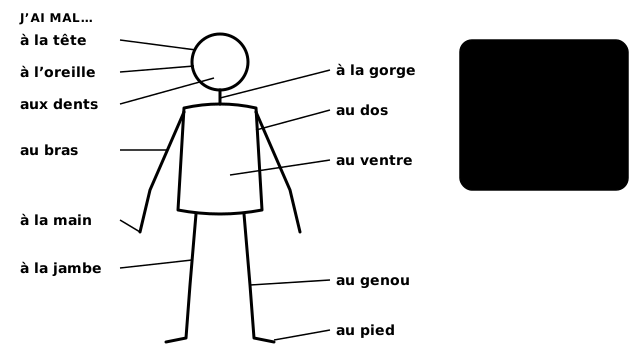
- J’ai mal à la gorge et j’ai de la fièvre. — I have a sore throat and a fever. [zhay mal a la GORZH]
- J’ai mal au ventre depuis hier soir. — I’ve had a stomach ache since last night.
- Je tousse et j’ai le nez qui coule. — I’m coughing and I have a runny nose.
- Je suis allergique à la pénicilline. — I’m allergic to penicillin.
- Je suis diabétique. Je prends de l’insuline. — I’m diabetic. I take insulin.
Careful
- Wrong: Je suis mal à la tête.
- Right: J’ai mal à la tête.
- Why: Pain is something you have: avoir mal. Same family as j’ai faim, j’ai froid, j’ai de la fièvre.
Careful
- Wrong: J’ai mal à le dos.
- Right: J’ai mal au dos.
- Why: à + le always contracts to au; à + les to aux. See Prepositions & places.
J’ai mal au cœur ≠ heart pain
J’ai mal au cœur means "I feel sick (nauseous)". For chest pain, say J’ai une douleur dans la poitrine — and call 15.
Mini-dialogue — à la pharmacie
Look for the green cross. French pharmacists give real advice for small problems.
- Vous : Bonjour. Vous avez quelque chose contre la toux ? — Hello. Do you have something for a cough?
- Le pharmacien : Toux sèche ou toux grasse ? — Dry cough or chesty cough?
- Vous : Sèche. Ça dure depuis trois jours. — Dry. It’s been going on for three days.
- Le pharmacien : Prenez ce sirop trois fois par jour. Si ça continue, allez voir un médecin. — Take this syrup three times a day. If it goes on, see a doctor.
- Vous : Il faut une ordonnance ? — Do I need a prescription?
- Le pharmacien : Non, pas pour celui-ci. — No, not for this one.
- Je voudrais prendre rendez-vous avec un médecin. — I’d like to make an appointment with a doctor. (many people book online)
- Où est la pharmacie de garde ? — Where is the on-duty pharmacy? (open at night and on Sundays)
36.7 Emergencies — urgences
Learn these before you travel, not during the emergency. Shout short words; on the phone, say what, where and who.

| Shout / say | Meaning |
|---|---|
| Au secours ! / À l’aide ! | Help! |
| Au feu ! | Fire! |
| Au voleur ! | Stop thief! |
| Appelez une ambulance ! | Call an ambulance! |
| Appelez la police ! | Call the police! |
| Il y a eu un accident. Il y a un blessé. | There has been an accident. Someone is injured. |
| Il ne respire plus ! | He’s not breathing! |
Mini-dialogue — calling the 15
The operator asks short questions. Answer short.
- Opérateur : SAMU, quelle est votre urgence ? — SAMU, what is your emergency?
- Vous : Mon ami est tombé. Il saigne beaucoup de la tête. — My friend fell. His head is bleeding a lot.
- Opérateur : Où êtes-vous exactement ? — Where are you exactly?
- Vous : Au 12, rue Victor-Hugo, devant la boulangerie. — At 12 rue Victor-Hugo, in front of the bakery.
- Opérateur : Il est conscient ? Il respire ? — Is he conscious? Is he breathing?
- Vous : Oui, il respire, mais il ne répond pas bien. — Yes, he’s breathing, but he isn’t responding well.
- Opérateur : Restez avec lui, on vous envoie une équipe. — Stay with him, we’re sending a team.
36.8 Lost items, theft and the police
In a city, go to the commissariat (police station); in the countryside, the gendarmerie. For loss you make a déclaration de perte; for theft you portez plainte (file a complaint) and get a copy for insurance.
- J’ai perdu mon passeport. — I’ve lost my passport. [zhay pehr-DEW mõ pas-POR]
- On m’a volé mon portefeuille dans le métro. — My wallet was stolen in the metro. (literally "someone stole me my wallet")
- Je voudrais porter plainte. — I’d like to file a complaint / report a crime.
- J’ai besoin d’une attestation pour mon assurance. — I need a certificate for my insurance.
- Où sont les objets trouvés ? — Where is the lost property office?
- Je dois faire opposition sur ma carte bancaire. — I need to block my bank card.
- Pouvez-vous m’indiquer l’adresse de l’ambassade de l’Inde ? — Can you tell me the address of the Indian embassy?
Careful
- Wrong: J’ai perdé mon sac.
- Right: J’ai perdu mon sac.
- Why: Perdre is an -re verb: its past participle ends in -u (perdu, vendu, attendu). See The past: passé composé.
Your emergency card
Before you travel, write on one card: your hotel address, 112, your blood group, your allergies in French (allergique à…), and your embassy’s number. Keep a photo of your passport on your phone.
À retenir
- Je voudrais… (I would like…) for requests, and Il y a un problème avec… (There’s a problem with…) for complaints. Start with Bonjour, and you can handle almost any desk.
- à destination de = going to; en provenance de = coming from. These two phrases decide whether you board or wait.
- Before you travel, write on one card: your hotel address, 112, your blood group, your allergies in French (allergique à…), and your embassy’s number. Keep a photo of your passport on your phone.
- You can now survive. Next, learn to talk: Conversation & opinions shows you how to start a chat, keep it going, react, agree and disagree — and end it gracefully.
36.9 Practice — Travel & emergencies
Exercise 1
Which number do you call for a medical emergency in France?
- 15
- 17
- 18
- 114
Answer
15
15 = SAMU (medical). 17 = police, 18 = pompiers. 112 works for everything.
Exercise 2
'Le train à destination de Nice' means the train…
- coming from Nice
- going to Nice
- stopping near Nice
- cancelled at Nice
Answer
going to Nice
à destination de = going to; en provenance de = coming from.
Exercise 3
'J'ai mal au cœur' usually means…
- I have heart pain
- I feel sick (nauseous)
- I'm heartbroken
- I have a cold
Answer
I feel sick (nauseous)
For chest pain say 'J'ai une douleur dans la poitrine'.
Exercise 4
The shower doesn't work. You say: La douche ne ___ pas.
- travaille
- marche
- va
- fait
Answer
marche
Machines marchent (or fonctionnent). Travailler is for people.
Exercise 5
J'ai mal ___ dos.
Hint: à + le
Answer
au
à + le = au: j'ai mal au dos.
Exercise 6
J'ai mal ___ dents.
Hint: à + les
Answer
aux
à + les = aux: j'ai mal aux dents.
Exercise 7
Tap the wrong word.
Je suis mal à la tête depuis ce matin.
Answer
Wrong word: suis.
Corrected: J'ai mal à la tête depuis ce matin.
Pain uses avoir: j'ai mal.
Exercise 8
Tap the wrong word.
J'ai perdé mon passeport à la gare.
Answer
Wrong word: perdé.
Corrected: J'ai perdu mon passeport à la gare.
perdre → perdu.
Exercise 9
Match the station and airport words.
| A | B |
|---|---|
| la voie | the boarding pass |
| le quai | window seat |
| la carte d'embarquement | the track |
| côté hublot | the platform |
Answer
la voie — the track; le quai — the platform; la carte d'embarquement — the boarding pass; côté hublot — window seat
These words decide where you go and where you sit.
Exercise 10
Match the cry to its meaning.
| A | B |
|---|---|
| Au secours ! | Stop thief! |
| Au feu ! | Call an ambulance! |
| Au voleur ! | Help! |
| Appelez une ambulance ! | Fire! |
Answer
Au secours ! — Help!; Au feu ! — Fire!; Au voleur ! — Stop thief!; Appelez une ambulance ! — Call an ambulance!
Short, loud, and worth knowing by heart.
Exercise 11
Put the words in order.
Words: est / compris / petit-déjeuner / Le
Answer
Le petit-déjeuner est compris
Le petit-déjeuner est compris ? = Is breakfast included?
Exercise 12
Put the words in order.
Words: mon / m'a / volé / On / portefeuille
Answer
On m'a volé mon portefeuille
On m'a volé + thing = my … was stolen.
Exercise 13
Give your booking at the hotel.
J'ai une réservation au nom de Sharma
Answer
Say: J'ai une réservation au nom de Sharma
au nom de = under the name of.
Exercise 14
Report the problem.
Il n'y a pas d'eau chaude
Answer
Say: Il n'y a pas d'eau chaude
Il n'y a pas de + noun (de becomes d' before a vowel).
Exercise 15
Say where it hurts.
J'ai mal à la gorge
Answer
Say: J'ai mal à la gorge
avoir mal + à la (gorge is feminine).
Exercise 16
Ask for a return ticket to Lyon.
Un aller-retour pour Lyon s'il vous plaît
Answer
Say: Un aller-retour pour Lyon s'il vous plaît
aller simple = one way; aller-retour = return.
Exercise 17
Shout for help.
Au secours
Answer
Say: Au secours
Au secours ! (or À l'aide !) = Help!
Exercise 18
Say you'd like to report a theft.
Je voudrais porter plainte
Answer
Say: Je voudrais porter plainte
porter plainte = to file a complaint with the police.
Next step
You can now survive. Next, learn to talk: Conversation & opinions shows you how to start a chat, keep it going, react, agree and disagree — and end it gracefully.