Chapter 21: The past: passé composé
le passé composé
“I ate”, “I have eaten”, “I did eat” — French uses one tense for all three: the passé composé. It is the past tense of conversation, messages and news. It has two parts, a helper verb and a past participle, and only one real question: avoir or être? This chapter answers it, then shows when the participle changes its ending.
- 1The basic recipe: avoir + participle
- 2Past participles: three regular patterns, and the irregulars
- 3The house of être: the movement verbs
- 4Agreement with être
- 5Agreement with avoir: the object that comes first
- 6Verbs that switch: sortir le chien vs sortir
- 7Negatives, questions, pronouns and adverbs
- 8When to use it — and when not
- 9In real life: “Tu as fait quoi ce week-end ?”
masculinefeminineplural
In one line
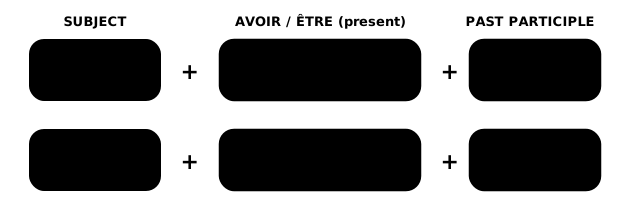
Passé composé = avoir or être in the present + past participle: j’ai mangé, je suis parti.
- Hier, j’ai regardé un film. — Yesterday I watched a film. [zhay ruh-gar-DAY]
- Elle est arrivée à Paris lundi. — She arrived in Paris on Monday. [ɛ-lɛ-ta-ree-VAY]
- Tu as fini tes devoirs ? — Have you finished your homework? / Did you finish…?
21.1 The basic recipe: avoir + participle
About 95% of verbs use avoir. Conjugate avoir in the present, then add the past participle, which never changes with avoir (with one exception in section 5).
| Subject | parler (to speak) | finir (to finish) |
|---|---|---|
| je / j’ | j’ai parlé | j’ai fini |
| tu | tu as parlé | tu as fini |
| il / elle / on | il a parlé | elle a fini |
| nous | nous avons parlé | nous avons fini |
| vous | vous avez parlé | vous avez fini |
| ils / elles | ils ont parlé | elles ont fini |
- Nous avons mangé au restaurant. — We ate at the restaurant. [noo‿za-võ mã-ZHAY]
- Ils ont attendu une heure. — They waited an hour. [eel-zõ-ta-tã-DEW]
- J’ai choisi le menu végétarien. — I chose the vegetarian menu.
ils ont vs ils sont
Make the difference audible: ils ont = [eel-ZÕ] (with a z liaison), ils sont = [eel SÕ]. Mixing them up changes the auxiliary — and the meaning.
21.2 Past participles: three regular patterns, and the irregulars
| Infinitive ending | Participle | Examples |
|---|---|---|
| -er (all, even aller) | -é | parler → parlé, aller → allé |
| -ir (finir type) | -i | finir → fini, partir → parti |
| -re (vendre type) | -u | vendre → vendu, attendre → attendu |
The most frequent verbs are irregular — which is good news: you meet them so often that they stick. Group them by sound to learn them faster.
| Sound | Verbs → participles |
|---|---|
| -u | avoir → eu · boire → bu · lire → lu · voir → vu · pouvoir → pu · vouloir → voulu · devoir → dû · savoir → su · connaître → connu · croire → cru · recevoir → reçu · venir → venu · vivre → vécu · courir → couru · falloir → fallu · pleuvoir → plu · plaire → plu |
| -is | prendre → pris (apprendre → appris, comprendre → compris) · mettre → mis (promettre → promis) · s’asseoir → assis |
| -it | faire → fait · dire → dit · écrire → écrit · conduire → conduit · traduire → traduit |
| -ert | ouvrir → ouvert · offrir → offert · découvrir → découvert · souffrir → souffert |
| others | être → été · naître → né · mourir → mort · rire → ri · suivre → suivi |
- J’ai eu de la chance. — I was lucky. [zhay EW]
- Qu’est-ce que tu as fait ce week-end ? — What did you do this weekend? [kɛs-kuh tew a Fɛ]
- Il a pris le train de 8 heures. — He took the 8 o’clock train.
- Vous avez vu le dernier épisode ? — Have you seen the last episode?
- J’ai dû partir tôt. — I had to leave early.
- Il a plu toute la journée, mais le film m’a plu. — It rained all day, but I liked the film. (pleuvoir and plaire share plu)
Careful
- Wrong: J’ai prendu le bus.
- Right: J’ai pris le bus.
- Why: Prendre and all its family (apprendre, comprendre, surprendre) make -pris.
21.3 The house of être: the movement verbs
A small group of verbs uses être instead of avoir. They are mostly verbs of movement or change of state — coming, going, being born, dying — and they take no direct object. Picture them around a house:
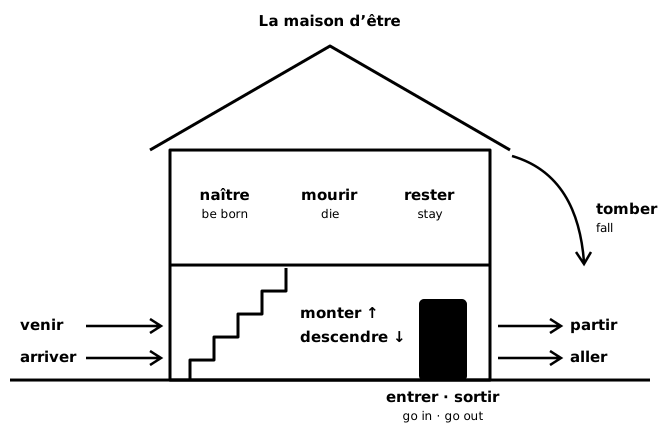
DR & MRS VANDERTRAMP
The classic memory trick for the être verbs: Devenir, Revenir, Monter, Rester, Sortir, Venir, Aller, Naître, Descendre, Entrer, Rentrer, Tomber, Retourner, Arriver, Mourir, Partir.
| Subject | aller — passé composé |
|---|---|
| je | je suis allé(e) |
| tu | tu es allé(e) |
| il / elle / on | il est allé · elle est allée · on est allé(e)s |
| nous | nous sommes allé(e)s |
| vous | vous êtes allé(e)(s) |
| ils / elles | ils sont allés · elles sont allées |
- Je suis né à Chennai en 1998. — I was born in Chennai in 1998. [zhuh swee NAY]
- Ils sont restés trois jours à Lyon. — They stayed three days in Lyon.
- Le chat est tombé du balcon, mais il va bien. — The cat fell off the balcony, but it’s fine.
- À quelle heure tu es rentré ? — What time did you get home?
- Elle est devenue médecin. — She became a doctor.
avoir or être?
Use être for the house verbs (movement / change of state) and for all pronominal verbs (je me suis levé). Everything else takes avoir.
Careful
- Wrong: J’ai allé au cinéma.
- Right: Je suis allé au cinéma.
- Why: Aller lives in the house of être. This is the most common passé composé error of all.
Careful
- Wrong: Son grand-père a mouru.
- Right: Son grand-père est mort.
- Why: Mourir takes être and has the irregular participle mort.
21.4 Agreement with être
With être, the participle behaves like an adjective: it agrees with the subject. Add -e for feminine, -s for plural, -es for feminine plural. Most of the time you cannot hear it — but you must write it.
- Paul est parti. / Léa est partie. — Paul left. / Léa left.
- Mes parents sont arrivés hier soir. — My parents arrived last night.
- Mes sœurs sont venues à la fête. — My sisters came to the party.
- Elle est morte en 1990. — She died in 1990. (here you hear the -t: [MORT])
- Madame, vous êtes déjà allée en France ? — Madam, have you been to France before? (polite vous for one woman → -e only)
A mixed group of men and women takes the masculine plural: Rahul et Anita sont arrivés.
Pronominal verbs
Reflexive verbs also use être and normally agree with the subject: elle s’est levée, nous nous sommes promenés. Two exceptions, for later: no agreement when a direct object follows (elle s’est lavé les mains), or when se means “to each other” with a verb that takes à (ils se sont parlé, elles se sont téléphoné). See Reflexive verbs.
- Les filles se sont bien amusées. — The girls had a lot of fun.
Careful
- Wrong: Ma mère est arrivé ce matin.
- Right: Ma mère est arrivée ce matin.
- Why: With être, add -e for a feminine subject. Hindi speakers know this instinct: “maa aayi”, not “maa aaya”.
21.5 Agreement with avoir: the object that comes first
With avoir, the participle never agrees with the subject: elle a mangé. But it does agree with a direct object placed before the verb. This happens in three situations:
| Object before the verb | Example |
|---|---|
| a direct pronoun (la, les, me, te…) | Ces photos ? Je les ai prises en Inde. |
| the relative que | Les pommes que j’ai mangées étaient délicieuses. |
| quel(le)(s) + noun in a question | Quelle robe as-tu choisie ? |
- La lettre ? Je l’ai écrite hier. — The letter? I wrote it yesterday. (you hear the t: [ay-KREET])
- La porte qu’il a ouverte donne sur le jardin. — The door that he opened leads to the garden.
- Elle a mangé les pommes. — She ate the apples. (object after the verb → no agreement)
Agreement in two lines
être → agree with the subject. avoir → agree only with a direct object that comes before the verb (never with lui, leur, en).
Careful
- Wrong: Elle a mangée une pizza.
- Right: Elle a mangé une pizza.
- Why: With avoir, the subject never controls agreement. Only a direct object placed before would.
21.6 Verbs that switch: sortir le chien vs sortir
Six house verbs can also take a direct object. When they do, the meaning changes and they switch to avoir: sortir, monter, descendre, rentrer, retourner, passer.
| Verb | With être (no object) | With avoir (+ object) |
|---|---|---|
| sortir | Je suis sorti. I went out. |
J’ai sorti la poubelle. I took the bin out. |
| monter | Elle est montée. She went up. |
Elle a monté les valises. She carried the cases up. |
| descendre | Il est descendu. He came down. |
Il a descendu l’escalier. He went down the stairs. |
| rentrer | Nous sommes rentrés. We came home. |
Nous avons rentré le linge. We brought the washing in. |
| passer | Je suis passé chez toi. I dropped by your place. |
J’ai passé une semaine à Nice. I spent a week in Nice. |
| retourner | Il est retourné en Inde. He went back to India. |
Il a retourné la crêpe. He flipped the crêpe. |
- Tu as sorti le chien ? — Non, je ne suis pas encore sorti. — Have you taken the dog out? — No, I haven’t gone out yet.
- On a passé un excellent week-end. — We had (spent) a great weekend.
The object test
Can you ask “what?” after the verb and get an answer? (J’ai monté quoi ? — les valises.) Then it’s avoir. No answer → être.
21.7 Negatives, questions, pronouns and adverbs
Negative: ne + auxiliary + pas + participle
Ne … pas wraps around the auxiliary only. The participle comes after pas.
- Je n’ai pas compris. — I didn’t understand. [zhuh nay pa kõ-PREE]
- Il n’est jamais venu chez nous. — He has never come to our place.
- Je n’ai rien vu et je n’ai vu personne. — I saw nothing, and I saw nobody. (personne goes after the participle)
Careful
- Wrong: Je n’ai mangé pas.
- Right: Je n’ai pas mangé.
- Why: The conjugated verb is ai, so ne … pas surrounds ai. The participle follows.
Questions
- Tu as bien dormi ? / Est-ce que tu as bien dormi ? — Did you sleep well?
- Avez-vous réservé ? · A-t-elle téléphoné ? · Est-il parti ? — Have you booked? · Did she call? · Has he left? (inversion: the auxiliary moves; -t- between two vowels)
Object pronouns and y / en
They go before the auxiliary (see Object pronouns):
- Je l’ai vu. · Je ne lui ai pas répondu. · Tu y es allé ? — I saw him. · I didn’t answer him/her. · Did you go there?
Short adverbs go between the two pieces
- J’ai déjà mangé. · Il a beaucoup travaillé. · Tu as bien fait. — I’ve already eaten. · He worked a lot. · You did the right thing.
- Je n’ai pas encore fini. — I haven’t finished yet.
21.8 When to use it — and when not
The passé composé is for completed actions and events: what happened, once or a set number of times. It covers both English “I did” and “I have done”.
| Time words | Example |
|---|---|
| hier, avant-hier | Hier, j’ai appelé le plombier. |
| ce matin, ce week-end | Ce matin, j’ai raté le bus. |
| la semaine dernière, l’année dernière | L’année dernière, on a déménagé. |
| il y a + time (ago) | Il est parti il y a dix minutes. |
| soudain, tout à coup, une fois | Soudain, le téléphone a sonné. |
Careful
- Wrong: J’ai habité à Pune depuis 2020.
- Right: J’habite à Pune depuis 2020.
- Why: English “I have lived here since…” is still true now, so French uses the present with depuis.
For descriptions, habits and background in the past (“it was raining”, “I used to…”), French uses a different tense — see Imparfait vs passé composé.
21.9 In real life: “Tu as fait quoi ce week-end ?”
- — Salut ! Tu as passé un bon week-end ? — — Hi! Did you have a good weekend?
- — Super ! Samedi, je suis allée à Giverny avec Maya. On a pris le train à 9 heures. — — Great! On Saturday I went to Giverny with Maya. We took the train at 9.
- — Ah, la maison de Monet ! Vous avez vu les nénuphars ? — — Ah, Monet’s house! Did you see the water lilies?
- — Oui, et j’ai pris plein de photos. Mais on est rentrées tard, et dimanche je n’ai rien fait ! — — Yes, and I took loads of photos. But we got back late, and on Sunday I did nothing!
- — Tu as bien fait. Moi, j’ai travaillé tout le week-end… — — Good for you. Me, I worked all weekend…
Notice je suis allée and on est rentrées: the speaker is a woman, and on = “Maya and I”.
À retenir
- Passé composé = avoir or être in the present + past participle: j’ai mangé, je suis parti.
- The classic memory trick for the être verbs: Devenir, Revenir, Monter, Rester, Sortir, Venir, Aller, Naître, Descendre, Entrer, Rentrer, Tomber, Retourner, Arriver,…
- Use être for the house verbs (movement / change of state) and for all pronominal verbs (je me suis levé). Everything else takes avoir.
- être → agree with the subject. avoir → agree only with a direct object that comes before the verb (never with lui, leur, en).
- Can you ask “what?” after the verb and get an answer? (J’ai monté quoi ? — les valises.) Then it’s avoir. No answer → être.
- Tonight, write five sentences about your day in the passé composé — at least two with être. Then read Imparfait vs passé composé to learn how to add the background to your stories.
21.10 Practice — Passé composé
Exercise 1
Hier, nous ___ au cinéma.
- avons allé
- sommes allés
- sommes allé
- avons allés
Hint: aller
Answer
sommes allés
aller takes être; nous → plural agreement: allés.
Exercise 2
J'___ un croissant ce matin.
- ai mangé
- suis mangé
- ai mangée
- ai manger
Answer
ai mangé
manger takes avoir; no agreement with the subject.
Exercise 3
Past participle of prendre:
- prendu
- pris
- prit
- prené
Answer
pris
prendre → pris (also appris, compris).
Exercise 4
Elle ___ la poubelle.
- est sortie
- a sorti
- est sorti
- a sortie
Hint: there is a direct object
Answer
a sorti
sortir + direct object → avoir: elle a sorti la poubelle.
Exercise 5
Which sentence is correct?
- Je n'ai mangé pas.
- Je n'ai pas mangé.
- Je ne pas ai mangé.
- Je n'ai pas mangée.
Answer
Je n'ai pas mangé.
ne … pas surrounds the auxiliary; the participle follows.
Exercise 6
Ma sœur est ___ (naître) en 2005.
Answer
née
naître → né; être + feminine subject → née.
Exercise 7
Qu'est-ce que tu as ___ (faire) hier ?
Answer
fait
faire → fait.
Exercise 8
Les photos ? Je les ai ___ (prendre) à Jaipur.
Hint: les comes before avoir
Answer
prises
Direct object les (feminine plural) before avoir → prises.
Exercise 9
Ils ___ partis à midi.
Hint: être, ils
Answer
sont
partir takes être: ils sont partis.
Exercise 10
Elle ___ eu de la chance.
Answer
a
avoir → j'ai eu, elle a eu.
Exercise 11
Tap the wrong word.
Hier j'ai allé chez mon oncle.
Answer
Wrong word: j'ai.
Corrected: Hier je suis allé chez mon oncle.
aller is a house verb: je suis allé.
Exercise 12
Tap the wrong word.
Ma mère est arrivé ce matin.
Answer
Wrong word: arrivé.
Corrected: Ma mère est arrivée ce matin.
With être, agree with the subject: arrivée.
Exercise 13
Tap the wrong word.
Elle a mangée toute la pizza.
Answer
Wrong word: mangée.
Corrected: Elle a mangé toute la pizza.
With avoir, no agreement with the subject.
Exercise 14
Put the words in order: I haven't finished yet.
Words: fini / n'ai / Je / pas / encore
Answer
Je n'ai pas encore fini
ne + ai + pas encore + participle.
Exercise 15
Match the infinitive to its past participle.
| A | B |
|---|---|
| ouvrir | mis |
| voir | été |
| mettre | dit |
| être | ouvert |
| dire | vu |
Answer
ouvrir — ouvert; voir — vu; mettre — mis; être — été; dire — dit
The irregulars group by sound: -ert, -u, -is, -é, -it.
Exercise 16
Avoir or être?
| A | B |
|---|---|
| rester | je me suis levé |
| marcher | j'ai monté les valises |
| se lever | je suis resté |
| monter les valises | j'ai marché |
Answer
rester — je suis resté; marcher — j'ai marché; se lever — je me suis levé; monter les valises — j'ai monté les valises
House verbs and pronominal verbs take être; a direct object switches to avoir.
Exercise 17
Say it aloud.
Je suis allé au marché ce matin
Answer
Say: Je suis allé au marché ce matin
je suis allé: zhuh swee-za-LAY, with liaison.
Exercise 18
Say it aloud.
Je n'ai pas compris
Answer
Say: Je n'ai pas compris
A line you will need every day: zhuh nay pa kõ-PREE.
Next step
Tonight, write five sentences about your day in the passé composé — at least two with être. Then read Imparfait vs passé composé to learn how to add the background to your stories.