Chapter 7: Nouns, gender & plurals
Le nom : genre et nombre
In French, every noun is either masculine or feminine — not only people, but tables, ideas and cups of coffee too. The gender decides the article, the adjectives and later the pronouns, so it is the first brick of the whole language. The good news: the ending of a noun very often tells you its gender.
- 1Two genders, and why they matter
- 2Endings that tell you the gender
- 3Other clues: meaning, and words with two genders
- 4Making the feminine of people and animals
- 5Plurals: usually just -s (which you cannot hear)
- 6Mistakes learners really make
- 7In real life — at the market
masculinefeminineplural
In one line
Every French noun is masculine (le, un) or feminine (la, une): always learn a new noun together with its article.
In this chapter, colour helps you: blue = masculine, pink = feminine, violet = plural.
- le livre — the book (masculine) [luh LEEVR]
- la table — the table (feminine) [la TABL]
- un garçon et une fille — a boy and a girl [ɛ̃ gar-SÕ ay ewn FEEY]
- les livres — the books (plural — same article for both genders) [lay LEEVR]
7.1 Two genders, and why they matter
French has two grammatical genders. For people and many animals, gender follows sex: le père (the father) is masculine, la mère (the mother) is feminine. For things and ideas, gender is simply a grammar label. A table is not “female” in any real sense — the word table just belongs to the feminine class.
If you speak Hindi, you already know this system. Hindi also puts every noun into a gender: kitaab is feminine, ghar is masculine, and you hear it in the verb or adjective: achhi kitaab, bada ghar. French does the same thing, but the main signal is the article in front of the noun.
| Masculine | Feminine | Plural (both) | |
|---|---|---|---|
| “the” | le / l’ | la / l’ | les |
| “a / some” | un | une | des |
| example | le chat | la maison | les chats |
Articles have a whole chapter of their own (see Articles). Here we focus on the nouns.
Hindi gender does not carry over
Do not copy the gender from Hindi or from any other language. The two systems agree only by chance — see the figure below.
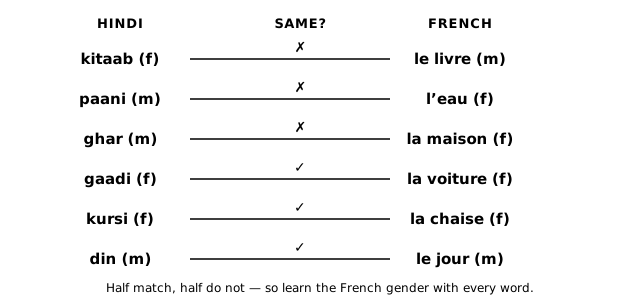
Learn with un / une
Before a vowel, le and la both become l’ and hide the gender (l’arbre, l’eau), so learn nouns with un or une: un arbre, une orange.
- l’arbre → un arbre — the tree → a tree (masculine) [LARBR, ɛ̃-NARBR]
- l’orange → une orange — the orange → an orange (feminine) [lo-RÃZH, ew-no-RÃZH]
7.2 Endings that tell you the gender
You do not have to guess blindly. Many endings belong strongly to one gender. Learn these endings once and you can predict the gender of thousands of words — including words you have never seen before.
Usually feminine
| Ending | Examples | Watch out |
|---|---|---|
| -tion / -sion | la nation, la télévision, la question | almost no exceptions |
| -té | la liberté, la santé, la beauté | le côté, l’été, le pâté, le comité |
| -ette | la baguette, la fourchette, la toilette | le squelette |
| -ence / -ance | la France, la chance, la différence | le silence |
| -ure | la voiture, la culture, la nature | le murmure, le mercure |
| -ie / -ée | la boulangerie, la vie, l’idée, la journée | le génie, le musée, le lycée |
| -ude / -ade / -ise | l’habitude, la salade, la valise | le stade |
Usually masculine
| Ending | Examples | Watch out |
|---|---|---|
| -ment | le gouvernement, l’appartement, le moment | almost no exceptions |
| -age | le fromage, le voyage, le garage | la page, la plage, l’image, la cage, la nage, la rage |
| -eau | le bateau, le gâteau, le bureau | l’eau, la peau |
| -isme | le tourisme, le journalisme | no exceptions |
| -oir | le miroir, le soir, le couloir | — |
| -et / -ier | le billet, le jouet, le papier, le cahier | — |
| -ème (Greek words) | le problème, le système, le thème | la crème |
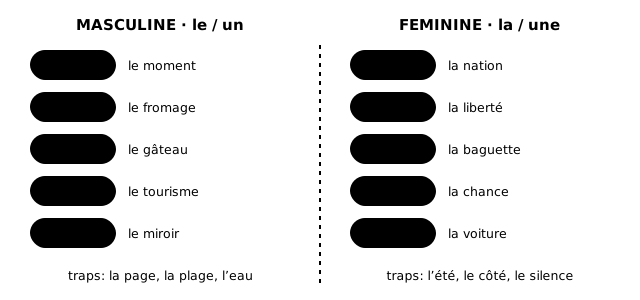
- la question, la liberté, la baguette — the question, freedom, the baguette [la kes-TYÕ, la lee-behr-TAY, la ba-GET]
- le moment, le fromage, le bateau — the moment, the cheese, the boat [luh mo-MÃ, luh fro-MAZH, luh ba-TOH]
- J’aime la plage en été. — I love the beach in summer. (two traps in one sentence) [zhem la PLAZH ã-nay-TAY]
- L’eau est froide. — The water is cold. (froide is the feminine form — the adjective shows the gender) [loh eh FRWAD]
- C’est un problème. — It’s a problem. (masculine, even though it ends in -e) [seh-tɛ̃ pro-BLEM]
The ending rule
-tion, -té, -ette, -ence, -ure are usually feminine; -ment, -age, -eau, -isme, -oir are usually masculine.
A rough rule for the rest
A noun ending in a written -e is more often feminine; a noun ending in a consonant is more often masculine. It is only a tendency — check the dictionary.
7.3 Other clues: meaning, and words with two genders
Sometimes the meaning of a word tells you its gender, whatever the ending:
| Group | Gender | Examples |
|---|---|---|
| days, months, seasons | masculine | le lundi, le printemps, le mois de mai |
| languages | masculine | le français, le hindi, l’anglais |
| colours used as nouns | masculine | le rouge, le bleu, le blanc |
| English loanwords | usually masculine | le week-end, le parking, le football |
| countries ending in -e | usually feminine | la France, l’Inde, la Chine (but le Mexique, le Cambodge) |
| school subjects in -ique | feminine | la musique, la physique, l’informatique |
Same word, two genders, two meanings
A few nouns change their meaning when they change gender. These are worth knowing early:
- le livre / la livre — the book / the pound (money, or half a kilo at the market)
- le tour / la tour — the tour, the turn / the tower (la tour Eiffel) [luh TOOR / la TOOR]
- le poste / la poste — the job, the TV/radio set / the post office
- le mode / la mode — the method, the mode / fashion
Fixed-gender words for people
Some nouns keep one gender whoever they describe: une personne, une victime, une star are always feminine, un bébé is always masculine. Mon père est une personne calme. My father is a calm person.
7.4 Making the feminine of people and animals
For people, most nouns have a masculine and a feminine form. The basic rule is to add -e. Listen carefully: when you add -e, a silent final consonant often becomes pronounced. That is how you hear the feminine.
- un ami → une amie — a (male) friend → a (female) friend — same sound [ɛ̃-na-MEE, ew-na-MEE]
- un étudiant → une étudiante — a student — the t is now heard [ay-tew-DYÃ → ay-tew-DYÃT]
- un Français → une Française — a Frenchman → a Frenchwoman — the s becomes a z sound [frã-SEH → frã-SEZ]
Other nouns follow fixed patterns. The ending changes in a predictable way:
| Pattern | Masculine | Feminine |
|---|---|---|
| -ien → -ienne | un Indien, un musicien | une Indienne, une musicienne |
| -on → -onne | un lion, un patron | une lionne, une patronne |
| -er → -ère | un boulanger, un étranger | une boulangère, une étrangère |
| -eur → -euse | un vendeur, un chanteur | une vendeuse, une chanteuse |
| -teur → -trice | un acteur, un directeur | une actrice, une directrice |
| -e → no change | un élève, un journaliste | une élève, une journaliste |
- un acteur → une actrice — an actor → an actress [ak-TUHR → ak-TREES]
- un vendeur → une vendeuse — a salesman → a saleswoman [vã-DUHR → vã-DUHZ]
- un Indien → une Indienne — an Indian man → an Indian woman [ɛ̃-nɛ̃-DYɛ̃ → ew-nɛ̃-DYEN]
- un journaliste → une journaliste — a journalist — only the article changes [zhoor-na-LEEST]
Different words for the two sexes
Many family words are completely different, just like English and Hindi (bhai / behen):
| Masculine | Feminine | English |
|---|---|---|
| l’homme | la femme | man / woman (also husband / wife: le mari / la femme) |
| le père | la mère | father / mother |
| le frère | la sœur | brother / sister |
| l’oncle | la tante | uncle / aunt |
| le garçon | la fille | boy / girl (la fille is also “daughter”) |
| le roi | la reine | king / queen |
Jobs: modern French feminises
Today France usually says la professeure, la docteure or une médecin, une autrice or une auteure, une ingénieure — older texts used the masculine for everyone.
7.5 Plurals: usually just -s (which you cannot hear)
To make most nouns plural, add -s. But this -s is silent: livre and livres sound exactly the same. So in speech you hear the plural mostly in the article: le / la [luh / la] becomes les [lay].
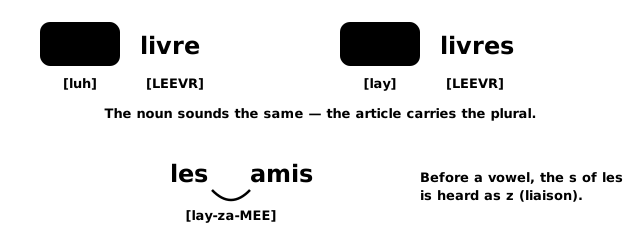
- la pomme → les pommes — the apple → the apples [la POM → lay POM]
- un enfant → des‿enfants — a child → children [ɛ̃-nã-FÃ → day-zã-FÃ]
The special plurals
| Singular ends in | Plural | Examples |
|---|---|---|
| -s, -x, -z | no change | le bras → les bras · le prix → les prix · le nez → les nez |
| -eau, -au, -eu | + x | le gâteau → les gâteaux · le jeu → les jeux · le cheveu → les cheveux |
| -al | → -aux | le journal → les journaux · le cheval → les chevaux · l’animal → les animaux |
| -ail (a few) | → -aux | le travail → les travaux (but le détail → les détails) |
| -ou (7 words) | + x | bijoux, cailloux, choux, genoux, hiboux, joujoux, poux — all others + s: les trous |
Exceptions to remember: les pneus, les bleus (-eu + s), and les festivals, les carnavals (-al + s).
- un gâteau → deux gâteaux — a cake → two cakes [ga-TOH]
- un journal → des journaux — a newspaper → newspapers — this plural you CAN hear [zhoor-NAL → zhoor-NOH]
- un cheval → des chevaux — a horse → horses [shuh-VAL → shuh-VOH]
Truly irregular
- un œil → des yeux — an eye → eyes — a completely different word [ɛ̃-NUHY → day-ZYUH]
- Elle a les yeux noirs. — She has dark eyes. [el a lay-ZYUH NWAR]
- monsieur → messieurs · madame → mesdames — sir → gentlemen · madam → ladies [muh-SYUH, may-SYUH, ma-DAM, may-DAM]
- Mesdames et messieurs, bonsoir ! — Ladies and gentlemen, good evening!
The plural rule
Add a silent -s; -eau/-eu add -x; -al becomes -aux; -s, -x, -z do not change; un œil becomes des yeux.
Nouns that live in the plural
Some nouns are (almost) always plural in French, even when English uses a singular:
- Je pars en vacances. — I’m going on holiday. (les vacances — always plural) [zhuh par ã va-KÃS]
- Les gens sont sympas ici. — People are nice here. (les gens = people) [lay ZHÃ sõ sɛ̃-PA ee-SEE]
- Où sont mes lunettes ? — Where are my glasses? [oo sõ may lew-NET]
Family names do not take -s: les Martin, les Sharma (the Martins, the Sharmas).
7.6 Mistakes learners really make
Fix these once and for all
- Wrong: La problème est simple.
- Right: Le problème est simple.
-
Why: Greek words in -ème (problème, système, thème) are masculine despite the -e.
-
Wrong: J’ai un voiture.
- Right: J’ai une voiture.
-
Why: -ure is feminine: la voiture, la culture, la nature.
-
Wrong: Lisez le page 10.
- Right: Lisez la page 10.
-
Why: -age is masculine, but page, plage, image, cage are the famous feminine exceptions.
-
Wrong: Je lis les journals.
- Right: Je lis les journaux.
-
Why: -al → -aux in the plural: journal → journaux, animal → animaux.
-
Wrong: Il a les œils bleus.
- Right: Il a les yeux bleus.
-
Why: The plural of œil is yeux — a different word.
-
Wrong: Mon frère est un personne gentille.
- Right: Mon frère est une personne gentille.
-
Why: personne is always feminine, even for a man — and its adjective is feminine too.
-
Wrong: La livre est sur la table. (meaning “the book”)
- Right: Le livre est sur la table.
- Why: Hindi kitaab is feminine, but le livre is masculine. La livre means “the pound”.
7.7 In real life — at the market
Notice how every noun arrives with its gender, and how the plural is heard in the article and the number.
- — Bonjour ! Je voudrais une baguette et un croissant, s’il vous plaît. — Hello! I’d like a baguette and a croissant, please. [zhuh voo-DREH ewn ba-GET ay ɛ̃ krwa-SÃ]
- — Voilà. Et avec ça ? — Here you are. Anything else? [vwa-LA. ay a-vek SA]
- — Deux gâteaux au chocolat et six œufs. — Two chocolate cakes and six eggs. [duh ga-TOH oh sho-ko-LA ay see-ZUH]
- — La salade est fraîche aujourd’hui. — The lettuce is fresh today. [la sa-LAD eh FRESH oh-zhoor-DWEE]
- — Parfait, et un fromage aussi. Merci ! — Perfect, and a cheese too. Thank you!
Note: un œuf [ɛ̃-NUHF] but des œufs [day-ZUH] — the f goes silent in the plural. A small surprise worth hearing.
À retenir
- Every French noun is masculine (le, un) or feminine (la, une): always learn a new noun together with its article.
- Before a vowel, le and la both become l’ and hide the gender (l’arbre, l’eau), so learn nouns with un or une: un arbre, une orange.
- -tion, -té, -ette, -ence, -ure are usually feminine; -ment, -age, -eau, -isme, -oir are usually masculine.
- A noun ending in a written -e is more often feminine; a noun ending in a consonant is more often masculine. It is only a tendency — check the dictionary.
- Today France usually says la professeure, la docteure or une médecin, une autrice or une auteure, une ingénieure — older texts used the masculine for everyone.
- Add a silent -s; -eau/-eu add -x; -al becomes -aux; -s, -x, -z do not change; un œil becomes des yeux.
7.8 Practice — Gender & plurals
Exercise 1
___ télévision
- le
- la
- les
- l'
Hint: Look at the ending -sion.
Answer
la
-tion / -sion nouns are feminine: la télévision.
Exercise 2
___ gouvernement
- le
- la
- une
- des
Hint: -ment
Answer
le
-ment nouns are masculine: le gouvernement.
Exercise 3
___ plage (the beach)
- le
- la
- un
- les
Hint: -age is a trap here.
Answer
la
Most -age nouns are masculine, but la plage, la page, l'image, la cage are feminine.
Exercise 4
___ problème
- le
- la
- une
- l'
Answer
le
-ème words from Greek are masculine: le problème, le système.
Exercise 5
The plural of un œil is…
- des œils
- des yeux
- des œux
- des œil
Answer
des yeux
œil → yeux is completely irregular.
Exercise 6
un acteur → une ___
Hint: -teur → -trice
Answer
actrice
-teur → -trice: acteur → actrice, directeur → directrice.
Exercise 7
un vendeur → une ___
Hint: -eur → -euse
Answer
vendeuse
-eur → -euse: vendeur → vendeuse, chanteur → chanteuse.
Exercise 8
un journal → des ___
Hint: -al
Answer
journaux
-al → -aux: journal → journaux.
Exercise 9
un gâteau → des ___
Hint: -eau
Answer
gâteaux / gateaux
-eau → -eaux: gâteau → gâteaux.
Exercise 10
un Indien → une ___
Hint: -ien
Answer
Indienne / indienne
-ien → -ienne, with a doubled n.
Exercise 11
Tap the wrong word.
Il a les œils verts.
Answer
Wrong word: œils.
Corrected: Il a les yeux verts.
The plural of œil is yeux.
Exercise 12
Tap the wrong word.
Je cherche le voiture rouge.
Answer
Wrong word: le.
Corrected: Je cherche la voiture rouge.
voiture ends in -ure: feminine, la voiture.
Exercise 13
Match each singular to its plural.
| A | B |
|---|---|
| un œil | des genoux |
| un journal | des prix |
| un genou | des yeux |
| un prix | des journaux |
Answer
un œil — des yeux; un journal — des journaux; un genou — des genoux; un prix — des prix
œil → yeux (irregular), -al → -aux, genou is one of the 7 -ou + x words, -x does not change.
Exercise 14
Match the word to its meaning.
| A | B |
|---|---|
| le livre | the tower |
| la livre | the tour, the turn |
| la tour | the book |
| le tour | the pound |
Answer
le livre — the book; la livre — the pound; la tour — the tower; le tour — the tour, the turn
Same word, different gender, different meaning.
Exercise 15
Put the words in order.
Words: mangent / des / gâteaux / enfants / Les
Answer
Les enfants mangent des gâteaux
Subject (les enfants) + verb + object. Both nouns are plural.
Exercise 16
Say it aloud — make the liaison in les amis.
Les amis sont dans la maison
Answer
Say: Les amis sont dans la maison
les‿amis: the s of les sounds like z before a vowel.
Exercise 17
Say it aloud.
Je voudrais une baguette et un croissant
Answer
Say: Je voudrais une baguette et un croissant
une baguette (f), un croissant (m).
Next step
Now that every noun has a gender, learn the little words in front of them — le, un, du and the rest — in Articles. Keep a notebook with nouns written in blue and pink.