Chapter 51: Messages, letters & emails
Messages, lettres et e-mails
In French, how you open and close a message says as much as what you write in between. A text to a friend ends with Bises; a letter to a company ends with a whole ceremonial sentence: Veuillez agréer…. This chapter gives you the right frame for every situation, a labelled map of the French formal letter, and model letters you can adapt today.
- 1Choose your register before you write
- 2Texts and quick messages
- 3Friendly emails and letters
- 4Everyday work emails
- 5The formal letter, piece by piece
- 6Model letters to adapt
- 7Phrase bank: openings and closings
masculinefeminineplural
The golden rule
Choose tu or vous first — then pick the greeting, the closing and every verb to match it. Never mix the two in one message.
51.1 Choose your register before you write
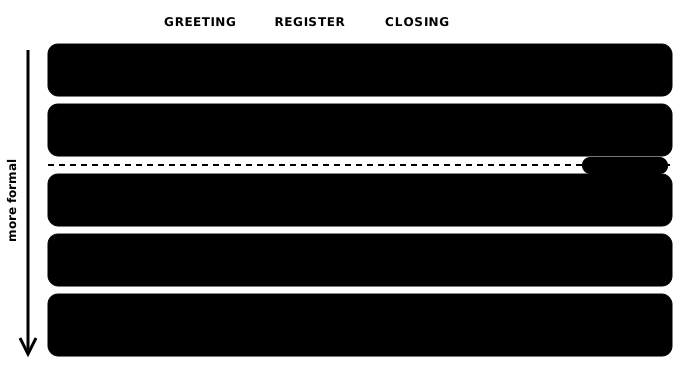
French written messages sit on a clear ladder, from very close (tu, kisses) to very formal (vous, fixed formulas). It works much like Hindi tum and aap: once you choose, the whole message follows. If you are not sure, go one step more formal — nobody is offended by too much politeness.
Careful
- Wrong: Merci pour votre réponse. Tu peux m’envoyer le document ?
- Right: Merci pour votre réponse. Pourriez-vous m’envoyer le document ?
- Why: You started with votre, so the whole message is in vous: verbs, possessives (votre/vos) and pronouns (vous). Switching to tu halfway sounds careless or rude. Thank you for your reply. Could you send me the document?
51.2 Texts and quick messages
Text messages (les SMS, les textos) and chat apps use short, spoken French: no ne, lots of t’es, and abbreviations like rdv (rendez-vous). The full list of abbreviations and slang lives in Registers & slang, and the spoken forms in Real spoken French. Here is just one model exchange so you see the rhythm.
- Salut ! T’es dispo ce soir ? — Hi! Are you free tonight? (t’es = tu es, dispo = disponible)
- Oui, pourquoi ? — Yes, why?
- Ciné à 20 h ? Y a un nouveau film indien. — Cinema at 8 p.m.? There’s a new Indian film on. (y a = il y a)
- Ok ! Rdv devant le cinéma à 19 h 45. — OK! Meet in front of the cinema at 7.45 p.m.
- Super, à toute ! — Great, see you soon! (à toute = à tout à l’heure)
Texting rule
Text-speak is only for people you say tu to. A message to your landlord or your boss — even on WhatsApp — stays in full words with vous.
51.3 Friendly emails and letters
To a friend or family member you open with Salut, Coucou or Cher / Chère + first name, followed by a comma or an exclamation mark. Cher is an adjective (“dear”), so it agrees with the person.
| Writing to | Greeting | Meaning |
|---|---|---|
| one man | Cher Paul, | Dear Paul, |
| one woman | Chère Marie, | Dear Marie, |
| several people (mixed or men) | Chers amis, | Dear friends, |
| several women | Chères amies, | Dear friends (all women), |
| a very close friend | Mon cher Thomas, / Ma chère Inès, | My dear… |
Useful lines for the body
- J’espère que tu vas bien. — I hope you are well.
- Ça fait longtemps qu’on ne s’est pas parlé ! — It’s been ages since we last talked!
- Désolée de ne pas t’avoir répondu plus tôt. — Sorry I didn’t reply sooner. (a woman writes désolée, a man désolé)
Friendly closings, from warm to warmest
| Closing | Literally | Use with |
|---|---|---|
| Amitiés, / Bien amicalement, | friendship / in friendship | friendly but not close: a neighbour, an old teacher |
| À bientôt ! | see you soon | almost anyone you say tu to |
| Bises, / Grosses bises, | kisses / big kisses | friends — the standard French sign-off |
| Bisous, | kisses (cosier) | close friends, family, partner |
| Je t’embrasse, | I kiss you / I hug you | family, old friends — affectionate, not romantic |
“Bises” is not romantic
French friends kiss on the cheek (la bise), so Bises at the end of a message is simply friendly — like “love” or “xx” among British friends. See Culture & the francophone world.
Model: an email to a friend
- Chère Inès, — Dear Inès, — chère, because Inès is a woman.
- Merci pour ta carte, ça m’a fait très plaisir ! Ici, tout va bien. — Thanks for your card, it made me very happy! All is well here.
- Je me suis installée à Lyon il y a trois semaines et je commence à m’habituer à la vie française. — I moved to Lyon three weeks ago and I’m starting to get used to French life.
- Et toi, comment ça va ? Tu viens toujours me voir en avril ? — And how are you? Are you still coming to see me in April?
- Grosses bises, Priya — Big kisses (love), Priya
Careful
- Wrong: Cher Madame,
- Right: Chère Madame, (someone you know) — or just Madame, (a stranger)
- Why: Cher agrees: chère for a woman. And with someone you have never met, French drops “dear” entirely and writes only Madame,. Don’t add the surname after Chère Madame in a letter.
51.4 Everyday work emails
Most of the French you will write at work or with offices is the semi-formal email: polite vous, but much lighter than a letter. Three parts matter: the objet (subject line), the greeting, and a short closing.
Greetings
- Bonjour Madame Dupont, — Hello Ms Dupont, — the safest choice when you know the name.
- Bonjour à tous, — Hello everyone, — to a team.
Titles in writing
The abbreviations are M. (Monsieur) and Mme (Madame) — never “Mr”. In a greeting, write the word in full: Bonjour Madame Dupont.
Closings
| Closing | Meaning | Tone |
|---|---|---|
| Cordialement, | Kind regards | neutral, a little cool; fine for strangers |
| Bien cordialement, / Très cordialement, | Warm regards | friendlier; the everyday office choice |
| Bien à vous, | Yours | polite and slightly personal |
| Bonne journée, / Bonne fin de journée, | Have a good day / a good rest of the day | friendly, often added before Cordialement |
| Merci d’avance, / Je vous remercie par avance, | Thanks in advance | when you have asked for something |
Model: a semi-formal email
- Objet : Réunion du jeudi 14 mai — Subject: Thursday 14 May meeting — days and months take no capital letter in French.
- Je vous remercie pour votre message et je vous confirme ma présence à la réunion de jeudi, à 10 h. — Thank you for your message; I confirm I will attend Thursday’s meeting at 10 a.m.
- Pourriez-vous m’envoyer l’ordre du jour avant mercredi ? — Could you send me the agenda before Wednesday?
- Je vous souhaite une bonne journée. Bien cordialement, Rahul Verma — I wish you a good day. Warm regards, Rahul Verma
Careful
- Wrong: Salut Monsieur, je vous écris au sujet de ma commande.
- Right: Bonjour Monsieur, je vous écris au sujet de ma commande.
- Why: Salut belongs to the tu world; Monsieur and vous belong to the vous world. The two clash. Hello Sir, I am writing to you about my order.
51.5 The formal letter, piece by piece
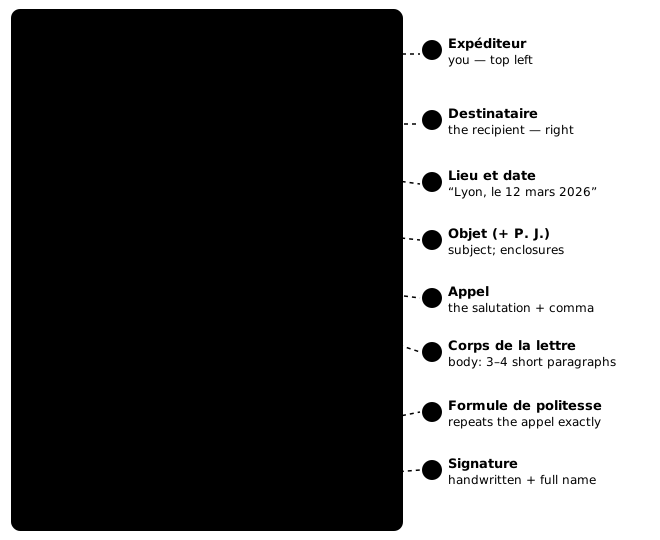
A French formal letter (lettre formelle or courrier) follows a fixed layout. Learn the map once and reuse it for every letter.
The salutation — l’appel
| Situation | Appel |
|---|---|
| you don’t know who will read it | Madame, Monsieur, |
| you know it is a woman / a man | Madame, / Monsieur, |
| a person with a title | Madame la Directrice, / Monsieur le Maire, |
| someone you know well, formally | Chère Madame, / Cher Monsieur, |
The date
- Paris, le 12 mars 2026 — Paris, 12 March 2026 — city, comma, le, day, month in small letters, year.
Careful
- Wrong: Paris, 12th Mars 2026
- Right: Paris, le 12 mars 2026
- Why: French dates take le, no “th”, and a small letter for the month. Full rules for dates are in Numbers, dates & time.
The closing formula — la formule de politesse
This long sentence is the most famous part of a French letter. It sounds old-fashioned, but it is still expected in every formal letter. Its one live rule: the words in commas repeat your appel exactly — if you opened with Madame la Directrice,, you close with …agréer, Madame la Directrice, l’expression….
- Veuillez agréer, Madame, Monsieur, l’expression de mes salutations distinguées. — Please accept, Madam, Sir, the expression of my distinguished greetings. — the standard “Yours faithfully”.
- Je vous prie d’agréer, Madame, Monsieur, l’expression de mes salutations distinguées. — I ask you to accept… — the same, very slightly softer.
- Je vous prie d’agréer, Monsieur le Directeur, l’expression de mes salutations respectueuses. — …my respectful greetings. — to a superior or an authority.
The safe formula
If you learn only one ending, learn: Je vous prie d’agréer, Madame, Monsieur, l’expression de mes salutations distinguées. It is correct for any reader. Older guides also use sentiments; salutations is always safe.
Careful
- Wrong: …je vous remercie de votre aide. Merci, bisous !
- Right: …je vous prie d’agréer, Madame, Monsieur, l’expression de mes salutations distinguées.
- Why: A formal letter never ends with a casual sign-off. Bisous is for friends and family only — in a letter to an office it sounds bizarre.
Careful
- Wrong: Respecté Monsieur, … Votre fidèlement,
- Right: Monsieur, … Veuillez agréer, Monsieur, l’expression de mes salutations distinguées.
- Why: Indian English habits like “Respected Sir” and “Yours faithfully” do not translate word for word. French has its own frames: Monsieur, at the top and the formula at the bottom.
51.6 Model letters to adapt
Here are the three letters you will write most often in France — and in DELF B1–B2 exams: a cover letter, a complaint and a request for information. Change the names, keep the frame.
The cover letter — la lettre de motivation
French recruiters expect the vous – moi – nous structure: first talk about them (show you know the company), then about you (your skills, with proof), then about us (what you will do together, and a request for an interview).
Vous – moi – nous
Cover letter body = vous (the company) → moi (my skills) → nous (our future together + interview).
Fully annotated model
- ① Priya Sharma — 14 rue des Lilas — 69003 Lyon — 06 39 98 12 34 — priya.sharma@exemple.fr — Expéditeur (top left): your name, address, phone and email. The postcode comes before the city.
- ② Atelier Cassiopée — Service des ressources humaines — 25 avenue Victor-Hugo — 75016 Paris — Destinataire (right): company, department (Human Resources), address.
- ③ Lyon, le 12 mars 2026 — Lieu et date (right): the city you write from.
- ④ Objet : Candidature au poste d’assistante commerciale (réf. AC-26) — P. J. : CV — Objet*: Application for the post of sales assistant (ref.). P. J.* (pièce jointe) = enclosure: CV.
- ⑤ Madame, Monsieur, — Appel: you don’t know who will read it, so both.
- ⑥ Spécialiste reconnu de la décoration artisanale, l’Atelier Cassiopée développe depuis plusieurs années ses ventes à l’international. C’est avec un vif intérêt que j’ai lu votre annonce. — VOUS: A well-known specialist in handmade decoration, Atelier Cassiopée has been growing its international sales for several years. It was with keen interest that I read your advert. — reconnu agrees with l’Atelier (masculine).
- ⑦ Titulaire d’un master en commerce international, j’ai effectué un stage de six mois au service export d’une entreprise textile à Jaipur. J’y ai géré les relations avec des clients européens. — MOI: Holding a master’s in international trade, I did a six-month internship in the export department of a textile company in Jaipur. There I managed relations with European clients. — facts and proof, not just adjectives.
- Rigoureuse et organisée, je parle couramment anglais, hindi et français. — Rigorous and organised, I speak fluent English, Hindi and French. — feminine adjectives, because Priya is a woman.
- ⑧ Rejoindre votre équipe me permettrait de mettre ces compétences au service de votre développement en Asie. Je serais heureuse de vous exposer mes motivations lors d’un entretien. — NOUS: Joining your team would let me put these skills to work for your growth in Asia. I would be happy to explain my motivation in an interview. — the conditional (permettrait, serais) is polite, not unsure.
- ⑨ Dans l’attente de votre réponse, je vous prie d’agréer, Madame, Monsieur, l’expression de mes salutations distinguées. — Formule: Looking forward to your reply, I ask you to accept… — the appel “Madame, Monsieur” is repeated. Then the signature and full name.
The complaint — la lettre de réclamation
Structure: the facts (what, when, reference number) → the problem → your request → the formula. Stay calm and precise; anger weakens a complaint.
- Objet : Réclamation – commande n° 48213 — Subject: Complaint – order no. 48213
- Le 2 février dernier, j’ai commandé sur votre site un aspirateur, que j’ai reçu le 10 février. — On 2 February, I ordered a vacuum cleaner on your website, which I received on 10 February.
- Or, l’appareil ne fonctionne pas : il s’arrête au bout de quelques secondes. — However, the appliance does not work: it stops after a few seconds. — or = “now, however”, perfect for introducing the problem.
- Je vous serais donc reconnaissant de bien vouloir procéder à son remplacement ou à son remboursement. — I would therefore be grateful if you would kindly replace or refund it. — a woman writes reconnaissante.
The request — la demande de renseignements
- Je souhaiterais obtenir des renseignements sur vos cours de français pour adultes. — I would like some information about your French classes for adults.
- Pourriez-vous m’indiquer les horaires, les tarifs et les dates d’inscription ? — Could you tell me the timetable, the fees and the enrolment dates?
- Je vous remercie par avance de votre réponse. Bien cordialement, Arjun Mehta — Thank you in advance for your reply. Warm regards, Arjun Mehta — sent by email, so a short closing is right.
Careful
- Wrong: Je veux des informations sur vos cours.
- Right: Je souhaiterais / Je voudrais obtenir des informations sur vos cours.
- Why: Je veux sounds like a demand. The conditional softens it. Je vous écris pour demander… (“I am writing to ask…”) is also perfectly polite. See Conditional & si clauses.
51.7 Phrase bank: openings and closings
The first and last lines of a letter are the hardest. Keep this bank close and pick one from each table.
First lines
| French | English |
|---|---|
| Je me permets de vous écrire au sujet de… | I am taking the liberty of writing to you about… |
| Je vous écris afin de… / pour… | I am writing (in order) to… |
| Suite à notre conversation téléphonique du 3 mars, … | Following our phone conversation of 3 March, … |
| En réponse à votre annonce parue le 5 mars, … | In response to your advert published on 5 March, … |
| J’ai bien reçu votre courrier du 10 mars et je vous en remercie. | I have received your letter of 10 March, thank you. |
| Comme convenu, je vous adresse… | As agreed, I am sending you… |
Last lines
| French | English |
|---|---|
| Dans l’attente de votre réponse, je vous prie d’agréer… | Looking forward to your reply, … |
| Je reste à votre disposition pour tout renseignement complémentaire. | I remain available for any further information. |
| Je vous remercie de l’attention que vous porterez à ma demande. | Thank you for considering my request. |
| En vous remerciant par avance, je vous prie d’agréer… | Thanking you in advance, … |
| N’hésitez pas à me contacter si vous avez besoin de précisions. | Do not hesitate to contact me if you need more details. |
Careful
- Wrong: Dans l’attente de vous lire, veuillez agréer, Madame, Monsieur, mes salutations distinguées.
- Right: Dans l’attente de votre réponse, je vous prie d’agréer, Madame, Monsieur, l’expression de mes salutations distinguées.
- Why: The person “waiting” is me, but veuillez (“please…”) has you as its subject — the sentence no longer hangs together. With Dans l’attente… or En vous remerciant…, continue with je. Dans l’attente de vous lire is common in business emails, but de votre réponse is safer in a letter.
Before you press Send
Check five things: an Objet, one register throughout, cher/chère agreement, the appel repeated in the formula, and your own adjectives agreeing with you (ravie, reconnaissante).
À retenir
- Choose tu or vous first — then pick the greeting, the closing and every verb to match it. Never mix the two in one message.
- Text-speak is only for people you say tu to. A message to your landlord or your boss — even on WhatsApp — stays in full words with vous.
- French friends kiss on the cheek (la bise), so Bises at the end of a message is simply friendly — like “love” or “xx” among British friends. See Culture & the francophone world.
- The abbreviations are M. (Monsieur) and Mme (Madame) — never “Mr”. In a greeting, write the word in full: Bonjour Madame Dupont.
- If you learn only one ending, learn: Je vous prie d’agréer, Madame, Monsieur, l’expression de mes salutations distinguées. It is correct for any reader. Older guides also use sentiments; salutations is always safe.
- Cover letter body = vous (the company) → moi (my skills) → nous (our future together + interview).
51.8 Practice — Messages, letters & emails
Exercise 1
___ Marie, (opening an email to a friend called Marie)
- Cher
- Chère
- Chers
- Chères
Hint: cher agrees with the person
Answer
Chère
Marie is one woman, so cher takes the feminine form: Chère Marie.
Exercise 2
You write to a company and don't know who will read the letter. Which appel?
- Madame, Monsieur,
- Salut,
- Cher Madame Monsieur,
- Coucou,
Answer
Madame, Monsieur,
Madame, Monsieur, is the standard salutation for an unknown reader.
Exercise 3
Which ending is grammatically sound?
- Dans l'attente de votre réponse, je vous prie d'agréer...
- Dans l'attente de votre réponse, veuillez agréer...
- Dans l'attente de votre réponse, bisous
- Dans l'attente de votre réponse, cordialement je
Answer
Dans l'attente de votre réponse, je vous prie d'agréer...
The one waiting is je, so the main clause must have je as its subject.
Exercise 4
In a lettre de motivation, the 'moi' paragraph is where you...
- describe the company
- present your skills and experience
- ask for an interview
- write the date
Answer
present your skills and experience
vous = the company, moi = your skills with proof, nous = working together and the interview.
Exercise 5
Veuillez ___, Madame, Monsieur, l'expression de mes salutations distinguées.
Hint: to accept (formal)
Answer
agréer
Veuillez agréer... is the classic formal closing formula.
Exercise 6
Paris, ___ 12 mars 2026
Hint: one little word before the day
Answer
le
French dates in letters: city, le + day + month + year.
Exercise 7
Tap the wrong word.
Cher Madame, je vous remercie de votre réponse.
Answer
Wrong word: Cher.
Corrected: Chère Madame, je vous remercie de votre réponse.
Madame is feminine, so cher becomes chère.
Exercise 8
Tap the word that clashes with the register.
Salut Monsieur, je vous écris au sujet de ma commande.
Answer
Wrong word: Salut.
Corrected: Bonjour Monsieur, je vous écris au sujet de ma commande.
Salut is for tu; with Monsieur and vous use Bonjour.
Exercise 9
This email started with vous. Tap the word that breaks it.
Merci pour votre message. Tu peux m'appeler demain ?
Answer
Wrong word: Tu.
Corrected: Merci pour votre message. Vous pouvez m'appeler demain ?
Never mix tu and vous in the same message.
Exercise 10
Tap the word that sounds too direct in a formal email.
Je veux des renseignements sur vos cours.
Answer
Wrong word: veux.
Corrected: Je souhaiterais obtenir des renseignements sur vos cours.
The conditional (souhaiterais, voudrais) is the polite way to ask.
Exercise 11
Put the words in order.
Words: écris / vous / Je / votre / au / de / annonce / sujet
Answer
Je vous écris au sujet de votre annonce
Je vous écris au sujet de... = I am writing to you about...
Exercise 12
Put the words in order.
Words: pour / disposition / votre / tout / Je / reste / à / renseignement
Answer
Je reste à votre disposition pour tout renseignement
A classic last line for formal emails and letters.
Exercise 13
Match each closing to where it belongs.
| A | B |
|---|---|
| Bisous | everyday work email |
| Amitiés | formal letter |
| Bien cordialement | close friends and family |
| Veuillez agréer... | friendly but not close |
Answer
Bisous — close friends and family; Amitiés — friendly but not close; Bien cordialement — everyday work email; Veuillez agréer... — formal letter
Each closing sits on one step of the register ladder.
Exercise 14
Match the parts of a formal letter.
| A | B |
|---|---|
| l'objet | the closing formula |
| l'appel | enclosures |
| la formule de politesse | the subject line |
| P. J. | the opening salutation |
Answer
l'objet — the subject line; l'appel — the opening salutation; la formule de politesse — the closing formula; P. J. — enclosures
These are the labels of the French formal letter layout.
Exercise 15
Say it aloud.
Je souhaiterais obtenir des renseignements
Answer
Say: Je souhaiterais obtenir des renseignements
souhaiterais = would like, the polite conditional.
Exercise 16
Say it aloud.
Dans l'attente de votre réponse
Answer
Say: Dans l'attente de votre réponse
The standard lead-in to the closing formula.
Next step
Write one real email today — to a French course, a museum or a hotel — using the request model. Then move on to Essays & structured writing, where the same care for structure becomes the French plan.