Chapter 45: Cognates & false friends
Mots transparents et faux amis
If you speak English, you already know thousands of French words. After 1066 the Norman kings of England spoke French for 300 years, and English took in about a third of its vocabulary from them. This chapter shows you how to recognise these mots transparents on sight — and how to dodge the faux amis, the “false friends” that look English but mean something else.
- 1Why French gives you free words
- 2Suffix rules: endings that translate themselves
- 3Spelling clues: decode the disguised words
- 4Same word, new sound, new gender
- 5True, partial and false friends
- 6The false friends you must know
- 7The traps in real sentences
masculinefeminineplural
The big idea
Most French words that look English are English in meaning — but a small, famous group are traps. Learn the patterns, then learn the traps by heart.
- C’est une question très importante. — It’s a very important question.
- Le président a pris une décision difficile. — The president made a difficult decision.
- La situation est absolument catastrophique. — The situation is absolutely catastrophic.
45.1 Why French gives you free words
English and French share words in two ways. Some came from Norman French after 1066 (beef, castle, justice, court). Many more came later from Latin, which both languages used for science, law and religion (nation, education, possible). The result: a sentence on politics, science or business can be 50% transparent to you.
The trick is to read French with your eyes first. Your ear will not recognise restaurant pronounced [res-to-RÃ], but your eye will. So read a lot — news headlines are perfect.
- Le gouvernement présente un nouveau programme économique. — The government presents a new economic programme.
- Les étudiants protestent contre la réforme de l’université. — The students are protesting against the university reform.
Read first, listen second
Cognates are easy to see but hard to hear: French stresses the last syllable and drops final consonants. Read the text, then listen to it.
45.2 Suffix rules: endings that translate themselves
Many French endings match an English ending one-to-one. Learn the pairs below and you can build — or guess — hundreds of words. (Prefixes and the wider system of word-building are in Word building & advanced words.)
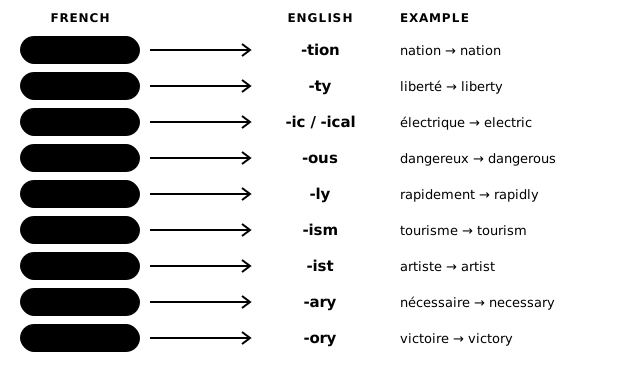
| French | English | More examples |
|---|---|---|
| -tion, -sion | -tion, -sion | information, télévision, attention, solution |
| -ité | -ty | université, qualité, réalité, électricité |
| -ique | -ic / -ical | logique, typique, politique, pratique |
| -eux / -euse | -ous | nerveux, curieux, sérieux, généreux, nombreux |
| -ment (adverb) | -ly | rapidement, normalement, finalement, simplement |
| -isme / -iste | -ism / -ist | optimisme, journaliste, réaliste, féminisme |
| -ible / -able | -ible / -able | possible, visible, confortable, acceptable |
| -if / -ive | -ive | actif, créatif, positif → active, creative |
| -ie | -y | biologie, géographie, économie, philosophie |
| -er (verb) | -ate | décorer, participer, éduquer, imiter |
| -iser / -ifier | -ise / -ify | organiser, simplifier, identifier |
- La révolution a transformé la nation. — The revolution transformed the nation.
- À l’université, j’ai découvert la liberté. — At university, I discovered freedom (liberty).
- C’est une solution logique et pratique. — It’s a logical, practical solution.
- Ce chemin est dangereux, et un peu mystérieux. — This path is dangerous, and a bit mysterious.
- Elle est nerveuse avant l’examen. — She is nervous before the exam. (feminine: -euse)
- Il a répondu rapidement et poliment. — He answered quickly and politely.
- Mon frère est optimiste ; ma sœur est réaliste. — My brother is an optimist; my sister is a realist.
Endings tell you the gender too
Nouns in -tion, -sion, -ité, -ie are almost always feminine; nouns in -isme, -ment are masculine. See Nouns, gender & plurals.
-ment has two jobs
On an adjective it makes an adverb: lente → lentement (slowly). On a verb it makes a masculine noun: gouverner → le gouvernement. And one -ment adverb is a famous trap: actuellement means “currently”, not “actually” (section 6).
45.3 Spelling clues: decode the disguised words
Some words are cognates in disguise: the sounds changed a little over the centuries. These five clues unlock them. They are guessing tools, not laws — but they work surprisingly often.
| Clue | French | English |
|---|---|---|
| é- at the start = s- | école, étudiant, épice, étrange, état, éponge, épouse | school, student, spice, strange, state, sponge, spouse |
| ê, ô, î, â = a lost s | forêt, hôpital, île, fête, bête, côte, intérêt, honnête, château | forest, hospital, isle, feast, beast, coast, interest, honest, castle |
| past participle -é = -ed | organisé, préparé, compliqué, intéressé | organised, prepared, complicated, interested |
| g(u)- = w- | guerre, garder, guêpe, gaufre, Guillaume | war, ward (guard), wasp, wafer, William |
| ch- = c- | chat, château, chameau, charpentier | cat, castle, camel, carpenter |
| -re = -er | ordre, membre, nombre, tigre, octobre | order, member, number, tiger, October |
- L’étudiant va à l’école. — The student goes to school.
- Il y a une fête dans la forêt. — There’s a feast (party) in the forest.
- L’hôpital est près de la côte. — The hospital is near the coast.
- Ce projet est bien organisé et bien préparé. — This project is well organised and well prepared.
- Une guêpe est entrée dans la cuisine. — A wasp came into the kitchen.
- Le chat dort dans le château. — The cat is sleeping in the castle.
The circumflex trick
When you see ê, ô, î, â, mentally add an s after the vowel: forêt → forest, hôte → host, pâte → paste.
45.4 Same word, new sound, new gender
A cognate is free for meaning, but never for sound, gender or spelling. Three things change.
Sound: stress the end, drop the last consonant
- un restaurant — a restaurant [res-to-RÃ]
- une nation — a nation — -tion sounds “syõ” [na-SYÕ]
- une question — a question — but after s, -tion sounds “tyõ” [kes-TYÕ]
- un hôtel — a hotel — the h is silent [ɛ̃-no-TEL]
- important — important [ɛ̃-por-TÃ]
Gender: the ending can lie
English has no gender, so cognates arrive “naked”. Learn each one with its article. These surprise learners because they end in -e but are masculine — or end in -age but are feminine.
- le problème, le système, le programme, le groupe — masculine, although they end in -e
- le musée, le lycée, le modèle — the museum, the high school, the model — masculine
- une image, une page, une plage, une cage — feminine, although most -age words (le voyage, le message) are masculine
Spelling: almost the same is still wrong
| English | French | What changes |
|---|---|---|
| address | adresse | one d, -esse |
| apartment | appartement | pp, extra e |
| example | exemple | e, not a |
| language | langage / langue | no u; a language = une langue |
| literature | littérature | tt, é |
| responsible | responsable | -able, not -ible |
| marriage | mariage | one r |
| character | caractère | no h, è |
45.5 True, partial and false friends
Not every look-alike is a trap. Think of a traffic light. Green words mean the same — use them. Amber words share one meaning but their main meaning is different — slow down. Red words are false friends — stop.

The amber zone: partial friends
| French | Main meaning | Shared with English? |
|---|---|---|
| la chance | luck (avoir de la chance = be lucky) | also “likelihood”; an opportunity = une occasion |
| la figure | face | also a figure in maths or a diagram |
| l’histoire (f.) | story | also history |
| réaliser | make, carry out, fulfil (a dream, a film) | “realise” = se rendre compte; réaliser is used for it in speech, but is criticised |
| ignorer | not know, be unaware of | also ignore someone |
| supporter | put up with, stand | also support a team; support a person or cause = soutenir |
| l’expérience (f.) | experience | also a scientific experiment |
| la place | seat; square; room (space) | a place = un endroit, un lieu |
| l’envie (f.) | wish, craving (avoir envie de = feel like) | also envy, but jealousy = la jalousie |
| contrôler | check, inspect | control (a skill, emotions) = maîtriser |
| terrible | terrible — but pas terrible = not great; in slang terrible ! = awesome | yes, with a twist |
- J’ai eu de la chance : le train était en retard. — I was lucky: the train was late.
- Elle a réalisé son rêve : elle a ouvert un restaurant. — She fulfilled her dream: she opened a restaurant.
- Je me suis rendu compte de mon erreur. — I realised my mistake. (no agreement on rendu here)
- J’ignore pourquoi il est parti. — I don’t know why he left.
- Je ne supporte pas le bruit. — I can’t stand noise.
- Excusez-moi, cette place est libre ? — Excuse me, is this seat free?
45.6 The false friends you must know
Here are the red-light words, grouped by type. Read each row as: this French word means X; if you want the English look-alike, say Y. Learn ten a day.
Things and places
| French | Real meaning | English trap → in French |
|---|---|---|
| la librairie | bookshop | library → la bibliothèque |
| le coin | corner | coin → une pièce (de monnaie) |
| le pain | bread | pain → la douleur |
| le four | oven | four → quatre |
| le car | coach (long-distance bus) | car → une voiture |
| la cave | cellar | cave → une grotte |
| le store | (window) blind | store → un magasin |
| la location | renting, rental | location → un endroit, un emplacement |
| la monnaie | change (coins); currency | money → l’argent |
| la lecture | reading | lecture → un cours, une conférence |
| le collège | secondary school (age 11–15) | college → la fac, l’université |
| la journée | day (all day long) | journey → un voyage, un trajet |
| les vacances | holidays | vacancy → un poste vacant, une chambre libre |
| l’entrée | starter (also: entrance) | US entrée → le plat principal |
| la phrase | sentence | phrase → une expression |
| le raisin | grapes | raisin → un raisin sec |
| le crayon | pencil | crayon → un crayon de cire |
| le préservatif | condom | preservative → un conservateur |
| l’agenda | diary, planner | agenda (meeting) → l’ordre du jour |
Clothes and the body
| French | Real meaning | English trap → in French |
|---|---|---|
| la veste | jacket | UK vest → un maillot de corps; US vest → un gilet |
| la robe | dress | (bath)robe → un peignoir |
| la blouse | overall, lab coat | blouse → un chemisier |
| le slip | briefs, underpants | slip (petticoat) → une combinaison |
| les baskets | trainers, sneakers | basket → un panier |
| le smoking | tuxedo, dinner jacket | smoking → fumer, le tabac |
| le bras | arm | bra → un soutien-gorge |
| la chair | flesh | chair → une chaise |
Work, news and abstract words
| French | Real meaning | English trap → in French |
|---|---|---|
| l’avertissement | warning | advertisement → une publicité |
| la déception | disappointment | deception → la tromperie |
| l’injure | insult | injury → une blessure |
| l’issue | way out; outcome | issue (problem) → un problème, une question |
| l’office | (church) service; agency (office de tourisme) | office (workplace) → le bureau |
| l’éditeur | publisher | editor → le rédacteur, la rédactrice |
| le délai | time allowed, deadline | delay → un retard |
| le patron | boss | patron → un client, un mécène |
| la nouvelle | piece of news; short story | novel → un roman |
| l’habit | outfit; (les habits) clothes | habit → une habitude |
| le hasard | chance (par hasard = by chance) | hazard → un danger, un risque |
| la réunion | meeting | reunion → des retrouvailles |
Adjectives and adverbs
| French | Real meaning | English trap → in French |
|---|---|---|
| actuel / actuellement | current / currently, now | actual(ly) → réel / en fait |
| éventuel / éventuellement | possible / possibly, if need be | eventually → finalement, à la fin |
| sensible | sensitive | sensible → raisonnable, sensé |
| sympathique (sympa) | nice, friendly | sympathetic → compatissant, compréhensif |
| formidable | great, terrific | formidable → redoutable |
| large | wide | large → grand |
| rude | harsh, tough (a winter, a job) | rude → impoli, grossier |
| excité | hyper, worked up; often sexually aroused | excited → j’ai hâte, enthousiaste |
| gentil | kind, nice | gentle → doux |
| propre | clean; own (ma propre voiture) | proper → convenable, correct |
| sale | dirty | sale → les soldes |
Verbs
| French | Real meaning | English trap → in French |
|---|---|---|
| assister à | attend (be present at) | assist (help) → aider (assister quelqu’un exists, but is formal) |
| attendre | wait (for) | attend → assister à, aller à |
| blesser | injure, hurt | bless → bénir |
| achever | finish, complete | achieve → atteindre, accomplir |
| demander | ask (for) | demand → exiger |
| prétendre | claim | pretend → faire semblant |
| rester | stay, remain | rest → se reposer |
| passer un examen | take, sit an exam | pass an exam → réussir un examen |
- Actuellement, je travaille à Lyon. — At the moment, I work in Lyon.
- J’ai acheté un roman à la librairie. — I bought a novel at the bookshop.
- Ma fille est très sensible : elle pleure au cinéma. — My daughter is very sensitive: she cries at the cinema.
- Éventuellement, je peux venir samedi. — If need be, I can come on Saturday.
- Nous avons assisté à un concert magnifique. — We attended a wonderful concert.
- Je t’attends devant la gare. — I’ll wait for you outside the station. (no “for”: attendre quelqu’un)
- Il s’est blessé au genou. — He hurt his knee.
- La boulangerie est au coin de la rue. — The bakery is on the corner of the street.
- Location de vélos : dix euros la journée. — Bike rental: ten euros a day.
- Il prétend qu’il parle six langues. — He claims he speaks six languages.
The top five traps
actuellement = now · librairie = bookshop · sensible = sensitive · éventuellement = possibly · attendre = wait. Actually = en fait.
45.7 The traps in real sentences
These are the mistakes French people hear every day from English speakers. Some are funny, some are embarrassing — the last one is both.
Careful
- Wrong: Actuellement, je suis indien, pas pakistanais.
- Right: En fait, je suis indien, pas pakistanais.
- Why: To correct someone (“actually…”), say en fait. Actuellement only means “at the moment”.
Careful
- Wrong: Je vais à la librairie pour emprunter un livre.
- Right: Je vais à la bibliothèque pour emprunter un livre.
- Why: You borrow at a bibliothèque (library); you buy at a librairie (bookshop).
Careful
- Wrong: J’ai attendu la réunion hier.
- Right: J’ai assisté à la réunion hier.
- Why: Attendre = wait for. To attend an event = assister à (or simply aller à).
Careful
- Wrong: Il est très sensible, il prend toujours de bonnes décisions.
- Right: Il est très raisonnable, il prend toujours de bonnes décisions.
- Why: Sensible = sensitive. Sensible = raisonnable or sensé.
Careful
- Wrong: Je suis fatigué, je vais rester un peu.
- Right: Je suis fatigué, je vais me reposer un peu.
- Why: Rester = stay. To rest = se reposer.
Careful
- Wrong: J’ai passé mon examen, je suis trop content !
- Right: J’ai réussi mon examen, je suis trop content !
- Why: Passer un examen only means you sat it. Passing = réussir.
Careful
- Wrong: Je suis très excité pour mes vacances.
- Right: J’ai vraiment hâte d’être en vacances.
- Why: Excité suggests hyper or sexually aroused. “I can’t wait” = j’ai hâte.
Careful
- Wrong: Ce yaourt ne contient pas de préservatifs.
- Right: Ce yaourt ne contient pas de conservateurs.
- Why: A préservatif is a condom. Food preservatives are conservateurs.
In real life: a conversation full of traps
- — Tu fais quoi actuellement ? — — What are you doing these days?
- — Je travaille dans une librairie, et le soir je donne des cours. — — I work in a bookshop, and in the evening I give lessons.
- — Et ton patron, il est sympa ? — — And your boss, is he nice?
- — Très gentil, mais un peu sensible. Éventuellement, je pourrais changer de travail. — — Very kind, but a bit touchy. I could possibly change jobs, if need be.
When to trust a cognate
Trust long, Latin-looking words (-tion, -ité, -ique). Distrust short everyday words (coin, pain, car, four, sale) — those are where the traps live.
À retenir
- Most French words that look English are English in meaning — but a small, famous group are traps. Learn the patterns, then learn the traps by heart.
- Cognates are easy to see but hard to hear: French stresses the last syllable and drops final consonants. Read the text, then listen to it.
- Nouns in -tion, -sion, -ité, -ie are almost always feminine; nouns in -isme, -ment are masculine. See Nouns, gender & plurals.
- When you see ê, ô, î, â, mentally add an s after the vowel: forêt → forest, hôte → host, pâte → paste.
- actuellement = now · librairie = bookshop · sensible = sensitive · éventuellement = possibly · attendre = wait. Actually = en fait.
- Trust long, Latin-looking words (-tion, -ité, -ique). Distrust short everyday words (coin, pain, car, four, sale) — those are where the traps live.
45.8 Practice — cognates & false friends
Exercise 1
Je vais à la ___ pour emprunter un livre. (borrow a book)
- librairie
- bibliothèque
- libraire
- boutique
Hint: Where do you borrow, not buy?
Answer
bibliothèque
You borrow at a bibliothèque (library). A librairie is a bookshop.
Exercise 2
What does 'actuellement' mean?
- actually
- currently, at the moment
- eventually
- accurately
Answer
currently, at the moment
Actuellement = now. 'Actually' is en fait.
Exercise 3
'Mon fils est très sensible.' means…
- My son is very sensible.
- My son is very sensitive.
- My son is very sensual.
- My son is very reasonable.
Answer
My son is very sensitive.
Sensible = sensitive. Sensible in English = raisonnable.
Exercise 4
Use the é- = s- clue. What does 'une épice' mean?
- an epic
- a spice
- a speech
- a space
Answer
a spice
é- at the start often stands for English s-: épice = spice, école = school.
Exercise 5
___ problème est difficile.
- Le
- La
Hint: A masculine noun ending in -e
Answer
Le
Problème, système, programme are masculine despite the final -e.
Exercise 6
The -ty ending becomes -ité. University = ___
Answer
université / l'université
-ty → -ité, and -ité nouns are feminine: l'université.
Exercise 7
The circumflex marks a lost s. Forest = ___
Answer
forêt / la forêt / foret
forêt = forest; hôpital = hospital; fête = feast.
Exercise 8
Je suis fatigué, je vais me ___ (rest) un peu.
Answer
reposer
To rest = se reposer. Rester means to stay.
Exercise 9
Elle est très nerv___ avant les examens. (nervous)
Hint: feminine of -eux
Answer
euse / nerveuse
-ous → -eux (m.) / -euse (f.): nerveux, nerveuse.
Exercise 10
Tap the false friend.
Hier, j'ai attendu la réunion de dix heures.
Answer
Wrong word: attendu.
Corrected: Hier, j'ai assisté à la réunion de dix heures.
To attend = assister à. Attendre = to wait for.
Exercise 11
Tap the false friend.
Ce gâteau ne contient aucun préservatif.
Answer
Wrong word: préservatif.
Corrected: Ce gâteau ne contient aucun conservateur.
Un préservatif is a condom; a preservative is un conservateur.
Exercise 12
Tap the word that does not mean what the speaker wants (he wants 'actually').
Actuellement je ne suis pas d'accord avec toi.
Answer
Wrong word: Actuellement.
Corrected: En fait je ne suis pas d'accord avec toi.
Actually = en fait. Actuellement = at the moment.
Exercise 13
Match each false friend to its real meaning.
| A | B |
|---|---|
| la librairie | bread |
| le coin | oven |
| le pain | cellar |
| le four | bookshop |
| la cave | corner |
Answer
la librairie — bookshop; le coin — corner; le pain — bread; le four — oven; la cave — cellar
Short everyday words are where most false friends hide.
Exercise 14
Match the verbs to their real meaning.
| A | B |
|---|---|
| rester | to wait for |
| blesser | to claim |
| attendre | to finish |
| prétendre | to stay |
| achever | to hurt |
Answer
rester — to stay; blesser — to hurt; attendre — to wait for; prétendre — to claim; achever — to finish
None of these mean rest, bless, attend, pretend or achieve.
Exercise 15
Put the words in order: 'Actually, I am Indian.'
Words: je / suis / indien / fait / En
Answer
En fait je suis indien
En fait corrects or adds a surprising fact.
Exercise 16
Put the words in order: 'He claims he is ill.'
Words: est / Il / qu'il / prétend / malade
Answer
Il prétend qu'il est malade
Prétendre = to claim; to pretend = faire semblant.
Exercise 17
Say it aloud.
J'ai acheté un roman à la librairie
Answer
Say: J'ai acheté un roman à la librairie
Librairie = bookshop, roman = novel.
Exercise 18
Say it aloud.
Actuellement je travaille dans un restaurant
Answer
Say: Actuellement je travaille dans un restaurant
Restaurant ends in a nasal: [res-to-RÃ], no t.
Next step
Cognates fill your nouns; now glue them together. Continue with Linking words to learn donc, pourtant, cependant and friends.