Chapter 5: Hello, please, thank you
Les premiers mots
With about forty words you can greet people, be polite, say who you are and survive when you do not understand. In France these little words matter a lot: a missing bonjour can feel rude. This chapter gives you the words, the right moment for each one, and the big choice every speaker makes: tu or vous?
- 1Saying hello at every time of day
- 2Saying goodbye
- 3Please, thank you, you’re welcome
- 4Excuse me, sorry, pardon
- 5Tu or vous?
- 6Introducing yourself
- 7Ça va? — How are you?
- 8Survival phrases
masculinefeminine
Rule number one
Always start with Bonjour — in a shop, a bus, an office, before any question. Add Monsieur or Madame for a stranger.
- Bonjour, Monsieur. — Hello, sir. [bõ-zhoor muh-SYÖ]
- Bonjour, Madame. — Hello, madam. [bõ-zhoor ma-DAM]
5.1 Saying hello at every time of day
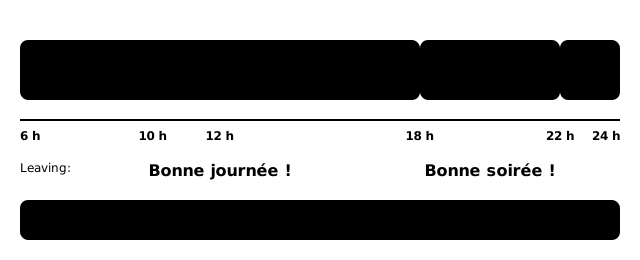
French has no separate “good morning” and “good afternoon”. Bonjour (literally “good day”) covers the whole day. In the evening it becomes bonsoir.
| French | When |
|---|---|
| Bonjour [bõ-ZHOOR] | Hello / good morning / good afternoon — polite, all day |
| Bonsoir [bõ-SWAR] | Good evening — arriving after about 6 pm |
| Salut [sa-LEW] | Hi / bye — friends, family, people your age |
| Coucou [koo-KOO] | Hiya — very casual, close friends, children, text messages |
| Bonne nuit [bon NWEE] | Good night — going to bed only |
Careful
- Wrong: (Arriving at a dinner at 8 pm) Bonne nuit !
- Right: Bonsoir !
- Why: Like English “good night”, bonne nuit means “sleep well”. To greet in the evening, say bonsoir.
Careful
- Wrong: (To a bank manager) Salut !
- Right: Bonjour, Madame.
- Why: Salut is informal, like “hi” — fine with friends, too casual for strangers or at work.
Monsieur, Madame — and the bise
Use Monsieur [muh-SYÖ] and Madame [ma-DAM] alone, without a surname: Bonjour, Madame. Use Madame for any adult woman: Mademoiselle is now old-fashioned and has been dropped from official forms. Friends and family greet with la bise, light cheek kisses (two in Paris, more in some regions); at work and with strangers, a handshake or just a smile and a bonjour.
5.2 Saying goodbye
- Au revoir ! — Goodbye! — always correct [oh ruh-VWAR]
- À bientôt ! — See you soon! [a byɛ̃-TOH]
- À demain ! — See you tomorrow! [a duh-MƐ̃]
- À tout à l’heure ! — See you later (today)! [a too-ta LÖR]
- À plus tard ! / À plus ! — See you later! / Later! (casual — in texts: A+) [a plew TAR / a PLEWSS]
- À la prochaine ! — Until next time! [a la pro-SHEN]
Wishing a good day
When you leave a shop or end a call, add a wish. The answer is always Merci, vous aussi ! (Thanks, you too!) or, with a friend, Toi aussi !
- Bonne journée ! — Merci, vous aussi ! — Have a nice day! — Thanks, you too! [bon zhoor-NAY … voo-zoh-SEE]
- Bonne soirée ! Bon week-end ! — Have a nice evening! Have a good weekend! [bon swa-RAY, bõ wee-KEND]
- Bon appétit ! Bon voyage ! — Enjoy your meal! Have a good trip! [bo-na-pay-TEE, bõ vwa-YAZH]
5.3 Please, thank you, you’re welcome
| French | English |
|---|---|
| s’il vous plaît | please (polite / plural) |
| s’il te plaît | please (to a friend) |
| merci / merci beaucoup | thank you / thank you very much |
| merci bien / mille mercis | thanks a lot / a thousand thanks |
| de rien | you’re welcome (everyday) |
| je vous en prie / je t’en prie | you’re welcome (polite / to a friend) |
| avec plaisir | with pleasure |
| pas de quoi | no problem (casual) |
- Un thé, s’il vous plaît. — Voilà. — Merci beaucoup ! — Je vous en prie. — A tea, please. — Here you are. — Thank you very much! — You're welcome.
- Tu me passes le sel, s’il te plaît ? — Tiens. — Merci ! — De rien. — Can you pass me the salt, please? — Here. — Thanks! — No problem.
merci = no, thanks
When someone offers you something, Merci alone (often with a small hand gesture) can mean “no, thank you”. To accept, say Oui, merci or Avec plaisir.
Careful
- Wrong: Merci très beaucoup.
- Right: Merci beaucoup. / Merci mille fois.
- Why: beaucoup already means “very much”. Never put très before it.
In Belgium, s’il vous plaît is also used to mean “here you are” when handing something over. In France, you say voilà or tenez (tiens to a friend).
5.4 Excuse me, sorry, pardon
| French | Use it to… |
|---|---|
| Excusez-moi (Excuse-moi with tu) | get attention before a question; apologise for a small thing |
| Pardon ! | bump into someone; squeeze past |
| Pardon ? | “Sorry, what did you say?” |
| Je suis désolé / désolée | say you are really sorry (regret) |
- Excusez-moi, Madame, où est la gare ? — Excuse me, madam, where is the station? [ex-kew-zay-MWA … oo eh la GAR]
- Oh, pardon ! — Oh, sorry! (bumping into someone) [par-DÕ]
- Je suis désolée, je suis en retard. — I'm sorry, I'm late. (a woman speaking: désolée) [day-zo-LAY … ã ruh-TAR]
Désolé agrees with the speaker: a man writes désolé, a woman désolée. Both sound exactly the same.
5.5 Tu or vous?
French has two words for “you”. Tu is informal and singular. Vous is polite (for one person) and the normal plural (for several people, polite or not). If you speak Hindi, you already know the idea:
| Hindi | French | With whom |
|---|---|---|
| tum | tu | friends, family, children, classmates |
| aap | vous | strangers, elders, shops, work, officials |
| tum log / aap log | vous | any group of two or more people |
Careful: Hindi tu (very intimate, or rude) is stronger than French tu. French tu is closer to tum.
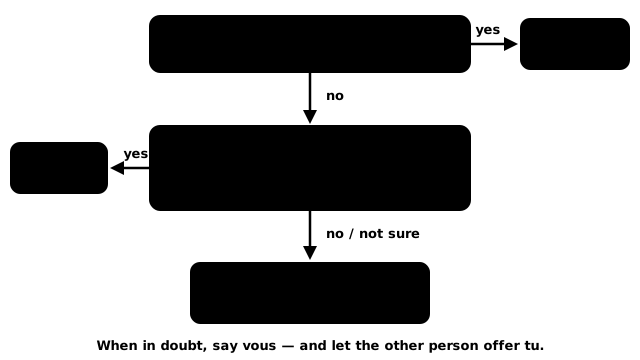
tu vs vous
vous = one stranger (polite) or any group. tu = one friend, relative or child. Not sure? vous.
The same question, two ways
| With tu | With vous |
|---|---|
| Comment tu t’appelles ? | Comment vous appelez-vous ? |
| Ça va ? / Tu vas bien ? | Comment allez-vous ? |
| Tu es d’où ? | Vous êtes d’où ? |
| Et toi ? | Et vous ? |
| s’il te plaît | s’il vous plaît |
Careful
- Wrong: (To a shop assistant) Tu as du lait ?
- Right: Vous avez du lait ?
- Why: Using tu with an adult stranger sounds rude or childish. The verb changes too: tu as → vous avez.
5.6 Introducing yourself
Your name
- Je m’appelle Priya. — My name is Priya. (literally: I call myself Priya) [zhuh ma-PEL pree-YA]
- Moi, c’est Arjun. — I'm Arjun. (relaxed, very common) [MWA, seh ar-JOON]
- Enchanté ! / Enchantée ! — Nice to meet you! (a man writes enchanté, a woman enchantée — same sound) [ã-shã-TAY]
Careful
- Wrong: Je m’appelle est Priya. / Mon nom est Priya.
- Right: Je m’appelle Priya.
- Why: je m’appelle is already a full verb: “I call myself”. Mon nom est… is grammatical but stiff; nobody says it.
Nationality
Nationality adjectives change for gender (blue = said by or about a man, pink = a woman). They take no capital letter after je suis.
| Masculine | Feminine |
|---|---|
| indien [ɛ̃-DYƐ̃] | indienne [ɛ̃-DYEN] |
| français [frã-SEH] | française [frã-SEZ] |
| anglais [ã-GLEH] | anglaise [ã-GLEZ] |
| américain [a-may-ree-KƐ̃] | américaine [a-may-ree-KEN] |
| canadien [ka-na-DYƐ̃] | canadienne [ka-na-DYEN] |
| pakistanais | pakistanaise |
| népalais | népalaise |
| britannique | britannique |
- Je suis indien. — I am Indian. (a man) [zhuh swee ɛ̃-DYƐ̃]
- Je suis indienne. — I am Indian. (a woman) — the nasal disappears, the n is heard [zhuh swee ɛ̃-DYEN]
Careful
- Wrong: (Priya speaking) Je suis indien.
- Right: Je suis indienne.
- Why: The adjective agrees with the speaker. A woman is indienne, française, canadienne.
Careful
- Wrong: Je suis Indien. Je parle Hindi.
- Right: Je suis indien. Je parle hindi.
- Why: French writes nationality adjectives and languages in small letters. Only the noun for a person takes a capital: les Indiens (Indian people).
Where you live, what you do, what you speak
- J’habite à Pune, en Inde. — I live in Pune, in India. — à + city, en + most countries [zha-BEET a … ã-NƐ̃D]
- Je viens de Chennai. — I come from Chennai. [zhuh vyɛ̃ duh …]
- Je suis étudiant. / Je suis étudiante. — I am a student. (man / woman) [ay-tew-DYÃ / ay-tew-DYÃT]
- Je suis ingénieur. Je suis médecin. — I am an engineer. I am a doctor. [ɛ̃-zhay-NYÖR, mayd-SƐ̃]
- Je parle hindi, anglais et un peu français. — I speak Hindi, English and a little French. [zhuh parl een-DEE, ã-GLEH ay ɛ̃ pö frã-SEH]
- J’ai vingt-cinq ans. — I am 25 (literally: I have 25 years). [zhay vɛ̃t-sɛ̃-KÃ]
Careful
- Wrong: Je suis un ingénieur.
- Right: Je suis ingénieur.
- Why: After je suis, professions take no article. (But: C’est un ingénieur — with c’est, the article comes back.)
Careful
- Wrong: J’habite en Mumbai.
- Right: J’habite à Mumbai.
- Why: Cities take à; most countries take en (en Inde, en France). More in Prepositions & places.
5.7 Ça va? — How are you?
Ça va ? (literally “it goes?”) is the everyday “how are you?”, and Ça va. is also the answer: “I’m fine.” Only the melody changes.
| Answer | Meaning |
|---|---|
| Très bien, merci ! | Very well, thanks! |
| Ça va bien. | I'm good. |
| Pas mal. | Not bad. |
| Comme ci, comme ça. | So-so. |
| Bof… | Meh… (casual) |
| Pas terrible. | Not great. |
Always bounce it back
After your answer, return the question: Et toi ? (friend) or Et vous ? (polite). Leaving it out feels abrupt.
Dialogue 1 — two students in Lyon (tu)
- Léa : Salut ! Moi, c’est Léa. Et toi ? — Hi! I'm Léa. And you?
- Rohan : Salut, Léa ! Je m’appelle Rohan. — Hi, Léa! My name is Rohan.
- Léa : Tu es d’où ? — Where are you from? [tew eh DOO]
- Rohan : Je suis indien, je viens de Pune. Et toi ? — I'm Indian, I come from Pune. And you?
- Léa : Moi, je suis française. J’habite ici, à Lyon. — I'm French. I live here, in Lyon.
- Rohan : Enchanté ! — Léa : Enchantée ! — Nice to meet you! — Nice to meet you!
- Léa : Bon, j’ai cours. À plus ! — Right, I have class. See you!
- Rohan : Salut, à demain ! — Bye, see you tomorrow!
Dialogue 2 — at a hotel reception (vous)
- Réceptionniste : Bonsoir, Monsieur. — Good evening, sir.
- M. Mehta : Bonsoir, Madame. J’ai une réservation au nom de Mehta. — Good evening, madam. I have a reservation in the name of Mehta.
- Réceptionniste : Vous pouvez épeler, s’il vous plaît ? — Can you spell it, please?
- M. Mehta : Oui : M, E, H, T, A. — Yes: M-E-H-T-A.
- Réceptionniste : Merci. Voici votre clé. Bonne soirée ! — Thank you. Here is your key. Have a nice evening!
- M. Mehta : Merci beaucoup. Vous aussi ! — Thank you very much. You too!
5.8 Survival phrases
These sentences rescue any conversation. Learn them by heart this week — they are worth more than a hundred nouns.
- Je ne comprends pas. — I don't understand. [zhuhn kõ-prã PA]
- Vous pouvez répéter, s’il vous plaît ? — Can you repeat, please? [voo poo-vay ray-pay-TAY]
- Plus lentement, s’il vous plaît. — More slowly, please. [plew lãt-MÃ]
- Vous parlez anglais ? — Do you speak English? [voo par-lay ã-GLEH]
- Je ne parle pas bien français. Je suis débutant. — I don't speak French well. I'm a beginner. (woman: débutante) [… day-bew-TÃ]
- Comment dit-on « thank you » en français ? — How do you say “thank you” in French? [ko-mã dee-TÕ … ã frã-SEH]
- Qu’est-ce que ça veut dire ? — What does that mean? [kes-kuh sa vö DEER]
- Je ne sais pas. — I don't know. [zhuhn seh PA]
- Où sont les toilettes, s’il vous plaît ? — Where are the toilets, please? [oo sõ lay twa-LET]
- Je voudrais un verre d’eau. — I would like a glass of water. [zhuh voo-DREH ɛ̃ vehr DOH]
- Oui. Non. D’accord. Peut-être. — Yes. No. OK. Maybe. [WEE, NÕ, da-KOR, pö-TETR]
Polite magic
Bonjour + excusez-moi + your question + s’il vous plaît + merci: this frame makes even broken French sound polite.
À retenir
- Always start with Bonjour — in a shop, a bus, an office, before any question. Add Monsieur or Madame for a stranger.
- When someone offers you something, Merci alone (often with a small hand gesture) can mean “no, thank you”. To accept, say Oui, merci or Avec plaisir.
- vous = one stranger (polite) or any group. tu = one friend, relative or child. Not sure? vous.
- After your answer, return the question: Et toi ? (friend) or Et vous ? (polite). Leaving it out feels abrupt.
- Bonjour + excusez-moi + your question + s’il vous plaît + merci: this frame makes even broken French sound polite.
- Introduce yourself aloud in four sentences: name, nationality, city, languages. Then go on to Numbers, dates & time — you will need them for your age, phone number and prices.
5.9 Practice — First words
Exercise 1
It's 9 pm. You walk into a restaurant. You say…
- Bonjour
- Bonsoir
- Bonne nuit
- Bonne journée
Answer
Bonsoir
Evening greeting = bonsoir. Bonne nuit is only for going to bed.
Exercise 2
When do you say 'Bonne nuit'?
- Arriving in the evening
- Going to bed
- Leaving a shop at noon
- Meeting a friend
Answer
Going to bed
Bonne nuit = sleep well. It is never a greeting.
Exercise 3
'Please', to a stranger:
- s'il te plaît
- s'il vous plaît
- de rien
- pardon
Answer
s'il vous plaît
vous = polite; s'il te plaît is for friends.
Exercise 4
Someone says 'Merci !'. You answer…
- Merci
- De rien
- Pardon
- Salut
Answer
De rien
de rien / je vous en prie = you're welcome.
Exercise 5
You bump into someone in the metro. You say…
- Pardon !
- Bonsoir !
- De rien !
- Enchanté !
Answer
Pardon !
Pardon for small bumps; excusez-moi to get attention; désolé for real regret.
Exercise 6
Tu or vous with a shop assistant you don't know?
- tu
- vous
Answer
vous
Strangers, shops, work, elders: vous.
Exercise 7
Hindi 'tum' is closest to French…
- tu
- vous
- il
- on
Answer
tu
tum ≈ tu (informal), aap ≈ vous (polite).
Exercise 8
Je m'___ Priya. (My name is Priya.)
Hint: from s'appeler
Answer
appelle
Je m'appelle = I call myself. Two p, two l.
Exercise 9
(Priya speaking) Je suis ___ . (Indian)
Hint: a woman
Answer
indienne
Feminine: indien → indienne. The nasal disappears: [ɛ̃-DYEN].
Exercise 10
Tap the extra word.
Je suis un ingénieur.
Answer
Wrong word: un.
Corrected: Je suis ingénieur.
No article for a profession after je suis.
Exercise 11
Tap the wrong word.
J'habite en Mumbai.
Answer
Wrong word: en.
Corrected: J'habite à Mumbai.
à + city; en + most countries (en Inde).
Exercise 12
Tap the wrong word.
Merci très beaucoup !
Answer
Wrong word: très.
Corrected: Merci beaucoup !
beaucoup already means 'very much'.
Exercise 13
Match the goodbyes.
| A | B |
|---|---|
| Au revoir | See you tomorrow |
| À bientôt | Have a nice day |
| À demain | Goodbye |
| Bonne journée | See you soon |
Answer
Au revoir — Goodbye; À bientôt — See you soon; À demain — See you tomorrow; Bonne journée — Have a nice day
À + a time = see you then.
Exercise 14
Match the survival phrases.
| A | B |
|---|---|
| Je ne comprends pas | More slowly |
| Vous pouvez répéter ? | I don't know |
| Plus lentement | I don't understand |
| Je ne sais pas | Can you repeat? |
Answer
Je ne comprends pas — I don't understand; Vous pouvez répéter ? — Can you repeat?; Plus lentement — More slowly; Je ne sais pas — I don't know
Learn these by heart — they rescue any conversation.
Exercise 15
'Ça va ?' — the best informal answer:
- Ça va, et toi ?
- Je m'appelle Léa.
- Bonne nuit.
- De rien.
Answer
Ça va, et toi ?
Answer, then bounce the question back: et toi ? / et vous ?
Exercise 16
Who writes 'Enchantée' with -ée?
- a man
- a woman
- a group
- nobody
Answer
a woman
Enchanté (man), enchantée (woman) — same sound.
Exercise 17
Put the words in order: 'What is your name?' (polite)
Words: appelez-vous / vous / Comment
Answer
Comment vous appelez-vous
Comment + vous + appelez-vous: the polite inverted question.
Exercise 18
Put the words in order: 'I don't understand.'
Words: ne / pas / comprends / Je
Answer
Je ne comprends pas
ne + verb + pas: the negation sandwich.
Exercise 19
Say it aloud.
Vous pouvez répéter s'il vous plaît
Answer
Say: Vous pouvez répéter s'il vous plaît
voo poo-VAY ray-pay-TAY seel voo PLEH — the most useful sentence in this chapter.
Exercise 20
Say it aloud (change the name if you like).
Je m'appelle Arjun et je suis indien
Answer
Say: Je m'appelle Arjun et je suis indien
zhuh ma-PEL … ay zhuh swee ɛ̃-DYƐ̃ (a woman: indienne).
Next step
Introduce yourself aloud in four sentences: name, nationality, city, languages. Then go on to Numbers, dates & time — you will need them for your age, phone number and prices.