Chapter 22: Imparfait vs passé composé
l’imparfait
A story has two layers: the scene (it was raining, I was tired, people were waiting) and the events (suddenly the door opened, someone shouted). French gives each layer its own tense. The passé composé tells the events; the imparfait paints the scene. Learn the easiest conjugation in French, then learn to choose.
- 1Forming the imparfait: one stem, one set of endings
- 2The one irregular: être → ét-
- 3Use 1 — description: the scene
- 4Use 2 — habits: “used to” and “would”
- 5Use 3 — the action in progress: “was doing”
- 6Choosing: imparfait or passé composé?
- 7Telling a story with both tenses
- 8Just did, was doing: venir de and être en train de
- 9In real life: childhood memories
In one line
Imparfait = the scene, the habit, what was going on. Passé composé = the event, what happened.
- Il pleuvait et j’étais fatigué. — It was raining and I was tired. (scene) [eel pluh-Vɛ]
- Quand j’étais petit, je jouais au cricket. — When I was little, I used to play cricket. (habit) [zhay-Tɛ puh-TEE]
- Je dormais quand le téléphone a sonné. — I was sleeping when the phone rang. (background + event)
22.1 Forming the imparfait: one stem, one set of endings
Take the nous form of the present tense, remove -ons, and add the endings. This works for every verb in French except one (être, section 2).
| Infinitive | nous (present) | Imparfait stem |
|---|---|---|
| parler | nous parlons | parl- |
| finir | nous finissons | finiss- |
| faire | nous faisons | fais- [fuh-Z…] |
| avoir | nous avons | av- |
| prendre | nous prenons | pren- |
| boire | nous buvons | buv- |
| aller | nous allons | all- |
| Subject | Ending | parler | avoir |
|---|---|---|---|
| je | -ais | je parlais | j’avais |
| tu | -ais | tu parlais | tu avais |
| il / elle / on | -ait | il parlait | elle avait |
| nous | -ions | nous parlions | nous avions |
| vous | -iez | vous parliez | vous aviez |
| ils / elles | -aient | ils parlaient | elles avaient |
Five endings, one sound
-ais, -ais, -ait, -aient all sound exactly the same: [ɛ], like “e” in “bed”. je parlais, il parlait, ils parlaient = [par-Lɛ]. Only nous and vous sound different.
- Nous habitions à Kolkata. — We lived (used to live) in Kolkata. [noo‿za-bee-TYÕ]
- Ils faisaient du bruit. — They were making noise. [eel fuh-Zɛ]
- Tu prenais le métro tous les jours ? — Did you take the metro every day?
Small spelling adjustments
Verbs in -ger keep an e before a (je mangeais, but nous mangions); verbs in -cer take ç before a (je commençais, but nous commencions). Verbs in -ier get a double i: nous étudiions, vous étudiiez. These keep the sound regular.
22.2 The one irregular: être → ét-
Nous sommes has no -ons to remove, so être has its own stem: ét-. The endings are the same.
| Subject | être | Example |
|---|---|---|
| je / j’ | j’étais | J’étais content. |
| tu | tu étais | Tu étais où ? |
| il / elle / on | il était | C’était génial ! |
| nous | nous étions | Nous étions en retard. |
| vous | vous étiez | Vous étiez à la réunion ? |
| ils / elles | ils étaient | Elles étaient sœurs. |
- C’était comment, le concert ? — C’était génial ! — How was the concert? — It was brilliant! [say-Tɛ zhay-nyal]
Impersonal verbs you will use constantly
| Present | Imparfait | Meaning |
|---|---|---|
| il y a | il y avait | there was / there were |
| il fait beau | il faisait beau | the weather was nice |
| il pleut | il pleuvait | it was raining |
| il faut | il fallait | it was necessary, we had to |
| c’est | c’était | it was |
- Il y avait beaucoup de monde au marché. — There were lots of people at the market. [eel-ya-VɛT]
22.3 Use 1 — description: the scene
Use the imparfait to describe how things were: weather, time, age, appearance, feelings, states of mind. These have no clear beginning or end in the story.
- Il était huit heures du soir. Il faisait froid. — It was eight in the evening. It was cold.
- J’avais dix-huit ans et je ne connaissais personne à Paris. — I was eighteen and I didn’t know anyone in Paris.
- La maison était grande et le jardin sentait les roses. — The house was big and the garden smelled of roses.
- Elle avait les cheveux longs et elle portait un sari bleu. — She had long hair and she was wearing a blue sari.
- J’avais faim, mais je voulais finir mon travail. — I was hungry, but I wanted to finish my work.
Careful
- Wrong: Quand j’ai été petit, j’ai habité à Goa.
- Right: Quand j’étais petit, j’habitais à Goa.
- Why: Childhood is a background period, not an event. Quand j’étais petit(e) is always imparfait.
22.4 Use 2 — habits: “used to” and “would”
English says “I used to walk to school” or “every summer we would go to the village”. French simply uses the imparfait. Hindi does something similar: “main school paidal jaata tha”.
- Tous les étés, on allait chez ma grand-mère. — Every summer we would go to my grandmother’s.
- D’habitude, je me levais à cinq heures. — I usually got up at five.
- Le dimanche, mon père préparait des dosas pour tout le monde. — On Sundays my father used to make dosas for everyone.
- À l’époque, on n’avait pas de portable. — Back then, we didn’t have mobile phones.
Signal words for the imparfait
d’habitude, souvent, toujours, tous les jours, chaque été, le lundi, autrefois, à l’époque, quand j’étais petit(e), pendant que — repetition or background.
22.5 Use 3 — the action in progress: “was doing”
The imparfait describes an action that was going on at a moment in the past — often when something else (an event, in passé composé) interrupts it.
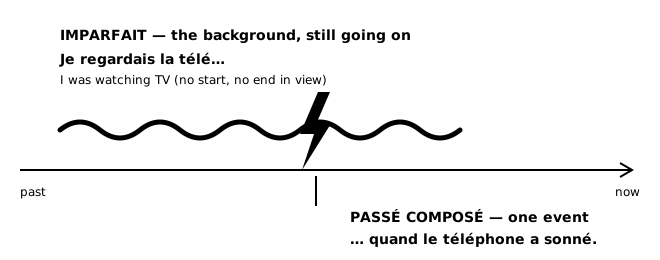
- Je prenais ma douche quand tu as appelé. — I was having a shower when you called.
- Pendant que les enfants dormaient, nous préparions la fête. — While the children were sleeping, we were getting the party ready. (two backgrounds)
- Il traversait la rue quand il est tombé. — He was crossing the road when he fell.
Careful
- Wrong: Je lisais quand soudain le téléphone sonnait.
- Right: Je lisais quand soudain le téléphone a sonné.
- Why: Soudain announces a single event that breaks in: passé composé.
22.6 Choosing: imparfait or passé composé?
Ask yourself one question about each verb: is this an event that moves the story forward, or a description of the situation?
The closed period
A duration with a clear limit takes the passé composé, even if it was long: J’ai habité à Delhi pendant cinq ans. Without the limit, it is background: J’habitais à Delhi.
Same verb, different meaning
Some verbs change meaning slightly between the two tenses — the imparfait gives a state, the passé composé a moment of change.
| Imparfait (state) | Passé composé (moment) |
|---|---|
| J’avais peur. I was afraid. |
J’ai eu peur. I got a fright. |
| Je savais la vérité. I knew the truth. |
J’ai su la vérité. I found out the truth. |
| Je connaissais Paul. I knew Paul. |
J’ai connu Paul en 2015. I met Paul in 2015. |
| Il devait venir. He was supposed to come. |
Il a dû partir. He had to leave (and did). |
| Je pouvais le faire. I was able to (in general). |
J’ai pu le faire. I managed to do it. |
Typical choices that go wrong
- Wrong: L’année dernière, j’allais en France trois fois.
- Right: L’année dernière, je suis allé en France trois fois.
-
Why: A counted number of times = a series of events → passé composé. (Souvent, without counting, would give imparfait.)
-
Wrong: Hier il a fait beau, alors on se promenait au parc.
- Right: Hier il faisait beau, alors on s’est promené au parc.
-
Why: The weather is the scene (imparfait); the walk is what you did (passé composé).
-
Wrong: Le film a été long, mais je l’aimais beaucoup.
- Right: Le film était long, mais il m’a beaucoup plu.
- Why: Describing the film = imparfait. Your overall reaction to a finished film = passé composé.
22.7 Telling a story with both tenses
Read this short story. Verbs in the imparfait (in italics) build the scene; verbs in the passé composé (in bold) are the events. Read the passé composé verbs alone — you get the plot. Read the imparfait verbs alone — you get the picture.
- C’était un samedi de juillet. Il faisait très chaud et la plage était pleine. — It was a Saturday in July. It was very hot and the beach was full. (scene)
- Les enfants jouaient dans l’eau et je lisais sous un parasol. — The children were playing in the water and I was reading under a parasol. (scene)
- Tout à coup, un chien est arrivé en courant. Il a pris mon sandwich et il est reparti. — Suddenly a dog came running. It took my sandwich and ran off again. (events)
- Tout le monde a ri. Moi, j’avais encore faim, mais l’histoire était trop drôle. — Everyone laughed. As for me, I was still hungry, but the story was too funny.
The film test
Imagine filming your story. The set and the background action (sun, crowd, children playing) are imparfait. Each new shot where something happens is passé composé.
22.8 Just did, was doing: venir de and être en train de
venir de + infinitive: the recent past
Venir de + infinitive means “to have just done”. In the present it is very common in conversation; in the imparfait it means “had just done”.
- Je viens de manger, merci. — I’ve just eaten, thanks. [zhuh vyɛ̃ duh mã-ZHAY]
- Le train vient de partir ! — The train has just left!
- Je venais de rentrer quand il a appelé. — I had just got home when he called.
Careful
- Wrong: J’ai juste mangé. (meaning “I’ve just eaten”)
- Right: Je viens de manger.
- Why: J’ai juste mangé sounds like “I only ate”. For “just now”, French uses venir de.
être en train de + infinitive: in the middle of
To insist that an action is in progress, use être en train de — in the present or the imparfait.
- Je ne peux pas parler, je suis en train de conduire. — I can’t talk, I’m driving. [ã trɛ̃ duh]
- On était en train de dîner quand la lumière s’est éteinte. — We were in the middle of dinner when the lights went out.
Two polite bonuses
- Si on allait au cinéma ce soir ? — How about going to the cinema tonight? (si + imparfait = a suggestion)
- Bonjour, je voulais savoir si vous aviez des chambres libres. — Hello, I wanted to know if you had any rooms free. (softer than “je veux”)
22.9 In real life: childhood memories
- — Tu habitais où quand tu étais petite ? — — Where did you live when you were little?
- — À Jaipur. On avait une grande maison avec une terrasse. Le soir, on y dormait quand il faisait trop chaud. — — In Jaipur. We had a big house with a terrace. In the evening we slept there when it was too hot.
- — Et pourquoi tu es partie ? — — And why did you leave?
- — Mon père a trouvé un travail à Bangalore. J’avais douze ans. Au début, j’étais triste, mais je me suis vite fait des amis. — — My father found a job in Bangalore. I was twelve. At first I was sad, but I quickly made friends.
Events: a trouvé, es partie, me suis fait. Scene and habits: habitais, avait, dormait, faisait, avais, étais.
À retenir
- Imparfait = the scene, the habit, what was going on. Passé composé = the event, what happened.
- -ais, -ais, -ait, -aient all sound exactly the same: [ɛ], like “e” in “bed”. je parlais, il parlait, ils parlaient = [par-Lɛ]. Only nous and vous sound different.
- d’habitude, souvent, toujours, tous les jours, chaque été, le lundi, autrefois, à l’époque, quand j’étais petit(e), pendant que — repetition or background.
- A duration with a clear limit takes the passé composé, even if it was long: J’ai habité à Delhi pendant cinq ans. Without the limit, it is background: J’habitais à Delhi.
- Imagine filming your story. The set and the background action (sun, crowd, children playing) are imparfait. Each new shot where something happens is passé composé.
- Tell a five-sentence story about something that happened to you: two imparfait sentences for the scene, three passé composé sentences for the events. Then turn to The future.
22.10 Practice — Imparfait vs passé composé
Exercise 1
Imparfait of nous finissons → je ___
- finis
- finissais
- finirais
- finissai
Answer
finissais
Stem finiss- (from nous finissons) + -ais.
Exercise 2
Imparfait of être, ils:
- ils étaient
- ils êtaient
- ils sontaient
- ils étiont
Answer
ils étaient
être has the irregular stem ét- + -aient.
Exercise 3
Quand j'___ petit, j'habitais à Goa.
- ai été
- étais
- suis
- serai
Answer
étais
Childhood is background: quand j'étais petit.
Exercise 4
Je regardais la télé quand mon frère ___.
- arrivait
- est arrivé
- arrive
- arrivera
Answer
est arrivé
The event that interrupts the background → passé composé.
Exercise 5
L'année dernière, je ___ à Paris trois fois.
- allais
- suis allé
- vais
- allait
Answer
suis allé
A counted number of times → passé composé.
Exercise 6
J'ai connu ma femme en 2010 means:
- I knew my wife in 2010.
- I met my wife in 2010.
- I used to know my wife.
- I know my wife since 2010.
Answer
I met my wife in 2010.
connaître in the passé composé = to meet for the first time.
Exercise 7
Il ___ (faire) très beau ce jour-là.
Hint: weather = scene
Answer
faisait
Description of the weather → imparfait: il faisait.
Exercise 8
Tous les dimanches, nous ___ (manger) chez mes grands-parents.
Hint: nous, habit
Answer
mangions
Habit → imparfait; -ger verb: nous mangions (no e before i).
Exercise 9
Le train ___ de partir ! (has just left)
Answer
vient
venir de + infinitive = to have just done.
Exercise 10
Il y ___ beaucoup de monde. (there were)
Answer
avait
il y a → il y avait in the imparfait.
Exercise 11
Tap the wrong word.
Je lisais quand soudain le téléphone sonnait.
Answer
Wrong word: sonnait.
Corrected: Je lisais quand soudain le téléphone a sonné.
soudain introduces a single event → passé composé.
Exercise 12
Tap the wrong word.
Quand j'ai été jeune, je jouais au foot.
Answer
Wrong word: été.
Corrected: Quand j'étais jeune, je jouais au foot.
quand j'étais jeune: background → imparfait.
Exercise 13
Put the words in order: I was sleeping when you called.
Words: appelé / Je / quand / dormais / as / tu
Answer
Je dormais quand tu as appelé
Background (imparfait) + interrupting event (passé composé).
Exercise 14
Match each sentence to its use.
| A | B |
|---|---|
| Il pleuvait. | event |
| Je jouais au tennis le samedi. | had just done |
| Soudain, il est parti. | description |
| Je venais de rentrer. | habit |
Answer
Il pleuvait. — description; Je jouais au tennis le samedi. — habit; Soudain, il est parti. — event; Je venais de rentrer. — had just done
Imparfait for scene and habit; passé composé for the event; venir de for the recent past.
Exercise 15
Say it aloud.
Quand j'étais petit je jouais au cricket
Answer
Say: Quand j'étais petit je jouais au cricket
étais and jouais end in the same sound: ɛ.
Exercise 16
Say it aloud.
C'était génial
Answer
Say: C'était génial
The phrase for any good memory: say-Tɛ zhay-NYAL.
Exercise 17
Say it aloud.
Je viens de manger merci
Answer
Say: Je viens de manger merci
venir de = have just done.
Next step
Tell a five-sentence story about something that happened to you: two imparfait sentences for the scene, three passé composé sentences for the events. Then turn to The future.