Chapter 38: Real spoken French
Le français parlé
You studied Je ne sais pas. Then you arrive in France and hear "chais pas". This is not slang and it is not bad French — it is how almost everyone speaks, every day. The grammar in your book is the written code; this chapter is the spoken one. First learn to understand it, then use the parts that feel natural to you.
- 1The disappearing ne
- 2On instead of nous
- 3Squeezed words — elisions and reductions
- 4Questions, the spoken way
- 5Fillers and little words
- 6Social codes: tu, ouais and friends
- 7Side by side: written vs spoken
- 8Training your ear
Two Frenches, one language
Written French keeps every little word. Everyday spoken French drops, squeezes and reorders them. Both are correct in their place — you need both.
38.1 The disappearing ne
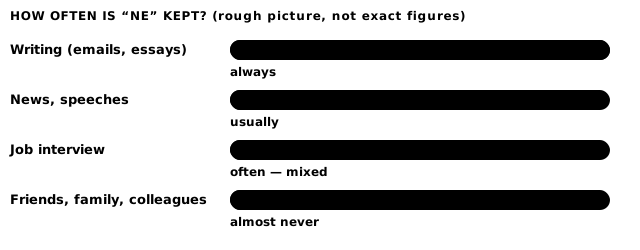
In conversation, the ne of the negative is dropped almost all the time. The pas (or rien, jamais, personne, plus) carries the negative alone. The full ne… pas is still used in writing, speeches, news and careful speech.
- Je sais pas. — I don’t know. (written: Je ne sais pas.)
- C’est pas grave. — It doesn’t matter. / No worries.
- J’ai rien compris. — I didn’t understand a thing.
- Il y a personne. — There’s nobody here.
- Je fume plus. — I don’t smoke any more. (here plus is said "plu", no s)
- T’inquiète ! — Don’t worry! — even pas has gone: Ne t’inquiète pas → T’inquiète.
Careful
- Wrong: Je ne sais. (pas dropped)
- Right: Je sais pas. / Je ne sais pas.
- Why: Spoken French drops ne, never pas. Pas is the word that really means "not".
38.2 On instead of nous
In speech, on has almost replaced nous for "we". It takes the il/elle form of the verb — which is easier anyway. To insist, people say nous, on…
| Written | Spoken |
|---|---|
| Nous allons au cinéma. | On va au ciné. |
| Nous avons mangé. | On a mangé. |
| Nous partons ? | On y va ? |
| Nous, nous restons. | Nous, on reste. |
| Nous nous voyons demain. | On se voit demain. |
Careful
- Wrong: On allons au parc.
- Right: On va au parc.
- Why: On means "we" but conjugates like il: on va, on fait, on est. (Adjectives may still agree: On est fatigués.)
on = we, people, someone
On also means "people in general" (En France, on mange tard.) or "someone" (On m’a volé mon vélo.). Context tells you which.
38.3 Squeezed words — elisions and reductions
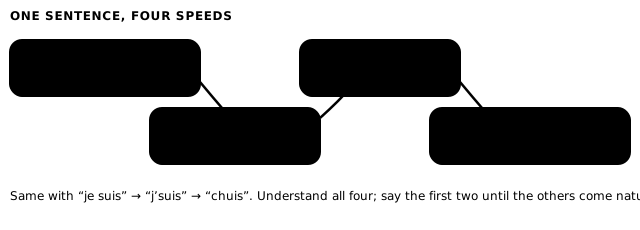
In fast speech, the short unstressed vowels vanish: the e of je, ne, le, de, que, the u of tu, the l of il. Consonants then crash into each other and change. You don’t write these forms (except in texts and comics), but you hear them all day.
| Full form | You hear |
|---|---|
| tu es / tu as | t’es / t’as |
| il y a | y a |
| il faut | faut |
| je suis | j’suis / chuis |
| il dit / elle dit | i’ dit / è dit |
| peut-être | p’têt |
| parce que | pa’ce que |
| qu’est-ce que | qu’est-c’que [kes-kuh] |
| quelque chose | quèque chose |
| puis | pis |
The 🔊 voice is a careful reading voice, so it often says the fuller form. Real speakers squeeze more — use the buttons for the words, and real French videos for the speed.
t’es ≠ tes, t’as ≠ ta
T’es (you are) sounds like tes (your, plural), and t’as (you have) like ta (your). Meaning comes from what follows: T’as vu tes clés ? = Have you seen your keys?
38.4 Questions, the spoken way
In writing you meet three question forms (see Asking questions). In speech, one dominates: the plain statement with a rising voice. Question words like où, quoi, quand, combien often go to the end. Inversion (Où vas-tu ?) survives mostly in fixed phrases and formal talk.
| Formal / written | Everyday spoken |
|---|---|
| Où vas-tu ? | Tu vas où ? |
| Qu’est-ce que c’est ? | C’est quoi ? |
| Que fais-tu ce soir ? | Tu fais quoi ce soir ? |
| Quand arrive-t-il ? | Il arrive quand ? |
| Combien cela coûte-t-il ? | Ça coûte combien ? |
| Qui est-ce ? | C’est qui ? |
| Pourquoi pars-tu ? | Pourquoi tu pars ? |
Quoi ? and Hein ? are blunt
Friends say Quoi ? or Hein ? when they didn’t hear. With strangers or at work, use Pardon ? or Comment ? — otherwise you sound rude.
38.5 Fillers and little words
Fillers give the speaker time and colour the sentence. They are the first thing that makes a learner sound natural — and the first thing that makes them sound silly if overused. Learn to recognise all of these; pick two or three to use.
| Filler | What it does | Example |
|---|---|---|
| euh… | thinking (English "um") | C’était, euh… mardi. |
| ben / bah | "well", obvious answer | Ben oui ! |
| bon | "right", moving on | Bon, on y va ? |
| du coup | "so / as a result" | Il pleuvait, du coup on est restés. |
| en fait | "actually", correcting | En fait, c’est pas loin. |
| genre | "like" (young speakers) | Il était genre super énervé. |
| … quoi | end tag: "you know" | C’était nul, quoi. |
| voilà | "that’s it", closing a point | Et voilà, c’est fini. |
| bref | "anyway", cutting short | Bref, on a raté le train. |
| tu vois / tu sais | checking you follow | Le petit café, tu vois ? |
| enfin | "I mean", self-correcting | Lundi, enfin, mardi. |
Careful
- Wrong: Du coup, j’ai, genre, du coup, réservé, quoi, du coup.
- Right: Du coup, j’ai réservé.
- Why: Du coup is so overused that even the French make fun of it. One filler per sentence, at most.
Hinglish has the same thing
Du coup works a lot like "toh" or "so basically", and quoi at the end like "na" or "yaar". You already know how fillers feel — you just need the French ones.
38.6 Social codes: tu, ouais and friends
Among young people, and increasingly in start-ups and creative jobs, tu is the default from the first second. With older people or in traditional settings, wait for them to offer it (see Hello, please, thank you). Everyday yes/no and greetings also have relaxed versions. (For true slang and verlan, see Registers & slang.)
| Careful | Relaxed | Meaning |
|---|---|---|
| Oui / Non | Ouais / Nan | yeah / nah |
| Bonjour | Salut / Coucou | hi / hiya (coucou: friends, family) |
| Au revoir | Salut / À plus / À toute | bye / see you / see you later |
| D’accord | OK / Ça marche | OK / sounds good |
| Il n’y a pas de problème. | Pas de souci ! | no problem |
| Vous voulez qu’on se tutoie ? | On se tutoie ? | shall we use tu? |
Ouais ouais… = I don’t believe you
A single ouais is a relaxed yes. A slow, falling ouais, ouais… or mouais means doubt — like a sarcastic "yeah, right".
38.7 Side by side: written vs spoken
Here is the same content in both codes. Read the left column, then listen to the right one — this is what you will actually hear.
| Written / careful | Everyday spoken |
|---|---|
| Je ne sais pas où il est. | Chais pas où il est. |
| Est-ce que tu as vu ce film ? | T’as vu ce film ? |
| Il n’y a plus de pain. | Y a plus de pain. |
| Nous ne sommes pas prêts. | On est pas prêts. |
| Il faut que nous partions. | Faut qu’on y aille. |
| Cela ne fait rien. | Ça fait rien. |
| Ce n’est pas la peine. | Pas la peine. |
| Tu es très fatigué ? | T’es crevé ? |
| Je ne comprends rien. | J’comprends rien. |
Mini-dialogue — two friends, real speed
The gloss gives the careful French, then the English.
- Inès : Salut ! T’es où, là ? — = Où es-tu en ce moment ? — Hi! Where are you right now?
- Karim : Bah chuis encore au boulot. Y a eu un problème, du coup j’suis en retard. — = Eh bien, je suis encore au travail. Il y a eu un problème, donc je suis en retard. — Well, I’m still at work. There was a problem, so I’m late.
- Inès : C’est pas grave. On se retrouve au ciné à huit heures ? — = Ce n’est pas grave. Nous nous retrouvons au cinéma… — No problem. Shall we meet at the cinema at eight?
- Karim : Ouais, ça marche. T’as pris les places ? — = Oui, d’accord. As-tu pris les billets ? — Yeah, sounds good. Did you get the tickets?
- Inès : Ben non, j’attendais de savoir si tu venais, quoi. — = Eh bien non, j’attendais de savoir si tu venais. — Well no, I was waiting to know if you were coming, you know.
- Karim : OK, j’m’en occupe. Allez, à toute ! — = Je m’en occupe. À tout à l’heure ! — OK, I’ll take care of it. Right, see you later!
38.8 Training your ear
Spoken French is fast because the rhythm groups (see Pronunciation clinic) glue words together. You don’t hear words — you hear blocks. Train yourself to catch the blocks.
- Chunks, not words: Qu’est-ce que t’en penses ? — You hear one block: "kes-kuh-tã-PÃS". Learn it as one unit — What do you think of it?
- Catch the stressed end: Je crois qu’il est parti à la gare. — Listen for the long syllables: …par-TI… la GARE. — I think he’s left for the station.
- Shadow it: Ah ouais, c’est clair, j’suis d’accord. — Play, then speak at the same time as the voice. Yeah, totally, I agree.
Understand everything, imitate selectively
Dropping ne, using on and asking Tu fais quoi ? are safe for you to use at once. Leave heavy reductions (chuis, chais pas) and fillers like genre until they come out by themselves.
A daily listening routine
Ten minutes a day: a French street-interview video or a podcast for learners. Watch French series with French subtitles, not English ones. Note one spoken form a day (y a, t’as, faut…) and listen for it until you catch it every time.
À retenir
- Written French keeps every little word. Everyday spoken French drops, squeezes and reorders them. Both are correct in their place — you need both.
- On also means "people in general" (En France, on mange tard.) or "someone" (On m’a volé mon vélo.). Context tells you which.
- Du coup works a lot like "toh" or "so basically", and quoi at the end like "na" or "yaar". You already know how fillers feel — you just need the French ones.
- Dropping ne, using on and asking Tu fais quoi ? are safe for you to use at once. Leave heavy reductions (chuis, chais pas) and fillers like genre until they come out by themselves.
- Ten minutes a day: a French street-interview video or a podcast for learners. Watch French series with French subtitles, not English ones. Note one spoken form a day (y a, t’as, faut…) and listen for it until you catch it…
- Now switch codes. At work, French gets more careful again: Work, phone & interviews gives you phone calls, meetings and job interviews — with vous and the full ne.
38.9 Practice — Real spoken French
Exercise 1
In everyday speech, 'Je ne sais pas' usually becomes…
- Je ne sais.
- Je sais pas.
- Ne sais pas.
- Je pas sais.
Answer
Je sais pas.
Spoken French drops ne, never pas.
Exercise 2
'On va au ciné ?' — what does 'on' mean here?
- one (formal)
- we
- they
- you (plural)
Answer
we
In speech, on almost always replaces nous for 'we'.
Exercise 3
'T'as vu ?' is a reduction of…
- Ta vue ?
- Tu as vu ?
- Tu es vu ?
- T'avais vu ?
Answer
Tu as vu ?
tu as → t'as.
Exercise 4
You didn't hear your boss. Best word?
- Quoi ?
- Hein ?
- Pardon ?
- Bah ?
Answer
Pardon ?
Quoi ? and Hein ? are fine with friends but blunt with strangers or at work.
Exercise 5
On ___ (aller) au parc cet après-midi.
Hint: on conjugates like il.
Answer
va
on va — the il/elle form.
Exercise 6
Spoken: 'Y ___ du monde.' (= Il y a du monde.)
Answer
a
il y a → y a.
Exercise 7
Tap the wrong word.
On allons au restaurant ce soir.
Answer
Wrong word: allons.
Corrected: On va au restaurant ce soir.
on takes the il form: on va.
Exercise 8
You are speaking to a shop assistant you don't know. Tap the word that sounds rude.
Quoi ? Vous pouvez répéter, s'il vous plaît ?
Answer
Wrong word: Quoi.
Corrected: Pardon ? Vous pouvez répéter, s'il vous plaît ?
Quoi ? is fine with friends, but blunt with strangers. Use Pardon ? or Comment ?
Exercise 9
Match the filler to its job.
| A | B |
|---|---|
| du coup | anyway, to cut it short |
| en fait | you know |
| bref | so, as a result |
| quoi (at the end) | actually |
Answer
du coup — so, as a result; en fait — actually; bref — anyway, to cut it short; quoi (at the end) — you know
Recognise them all; use two or three yourself.
Exercise 10
Match the spoken question to the formal one.
| A | B |
|---|---|
| Tu vas où ? | Quand arrive-t-il ? |
| C'est quoi ? | Qui est-ce ? |
| Il arrive quand ? | Où vas-tu ? |
| C'est qui ? | Qu'est-ce que c'est ? |
Answer
Tu vas où ? — Où vas-tu ?; C'est quoi ? — Qu'est-ce que c'est ?; Il arrive quand ? — Quand arrive-t-il ?; C'est qui ? — Qui est-ce ?
In speech, question words often move to the end.
Exercise 11
Put the words in order (spoken style).
Words: quoi / fais / Tu / ce / soir
Answer
Tu fais quoi ce soir
Spoken style: statement order + question word at the end.
Exercise 12
Put the words in order.
Words: du / Il / coup / restés / pleuvait / est / on
Answer
Il pleuvait du coup on est restés
du coup = so, as a result.
Exercise 13
Say 'I don't know' the everyday way.
Je sais pas
Answer
Say: Je sais pas
No ne in normal speech.
Exercise 14
Ask where your friend is.
T'es où
Answer
Say: T'es où
tu es → t'es; question word at the end.
Exercise 15
Say 'It doesn't matter' (spoken).
C'est pas grave
Answer
Say: C'est pas grave
Ce n'est pas grave → C'est pas grave.
Exercise 16
Suggest leaving.
On y va
Answer
Say: On y va
on = we. On y va ? = Shall we go?
Exercise 17
Say 'There's no more bread' (spoken).
Y a plus de pain
Answer
Say: Y a plus de pain
Il n'y a plus → Y a plus.
Exercise 18
Say 'No problem!' the relaxed way.
Pas de souci
Answer
Say: Pas de souci
Pas de souci ! is everywhere in everyday French.
Next step
Now switch codes. At work, French gets more careful again: Work, phone & interviews gives you phone calls, meetings and job interviews — with vous and the full ne.