Chapter 23: The future
le futur proche et le futur simple
French has two everyday futures. The futur proche — je vais partir, “I’m going to leave” — is easy and is the one you hear most in conversation. The futur simple — je partirai, “I will leave” — is one word, used for predictions, promises and plans further away. You need both, and one rule that surprises every English speaker: quand je serai à Paris…
- 1The futur proche: aller + infinitive
- 2The futur simple: one word, built on the infinitive
- 3The irregular stems
- 4Which future? Near and sure, or further and predicted
- 5Quand + future: where French differs from English
- 6Negatives, questions and pronouns in the futur simple
- 7In real life: plans and the weather forecast
In one line
Futur proche = aller + infinitive (je vais manger). Futur simple = infinitive + -ai, -as, -a, -ons, -ez, -ont (je mangerai).
- Ce soir, je vais regarder un film. — Tonight I’m going to watch a film. [zhuh vay ruh-gar-DAY]
- Un jour, je parlerai français couramment. — One day I will speak French fluently. [zhuh par-luh-RAY]
- Quand tu seras à Lyon, appelle-moi. — When you are in Lyon, call me. (French: “when you will be”) [kã tew suh-RA]
23.1 The futur proche: aller + infinitive
If you know aller in the present, you already know this future. It works exactly like English “going to”, and Hindi speakers will recognise “main khaana khaane wala hoon”.
| Subject | aller | + infinitive |
|---|---|---|
| je | vais | je vais partir |
| tu | vas | tu vas partir |
| il / elle / on | va | elle va partir |
| nous | allons | nous allons partir |
| vous | allez | vous allez partir |
| ils / elles | vont | ils vont partir |
- On va manger au restaurant samedi. — We’re going to eat out on Saturday.
- Attention, tu vas tomber ! — Careful, you’re going to fall! (about to happen)
- Ils vont avoir un bébé en mars. — They’re going to have a baby in March.
- Il va pleuvoir, prends un parapluie. — It’s going to rain, take an umbrella.
Negatives, pronouns, reflexives
Ne … pas goes around aller; object and reflexive pronouns go before the infinitive.
- Je ne vais pas venir ce soir. — I’m not going to come tonight.
- Ne t’inquiète pas, je vais le faire. — Don’t worry, I’m going to do it.
- Nous allons nous marier en décembre. — We are going to get married in December.
Careful
- Wrong: Je vais à manger.
- Right: Je vais manger.
- Why: No preposition between aller and the infinitive. Je vais à… is for places: je vais à Delhi.
23.2 The futur simple: one word, built on the infinitive
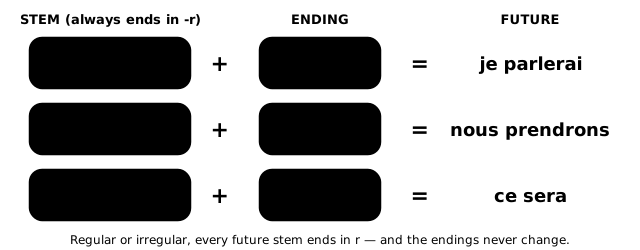
For most verbs, take the whole infinitive and add the endings. Verbs in -re drop their final -e first. The endings are easy to remember: they are the present of avoir (ai, as, a, (av)ons, (av)ez, ont).
| Subject | parler | finir | prendre |
|---|---|---|---|
| je | parlerai | finirai | prendrai |
| tu | parleras | finiras | prendras |
| il / elle / on | parlera | finira | prendra |
| nous | parlerons | finirons | prendrons |
| vous | parlerez | finirez | prendrez |
| ils / elles | parleront | finiront | prendront |
- Je te téléphonerai demain. — I’ll phone you tomorrow. [tay-lay-fon-RAY]
- Les magasins fermeront à 20 heures. — The shops will close at 8 pm.
- Vous choisirez votre place à l’enregistrement. — You will choose your seat at check-in.
- Nous attendrons les résultats. — We’ll wait for the results.
Spelling changes from the present stay
Verbs that change their stem in je of the present keep it in the future: acheter → j’achèterai, appeler → j’appellerai, se lever → je me lèverai, payer → je paierai (or payerai).
Future or conditional?
je parlerai (I will speak) and je parlerais (I would speak) sound almost the same. In writing, the -s matters. See Conditional & si clauses.
23.3 The irregular stems
About twenty common verbs have an irregular stem — but the endings stay exactly the same, and every stem still ends in -r. Learn them in groups.
| Verb | Stem | Example |
|---|---|---|
| être | ser- | Je serai là à midi. |
| avoir | aur- | Tu auras le temps ? |
| aller | ir- | On ira à la plage. |
| faire | fer- | Il fera beau demain. |
| pouvoir | pourr- | Vous pourrez venir ? |
| vouloir | voudr- | Ils voudront manger. |
| venir (tenir) | viendr- (tiendr-) | Elle viendra avec nous. |
| voir | verr- | On verra ! |
| devoir | devr- | Tu devras te lever tôt. |
| savoir | saur- | Nous saurons demain. |
| envoyer | enverr- | Je t’enverrai les photos. |
| falloir | faudr- | Il faudra réserver. |
| pleuvoir | pleuvr- | Il pleuvra ce week-end. |
| courir · mourir | courr- · mourr- | Je courrai le marathon. |
| recevoir | recevr- | Vous recevrez un e-mail. |
Compounds follow their base verb: devenir → deviendr-, revenir → reviendr-, prévoir → prévoir- (an exception!), refaire → refer-.
- Ne t’inquiète pas, ça ira. — Don’t worry, it’ll be fine. [sa ee-RA]
- On verra bien. — We’ll see. [õ vɛ-RA BYɛ̃]
- Ce sera tout ? — Will that be all? — what the baker says [suh suh-RA TOO]
- Qu’est-ce que tu feras après tes études ? — What will you do after your studies?
Careful
- Wrong: Je allerai en France.
- Right: J’irai en France.
- Why: Aller has the shortest stem of all: ir-. And remember: no y before it (j’irai, not *j’y irai).
Careful
- Wrong: Il fairera chaud.
- Right: Il fera chaud.
- Why: Faire → fer-. The weather forecast is full of it: il fera beau, il fera froid.
23.4 Which future? Near and sure, or further and predicted
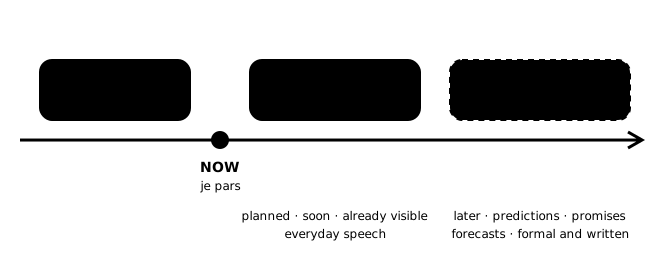
Often both are correct, as in English (“I’m going to call” / “I’ll call”). But each has its favourite territory.
| Futur proche | Futur simple |
|---|---|
| a plan already decided Je vais acheter une voiture. |
an intention, less fixed J’achèterai une voiture un jour. |
| something you can already see coming Regarde ces nuages, il va pleuvoir. |
a forecast or prediction Demain, il pleuvra sur la Bretagne. |
| conversation, messages | promises: Je te le promets, je viendrai. |
| “about to”: Le film va commencer. | formal texts, instructions, after quand and si |
- Dépêche-toi, le film va commencer ! — Hurry up, the film is about to start!
- Je te le promets, je ne le ferai plus. — I promise, I won’t do it again.
- En 2050, la Terre comptera près de dix milliards d’habitants. — In 2050, the Earth will have nearly ten billion people.
Choosing
Speaking about tonight or this weekend? Futur proche. Promising, predicting, or speaking about “one day”? Futur simple. In doubt, both are usually understood.
23.5 Quand + future: where French differs from English
In English, after when, you use the present: “When I am in Paris, I’ll call you.” French is more logical: if the action is in the future, the verb after quand is in the future too. The same goes for lorsque (when), dès que / aussitôt que (as soon as) and tant que (as long as).
- Quand je serai à Paris, je t’appellerai. — When I am in Paris, I’ll call you.
- Dès qu’il arrivera, on mangera. — As soon as he arrives, we’ll eat.
- Tant que tu vivras ici, tu respecteras les règles. — As long as you live here, you’ll respect the rules.
- Quand tu auras le temps, regarde ce film. — When you have time, watch this film.
Careful
- Wrong: Quand je suis grand, je serai pilote.
- Right: Quand je serai grand, je serai pilote.
- Why: Being grown-up is in the future, so French uses the future after quand. Copying the English present is the classic error.
But si stays in the present
Si (if) is different: it is never followed by the future. Use si + present, then the future.
- S’il pleut, on restera à la maison. — If it rains, we’ll stay at home.
- Si tu veux, je viendrai te chercher. — If you like, I’ll come and pick you up.
Careful
- Wrong: S’il pleuvra demain, on restera ici.
- Right: S’il pleut demain, on restera ici.
- Why: Never future (or conditional) right after si meaning “if”. More si patterns in Conditional & si clauses.
quand vs si
quand + future (it will happen): quand je serai riche. si + present (maybe it happens): si je suis riche.
23.6 Negatives, questions and pronouns in the futur simple
The futur simple is one word, so it behaves like the present: ne and pronouns go before it, pas after it.
- Je ne serai pas là demain. — I won’t be here tomorrow.
- Tu le feras ? — Oui, je le ferai ce soir. — Will you do it? — Yes, I’ll do it tonight.
- Viendrez-vous à la réunion ? — Will you come to the meeting? (formal)
- Il n’y aura pas de cours lundi. — There will be no class on Monday. (il y a → il y aura)
The future as a gentle order
The tu/vous future can soften an instruction, the way a parent or teacher speaks:
- Tu feras attention sur la route, d’accord ? — You’ll be careful on the road, OK?
- Vous prendrez un comprimé matin et soir. — You will take one tablet morning and evening. (a doctor)
23.7 In real life: plans and the weather forecast
- — Qu’est-ce que tu vas faire pendant les vacances ? — — What are you going to do in the holidays?
- — Je vais rentrer en Inde voir ma famille. Et toi ? — — I’m going back to India to see my family. And you?
- — Je ne sais pas encore. Quand j’aurai mes résultats, je déciderai. — — I don’t know yet. When I get my results, I’ll decide.
- — Si tu restes à Paris, on pourra se voir en août ! — — If you stay in Paris, we’ll be able to see each other in August!
La météo de demain
- Demain, il fera beau sur le sud de la France. Les températures atteindront trente degrés. — Tomorrow it will be sunny in the south of France. Temperatures will reach thirty degrees.
- Dans le nord, il pleuvra le matin et le vent soufflera fort. — In the north it will rain in the morning and the wind will blow hard.
À retenir
- Futur proche = aller + infinitive (je vais manger). Futur simple = infinitive + -ai, -as, -a, -ons, -ez, -ont (je mangerai).
- je parlerai (I will speak) and je parlerais (I would speak) sound almost the same. In writing, the -s matters. See Conditional & si clauses.
- Speaking about tonight or this weekend? Futur proche. Promising, predicting, or speaking about “one day”? Futur simple. In doubt, both are usually understood.
- quand + future (it will happen): quand je serai riche. si + present (maybe it happens): si je suis riche.
- Say three things you are going to do this weekend (futur proche) and three things you will do “one day” (futur simple) — out loud. Then continue with Giving instructions.
23.8 Practice — The future
Exercise 1
Ce soir, nous ___ un film.
- allons regarder
- allons à regarder
- regarderons à
- allons regardé
Answer
allons regarder
Futur proche: aller + infinitive, no preposition.
Exercise 2
Futur simple of être, je:
- j'étrai
- je serai
- je serais
- je sois
Answer
je serai
être → stem ser- + -ai. (serais is the conditional.)
Exercise 3
Quand tu ___ à Delhi, appelle-moi.
- es
- seras
- serais
- étais
Answer
seras
quand + future action → futur simple.
Exercise 4
S'il ___ demain, on restera à la maison.
- pleuvra
- pleut
- pleuvrait
- va pleuvoir
Answer
pleut
si (if) is followed by the present, never the future.
Exercise 5
Futur simple of aller, nous:
- allerons
- irons
- irions
- allons
Answer
irons
aller → stem ir-: nous irons.
Exercise 6
Il ___ (faire) beau demain.
Answer
fera
faire → fer- + -a: il fera.
Exercise 7
Je t'___ (envoyer) les photos ce soir.
Answer
enverrai
envoyer → enverr- + -ai.
Exercise 8
Vous ___ (pouvoir) venir samedi ?
Answer
pourrez
pouvoir → pourr- + -ez.
Exercise 9
Il ___ (falloir) réserver une table.
Answer
faudra
falloir → faudr- + -a: il faudra.
Exercise 10
Dès qu'elle ___ (arriver), on partira.
Hint: dès que + future
Answer
arrivera
dès que + future action → futur simple.
Exercise 11
Tap the wrong word.
Quand je suis grand, je serai médecin.
Answer
Wrong word: suis.
Corrected: Quand je serai grand, je serai médecin.
After quand, a future action takes the futur simple.
Exercise 12
Tap the wrong word.
Demain je allerai au marché.
Answer
Wrong word: allerai.
Corrected: Demain j'irai au marché.
aller → ir-: j'irai.
Exercise 13
Put the words in order: I'm not going to come.
Words: Je / ne / venir / vais / pas
Answer
Je ne vais pas venir
ne … pas around aller, then the infinitive.
Exercise 14
Put the words in order: We'll see.
Words: verra / On / bien
Answer
On verra bien
voir → verr-: on verra.
Exercise 15
Match the verb to its future stem.
| A | B |
|---|---|
| avoir | saur- |
| voir | viendr- |
| savoir | voudr- |
| venir | aur- |
| vouloir | verr- |
Answer
avoir — aur-; voir — verr-; savoir — saur-; venir — viendr-; vouloir — voudr-
Irregular stems — the endings stay the same.
Exercise 16
Say it aloud.
Ne t'inquiète pas ça ira
Answer
Say: Ne t'inquiète pas ça ira
ça ira = it'll be fine (aller → ir-).
Exercise 17
Say it aloud.
Quand je serai à Paris je t'appellerai
Answer
Say: Quand je serai à Paris je t'appellerai
quand + futur simple, unlike English.
Next step
Say three things you are going to do this weekend (futur proche) and three things you will do “one day” (futur simple) — out loud. Then continue with Giving instructions.