Chapter 48: Registers & slang
Registres, argot et verlan
French has several words for the same thing, and each one tells people who you think you are talking to. A car can be un véhicule, une voiture, une bagnole or une caisse. In this chapter you climb the ladder of registers, learn how verlan flips words inside out, decode text-message French — and, just as important, learn when to keep all of it out of your mouth and your emails.
- 1The register ladder
- 2Familier: the words of everyday friends
- 3Verlan: French turned inside out
- 4Slang you will hear every day
- 5Texting French: SMS abbreviations
- 6Going up: soutenu words
- 7When NOT to use slang
- 8In real life: one message, four registers
In one line
A register (un registre de langue) is a level of formality: soutenu (formal) → courant (standard) → familier (casual) → argotique / populaire (slang).
- Je n’ai plus d’argent. — I have no more money. (courant — safe everywhere)
- J’ai plus de fric. — I’m out of cash. (familier — friends, family)
- J’ai plus une thune. — I’m totally broke. (argot — very casual slang)
48.1 The register ladder
Think of registers as the steps of a ladder. The middle step, courant, is standard French: correct, neutral, safe with anyone. Go up and you get soutenu, the French of formal letters, speeches and literature. Go down and you get familier, the relaxed French of friends, and below it argotique (slang) or populaire, the French of in-groups, teenagers and the street.
Hindi speakers already know this idea: aap / tum / tu or bhojan / khaana carry different levels of respect. French does the same with whole vocabularies.
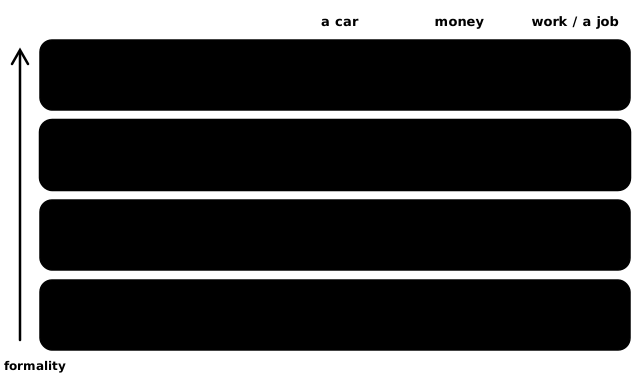
| Register | Where you meet it | Typical features |
|---|---|---|
| Soutenu | Formal letters, speeches, literature, the news at its most careful | Rare words, full negation, inversion: Puis-je… ? |
| Courant | Work, shops, teachers, strangers, most books | Standard words, vous with strangers |
| Familier | Friends, family, relaxed colleagues, social media | Short words, tu, dropped ne |
| Argotique / populaire | Youth, songs, films, the street, closed groups | Verlan, borrowed words, words that change fast |
Learn up, understand down
Actively use courant (and some soutenu for writing). Learn to understand familier and argot — but use them only with people who use them with you.
Grammar changes with register too — dropped ne, on instead of nous, chais pas — but those belong to the chapter Real spoken French. Here we focus on words. For tu vs vous basics, see Hello, please, thank you.
48.2 Familier: the words of everyday friends
Familier words are not "bad French". French people of every age use them at home, with friends and often at work over coffee. Many are just shorter or punchier versions of standard words. Here are the ones you will hear constantly.
| Courant | Familier | Argot / note |
|---|---|---|
| un homme | un mec, un type | un keum (verlan) |
| une femme | une nana | une meuf (verlan) |
| un enfant | un gosse, un môme, un gamin | — (see the Québec warning below) |
| un ami | un copain, un pote | un poto |
| la police | les flics | les keufs (verlan) |
| manger | bouffer | (la bouffe = food) |
| travailler | bosser | (le boulot, le taf = the job) |
| se dépêcher | se grouiller, se magner | — |
| regarder | mater | can sound like "ogling" people |
| comprendre | piger | capter |
| avoir peur | flipper, avoir la trouille | — |
| fatigué | crevé, naze | — |
| ennuyeux | chiant (slightly vulgar) | relou = annoying (verlan) |
| un livre | un bouquin | — |
| les vêtements | les fringues | — |
| les chaussures | les godasses, les pompes | — |
| très | vachement, super | grave, trop (youth) |
- Mon pote s’est acheté une nouvelle bagnole. — My mate bought himself a new car.
- On bouffe où ce soir ? — Where are we eating tonight?
- Grouille-toi, le film commence ! — Hurry up, the film is starting!
- Je bosse tout le week-end, c’est chiant. — I’m working all weekend, it’s a pain. (chiant is mildly vulgar)
- T’as pigé ce qu’il a dit ? — Did you get what he said?
- J’ai flippé pendant tout le film. — I was scared during the whole film.
- Les gosses sont crevés, ils dorment déjà. — The kids are exhausted, they’re already asleep.
- Il est sympa, ce mec. — He’s nice, that guy.
Québec trap: gosses
In France les gosses = the kids. In Québec, gosses is a vulgar word for testicles. With Canadians, just say les enfants or les jeunes.
'Familier' is not the same as 'vulgaire'
Dictionaries mark words fam. (casual) or vulg. (vulgar). Bouquin is harmless; chiant, se casser (to clear off) or osef are rude. French also has strong swear words that you will hear in films; recognise them, but do not try them out — a learner’s swear word always sounds louder than intended.
48.3 Verlan: French turned inside out
Verlan is a slang game: you swap the syllables of a word. The name itself is verlan: l’envers ("the reverse") → vers-l’en → verlan. It grew in the Paris suburbs (les banlieues) in the 1970s–90s and spread through rap, films and teenagers to the whole country. Some verlan words are now so common that your French teacher will understand them.
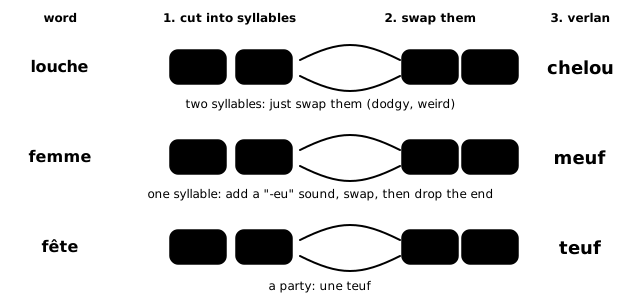
How verlan is built
Cut the word into syllables and reverse them. One-syllable words first get an extra "eu" sound (femme → fa-meu → meu-fa → meuf).
| Verlan | From | Meaning |
|---|---|---|
| une meuf | femme | a woman, a girl; ma meuf = my girlfriend |
| un keum | mec | a guy; mon keum = my boyfriend |
| relou | lourd (heavy) | annoying, a pain |
| ouf | fou | crazy, amazing |
| chelou | louche | weird, dodgy |
| vénère | énervé | angry, wound up |
| céfran | français | French (often = "white French", so it can sound labelling) |
| une teuf | fête | a party |
| zarbi | bizarre | strange |
| laisse béton | laisse tomber | forget it (made famous by a 1977 song by Renaud) |
| un ripou | pourri (rotten) | a corrupt cop / official |
| les keufs | flics | the cops |
| un beur → un rebeu | arabe | a person of North African origin (sensitive — see below) |
- Il est trop relou, il m’appelle toutes les cinq minutes. — He’s so annoying, he calls me every five minutes.
- C’est chelou, cette histoire. — That story is weird.
- Ma mère est vénère parce que je suis rentré tard. — My mum is furious because I came home late.
- On fait une teuf samedi, tu viens ? — We’re having a party on Saturday, are you coming?
- Laisse béton, c’est pas grave. — Forget it, it doesn’t matter.
Re-verlan and sensitive words
When a verlan word becomes too mainstream, young speakers sometimes flip it again: arabe → beur → rebeu, femme → meuf → feumeu. Slang always runs away from the mainstream.
Words about origin: listen, don’t use
Beur, rebeu and céfran label people by origin. People inside a community may use them about themselves, but from a foreigner they can sound reductive or offensive. Say une personne d’origine maghrébine or simply the person’s name.
48.4 Slang you will hear every day
These expressions are everywhere among people under 40 — in cafés, on YouTube, in series. Most are familier rather than strictly argot, so they are useful to recognise early.
| Expression | Meaning | Standard equivalent |
|---|---|---|
| C’est ouf ! | It’s crazy / amazing! | C’est incroyable ! |
| grave | totally, really | vraiment, tout à fait |
| kiffer | to love, to really like | adorer, aimer beaucoup |
| trop + adjective | so…, really… | très… |
| Ça craint. | That sucks / that’s dodgy. | C’est embêtant / inquiétant. |
| C’est nul. | It’s rubbish. | C’est très mauvais. |
| Je suis crevé(e). | I’m exhausted. | Je suis très fatigué(e). |
| avoir la dalle | to be starving | avoir très faim |
- Ce concert, c’était ouf ! — That concert was amazing!
- — Il est sympa, non ? — Grave ! — — He’s nice, isn’t he? — Totally!
- Je suis grave d’accord avec toi. — I totally agree with you.
- Je kiffe cette série. — I love this series.
- Il est trop mignon, ton chien ! — Your dog is so cute!
- Le dernier métro est parti ? Ça craint. — The last metro has gone? That sucks.
- Ce film est nul, on s’en va ? — This film is rubbish, shall we leave?
- J’ai la dalle, on va manger ? — I’m starving, shall we go and eat?
'trop' has two meanings
Standard trop = too (much): C’est trop cher = it’s too expensive. Familier trop = very: C’est trop bien = it’s really great. Context decides.
Many fixed idioms (avoir la flemme, poser un lapin) are also familier; you will find them in Idioms & expressions.
48.5 Texting French: SMS abbreviations
French text messages (les textos, les SMS) squeeze words into a few letters. You need to read them; you write them only to friends. Most abbreviations come from the spoken, familier form, so jsp is je sais pas, not je ne sais pas.
| Abbr. | Full form | Meaning |
|---|---|---|
| slt | salut | hi |
| cc | coucou | hey (very friendly) |
| bjr | bonjour | hello |
| mdr | mort de rire | LOL ("dead from laughing") |
| ptdr | pété de rire | ROFL (even stronger) |
| stp / svp | s’il te plaît / s’il vous plaît | please (tu / vous) |
| bcp | beaucoup | a lot |
| jsp | je sais pas | I dunno |
| dsl | désolé(e) | sorry |
| tkt | t’inquiète (pas) | don’t worry |
| pk / pq | pourquoi | why |
| jtm | je t’aime | I love you |
| auj | aujourd’hui | today |
| rdv | rendez-vous | appointment, meeting |
| mtn | maintenant | now |
| ct | c’était | it was |
| osef | on s’en fout | who cares (vulgar) |
| a+ | à plus (tard) | see you later |
- cc, tu fais quoi auj ? rdv au café à 18h ? — Hey, what are you doing today? Meet at the café at 6 pm?
- dsl jsp, je bosse mtn. tkt, je te rappelle. — Sorry, I don’t know, I’m working now. Don’t worry, I’ll call you back.
- ct trop bien hier mdr — Yesterday was so great lol.
For how to write complete, well-formed messages and emails, see Messages, letters & emails.
48.6 Going up: soutenu words
The other direction matters too, especially for B2–C1 writing. Swapping a courant word for a soutenu one makes a letter or an essay sound mature. Use these in writing and formal speech, not when ordering a croissant.
| Courant | Soutenu | Meaning |
|---|---|---|
| vouloir | souhaiter, désirer | to wish, to want |
| aller (à) | se rendre (à) | to go (to) |
| avoir peur | craindre, redouter | to fear |
| comprendre | saisir, appréhender | to grasp |
| se dépêcher | se hâter | to hasten |
| ennuyeux | fastidieux | tedious |
| un livre | un ouvrage | a book, a work |
| une maison | une demeure | a residence |
| la police | les forces de l’ordre | the police forces |
| malade | souffrant(e) | unwell |
| désolé | navré | very sorry |
- Je souhaiterais prendre rendez-vous avec vous. — I would like to make an appointment with you.
- Je me rendrai à Lyon la semaine prochaine. — I shall be going to Lyon next week.
- Je suis navré de ce contretemps. — I am very sorry for this delay / mishap.
- Les forces de l’ordre sont intervenues rapidement. — The police intervened quickly.
Formal grammar (the passé simple, the ne explétif, inversion in literature) is covered in Literary & formal French.
48.7 When NOT to use slang
A learner who uses slang in the wrong place does not sound cool — they sound as if they do not know the rules. French society is quite attentive to register, especially in writing. Keep slang, verlan and text abbreviations out of these situations:
- Job interviews and professional meetings — courant, with vous.
- Emails to teachers, universities, the administration (la préfecture, la CAF, your bank): full words, a formal opening and closing.
- Older people and strangers: vous and courant until they invite you to relax.
- DELF / DALF writing and speaking: examiners grade "adequacy to the situation". Slang in a formal letter costs you marks. (See DELF, DALF & your level.)
The safe default
Unsure? Use courant + vous. Nobody is offended by standard French; many people are put off by slang from a stranger.
Register mistakes learners make
- Wrong: Madame, je vous écris pour avoir un boulot dans votre boîte.
- Right: Madame, je vous écris afin d’obtenir un poste dans votre entreprise.
-
Why: Boulot and boîte (company) are familier. A cover letter needs courant or soutenu: un poste, un emploi, une entreprise.
-
Wrong: (to a stranger in the street) Excuse-moi, tu peux m’aider ?
- Right: Excusez-moi, vous pourriez m’aider, s’il vous plaît ?
-
Why: With an adult stranger, use vous. Tu is for friends, family, children — or when someone invites you: On peut se tutoyer ?
-
Wrong: Monsieur le Directeur, votre offre est grave intéressante.
- Right: Monsieur le Directeur, votre offre est très intéressante.
-
Why: Mixing registers is jarring: a formal opening followed by youth slang sounds comic. Keep one register through the whole text.
-
Wrong: Bjr, jsp si je peux venir auj, dsl.
- Right: Bonjour Madame, je ne sais pas si je pourrai venir aujourd’hui. Je vous prie de m’excuser.
-
Why: SMS abbreviations never go in an email to a teacher or an office. Write every word, keep the ne, and add a polite formula.
-
Wrong: (in an interview) J’ai kiffé mon dernier stage, c’était ouf.
- Right: J’ai beaucoup apprécié mon dernier stage, c’était très enrichissant.
-
Why: Kiffer and ouf are youth slang. In an interview, choose precise standard words: apprécier, enrichissant, passionnant.
-
Wrong: (to a shop assistant) Salut, je voudrais un pain.
- Right: Bonjour, je voudrais une baguette, s’il vous plaît.
- Why: Salut is for people you know. Shops, offices and strangers get Bonjour (Madame / Monsieur).
48.8 In real life: one message, four registers
You are ill and cannot come to a meeting. Watch how the same message changes depending on who receives it.
- Soutenu — Je suis navré, mais je ne pourrai pas me rendre à notre rendez-vous : je suis souffrant. — I am very sorry, but I shall not be able to attend our meeting: I am unwell. (to a director, a client)
- Courant — Désolé, je ne peux pas venir au rendez-vous, je suis malade. — Sorry, I can’t come to the meeting, I’m ill. (to a colleague, a teacher)
- Familier — Dsl, je peux pas venir, je suis malade comme un chien. — Sorry, can’t come, I’m sick as a dog. (to a friend)
- Argotique — Wesh, je suis HS, je viens pas, tkt. — Hey, I’m out of action, not coming, don’t worry. (to a close friend; HS = hors service)
A short dialogue among friends
- — Salut ! T’étais où hier ? La teuf, c’était ouf. — — Hi! Where were you yesterday? The party was amazing.
- — J’ai bossé jusqu’à minuit, j’étais crevé. — — I worked until midnight, I was exhausted.
- — Ça craint ! Ton chef est trop relou. — — That sucks! Your boss is such a pain.
- — Grave. Bon, j’ai la dalle : on va bouffer ? — — Totally. Right, I’m starving: shall we go and eat?
Match the other person
Let the French speaker set the level. If they say tu and use slang, you can relax a step; if they stay with vous, stay there too.
À retenir
- A register (un registre de langue) is a level of formality: soutenu (formal) → courant (standard) → familier (casual) → argotique / populaire (slang).
- Actively use courant (and some soutenu for writing). Learn to understand familier and argot — but use them only with people who use them with you.
- Cut the word into syllables and reverse them. One-syllable words first get an extra "eu" sound (femme → fa-meu → meu-fa → meuf).
- Standard trop = too (much): C’est trop cher = it’s too expensive. Familier trop = very: C’est trop bien = it’s really great. Context decides.
- Unsure? Use courant + vous. Nobody is offended by standard French; many people are put off by slang from a stranger.
- Let the French speaker set the level. If they say tu and use slang, you can relax a step; if they stay with vous, stay there too.
48.9 Practice — Registers & slang
Exercise 1
Which word is the familier way to say 'une voiture'?
- un véhicule
- une automobile
- une bagnole
- un emploi
Hint: Friends, not a formal letter.
Answer
une bagnole
véhicule/automobile are formal, bagnole is familier, caisse is slang.
Exercise 2
'relou' is the verlan form of…
- lourd
- roulé
- louer
- relevé
Hint: Swap the two syllables back.
Answer
lourd
lourd (heavy) → reversed sounds → relou = annoying, a pain.
Exercise 3
You email a university office. Which opening is right?
- Salut,
- Coucou,
- Madame, Monsieur,
- Wesh,
Answer
Madame, Monsieur,
An administration needs a formal opening; salut, coucou and wesh are for friends.
Exercise 4
Match the verlan word to the standard word.
| A | B |
|---|---|
| meuf | fête |
| keum | louche |
| teuf | énervé |
| chelou | femme |
| vénère | mec |
Answer
meuf — femme; keum — mec; teuf — fête; chelou — louche; vénère — énervé
Verlan reverses syllables: fê-te → teuf, lou-che → chelou.
Exercise 5
Match the text abbreviation to its full form.
| A | B |
|---|---|
| mdr | je sais pas |
| tkt | désolé |
| jsp | rendez-vous |
| dsl | mort de rire |
| rdv | t'inquiète |
Answer
mdr — mort de rire; tkt — t'inquiète; jsp — je sais pas; dsl — désolé; rdv — rendez-vous
SMS forms come from spoken French: jsp = je sais pas.
Exercise 6
J'ai trop faim, j'ai la ___ ! (I'm starving)
Hint: avoir la … = to be starving
Answer
dalle
avoir la dalle = avoir très faim (familier).
Exercise 7
Mon ___ m'a aidé à déménager. (my mate)
Hint: familier for ami, starts with p
Answer
pote / copain
un pote / un copain = a friend (familier).
Exercise 8
Formal letter: Je ___ obtenir un rendez-vous. (I would like)
Hint: conditional of souhaiter, je
Answer
souhaiterais / voudrais
je souhaiterais is the polite, formal 'I would like'.
Exercise 9
___-toi, le train part dans deux minutes ! (Hurry up)
Hint: familier: se grouiller
Answer
Grouille / Dépêche / Magne
Grouille-toi ! = Dépêche-toi ! (familier).
Exercise 10
Tap the word that is too casual for a cover letter.
Madame, je vous écris pour obtenir un boulot dans votre entreprise.
Answer
Wrong word: boulot.
Corrected: Madame, je vous écris pour obtenir un poste dans votre entreprise.
boulot is familier; use un poste or un emploi.
Exercise 11
Tap the slang word in this formal sentence.
Monsieur le Directeur, votre proposition est grave intéressante.
Answer
Wrong word: grave.
Corrected: Monsieur le Directeur, votre proposition est très intéressante.
grave = 'totally' is youth slang; use très.
Exercise 12
What does 'Ça craint' mean?
- That's great
- That sucks
- I'm scared
- That's expensive
Answer
That sucks
Ça craint = it's bad / dodgy (familier).
Exercise 13
Which register is 'les forces de l'ordre'?
- soutenu
- courant
- familier
- argotique
Answer
soutenu
police (courant) → flics (familier) → keufs (argot); forces de l'ordre is formal.
Exercise 14
In a familier sentence, 'C'est trop bien' means…
- It's too good to be true
- It's really great
- It's not good enough
- It's quite good
Answer
It's really great
Familier trop + adjective = very.
Exercise 15
Put the words in order (to a stranger).
Words: s'il / vous / plaît / m'aider / Pourriez-vous
Answer
Pourriez-vous m'aider s'il vous plaît
With strangers: vous + polite conditional pourriez.
Exercise 16
Put the words in order (to a friend).
Words: ce / Je / suis / trop / crevé / soir
Answer
Je suis trop crevé ce soir
Familier: trop crevé = really exhausted.
Exercise 17
Say it aloud — casual, to a friend.
C'est ouf, je kiffe trop cette chanson
Answer
Say: C'est ouf, je kiffe trop cette chanson
ouf (verlan of fou) and kiffer are youth slang.
Exercise 18
Now say it formally.
Je souhaiterais prendre rendez-vous avec vous
Answer
Say: Je souhaiterais prendre rendez-vous avec vous
souhaiter in the conditional is the formal choice.
Next step
Now build words yourself: Word building & advanced words shows how prefixes and suffixes create thousands of words — and gives you the C1 vocabulary that lifts your writing to the soutenu step.