Chapter 24: Giving instructions
l’impératif
Viens ! Écoutez ! Allons-y ! The imperative is how you tell, invite or ask someone to do something. In French it is easy to form — it is the present tense without the subject — but it has three traps: a missing -s, a few irregular forms, and pronouns that change place. And because a bare command can sound rude, you will also learn the polite ways to ask.
- 1Three forms: tu, nous, vous
- 2The missing -s of -er verbs
- 3The four irregulars: sois, aie, sache, veuille
- 4Negative commands: ne … pas around the verb
- 5Where the pronouns go
- 6Commands you will hear every day
- 7Polite alternatives: asking instead of ordering
- 8In real life: asking the way
In one line
Imperative = the present tense of tu, nous, vous without the subject: tu viens → Viens ! vous écoutez → Écoutez !
- Viens ici ! — Come here! (to one friend) [vyɛ̃‿zee-SEE]
- Écoutez bien. — Listen carefully. (to a group, or politely) [ay-koo-TAY BYɛ̃]
- Allons-y ! — Let’s go! [a-lõ-ZEE]
24.1 Three forms: tu, nous, vous
There is no imperative for je or il. You choose the form by who you speak to:
| Form | Speaking to… | Example |
|---|---|---|
| tu | one friend, child, family member | Attends ! Wait! |
| nous | a group including you — “let’s” | Attendons ! Let’s wait! |
| vous | several people, or one person politely | Attendez ! Wait! |
Just like tum / aap in Hindi: use the tu form with people you call tu, and vous with everyone else.
| Verb | tu | nous | vous |
|---|---|---|---|
| finir | finis | finissons | finissez |
| prendre | prends | prenons | prenez |
| faire | fais | faisons | faites |
| venir | viens | venons | venez |
| dire | dis | disons | dites |
- Prends ton manteau, il fait froid. — Take your coat, it’s cold. [prã tõ man-TO]
- Faites attention à la marche. — Mind the step. [fɛt‿za-tã-SYÕ]
- Finissons ce travail avant midi. — Let’s finish this work before noon.
- Dites-moi tout ! — Tell me everything! [deet-mwa TOO]
24.2 The missing -s of -er verbs
For -er verbs (and aller), the tu form drops the -s. You can’t hear it, but you must not write it. The same happens with verbs like ouvrir, offrir, cueillir, whose present ends in -es.
| Present (tu) | Imperative | Meaning |
|---|---|---|
| tu manges | Mange ! | Eat! |
| tu écoutes | Écoute ! | Listen! |
| tu vas | Va ! | Go! |
| tu ouvres | Ouvre la fenêtre ! | Open the window! |
| tu finis | Finis ! | Finish! (not -er: the -s stays) |
Careful
- Wrong: Manges ta soupe !
- Right: Mange ta soupe !
- Why: -er verbs lose the -s in the tu command. A very common spelling mistake, even among French children.
…which comes back before y and en
To make a smooth liaison, the -s returns before y and en:
- Va au marché ! → Vas-y ! — Go to the market! → Go (there)! / Go on! [va-ZEE]
- Il reste du gâteau. Manges-en ! — There’s some cake left. Have some! [mãzh-ZÃ]
- Ton projet ? Penses-y ! — Your project? Think about it!
The -s rule
-er verbs: tu manges → Mange ! (no -s) — but Vas-y ! Manges-en ! (-s back before y/en). All other verbs keep their -s: Finis ! Prends !
24.3 The four irregulars: sois, aie, sache, veuille
Only four verbs have special imperative forms. They come from the subjunctive (see The subjunctive), but for now just learn them — especially être and avoir.
| Verb | tu | nous | vous |
|---|---|---|---|
| être | sois [swa] | soyons | soyez [swa-YAY] |
| avoir | aie [ɛ] | ayons | ayez [ay-YAY] |
| savoir | sache [SASH] | sachons | sachez |
| vouloir | veuille | (veuillons) | veuillez [vuh-YAY] |
- Sois sage ! — Be good! (to a child) [swa SAZH]
- Soyez les bienvenus ! — Welcome! (to a group)
- N’aie pas peur. — Don’t be afraid. [nɛ pa PUHR]
- Ayez la gentillesse de répondre rapidement. — Please be kind enough to reply quickly. (formal)
- Sachez que le magasin est fermé lundi. — Please note that the shop is closed on Monday.
- Veuillez patienter, s’il vous plaît. — Please hold / please wait. — the phone message you will hear a hundred times [vuh-yay pa-syã-TAY]
Careful
- Wrong: Es calme !
- Right: Sois calme !
- Why: Être doesn’t use the present (tu es) for commands. It uses sois / soyons / soyez.
24.4 Negative commands: ne … pas around the verb
Put ne before the verb and pas (or jamais, plus, rien) after it.
- Ne touche pas ! — Don’t touch! [nuh toosh PA]
- N’oublie pas tes clés. — Don’t forget your keys. [noo-blee pa tay KLAY]
- Ne soyez pas en retard demain. — Don’t be late tomorrow.
- Ne dis rien à personne ! — Don’t say anything to anyone!
- Ne parlons plus de ça. — Let’s not talk about that any more.
In fast speech
People often drop ne: Touche pas ! T’inquiète pas ! Recognise it — but write the full form. See Real spoken French.
24.5 Where the pronouns go
This is the real difficulty of the imperative. In a positive command, object pronouns move after the verb, joined with a hyphen — and me / te become moi / toi. In a negative command, everything goes back to the normal place, before the verb.

- Aide-moi, s’il te plaît. / Ne m’aide pas, je veux essayer seul. — Help me, please. / Don’t help me, I want to try on my own.
- Ce gâteau ? Goûte-le ! / Ne le mange pas tout ! — This cake? Taste it! / Don’t eat it all!
- Ton passeport ? Donne-le-moi. — Your passport? Give it to me. [don-luh-MWA]
- Ta grand-mère ? Téléphone-lui ce soir. — Your grandmother? Phone her tonight.
Reflexive verbs in commands
| se lever | Positive | Negative |
|---|---|---|
| tu | Lève-toi ! | Ne te lève pas ! |
| nous | Levons-nous ! | Ne nous levons pas ! |
| vous | Levez-vous ! | Ne vous levez pas ! |
- Asseyez-vous, je vous en prie. — Please, do sit down. [a-say-yay-VOO]
- Assieds-toi ! / Ne t’inquiète pas. — Sit down! / Don’t worry. [a-syay-TWA]
- Dépêchons-nous, le magasin ferme ! — Let’s hurry, the shop is closing!
- Va-t’en ! / Ne t’en va pas ! — Go away! / Don’t go! [va-TÃ]
Pronoun-position errors
- Wrong: Donne-me le livre.
- Right: Donne-moi le livre.
-
Why: After the verb, me becomes moi (and te becomes toi).
-
Wrong: Ne lève-toi pas !
- Right: Ne te lève pas !
-
Why: In a negative command, the pronoun goes back before the verb, in its normal form te.
-
Wrong: Donne-moi-le !
- Right: Donne-le-moi !
- Why: In positive commands: direct pronoun (le, la, les) first, then moi, lui, nous, leur. The full order is in Y, en & pronoun order.
Pronoun position
Positive: verb-pronoun (Regarde-moi !). Negative: ne + pronoun + verb + pas (Ne me regarde pas !).
24.6 Commands you will hear every day
Many short imperatives work as everyday expressions. Their meaning is often not literal.
| French | Literal | Real meaning |
|---|---|---|
| Tiens ! / Tenez ! | hold! | Here you are! / Oh, look! |
| Allez ! | go! | Come on! (encouragement) |
| Vas-y ! / Allez-y ! | go there! | Go ahead! Go on! |
| Voyons… | let’s see | Let’s see… / Come now! |
| Dis donc ! | say then | Wow! / Hey! |
| Écoute… | listen | Look… (before an opinion) |
| Arrête ! | stop! | Stop it! / No way! |
| Entrez ! | enter! | Come in! |
| Excusez-moi | excuse me | Excuse me (to get attention) |
- Tenez, voici votre monnaie. — Here you are, here’s your change. [tuh-NAY]
- Allez, encore un effort ! — Come on, one more push!
- Dis donc, tu as changé de coiffure ! — Hey, you’ve got a new haircut!
24.7 Polite alternatives: asking instead of ordering
A bare imperative is fine with friends, in instructions and in emergencies. But with strangers, staff or colleagues, French speakers usually soften it — or replace it with a question. Climb the ladder as the situation gets more formal:
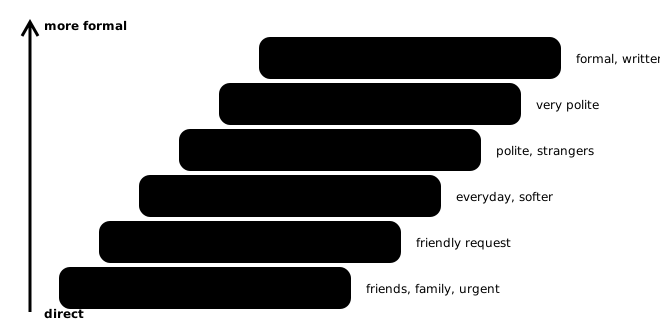
- Vous pouvez répéter, s’il vous plaît ? — Could you repeat that, please? — the learner’s best friend [voo poo-vay ray-pay-TAY]
- Pourriez-vous m’indiquer la gare ? — Could you show me the way to the station? [poo-ryay-VOO]
- Veuillez trouver ci-joint mon CV. — Please find my CV attached. (formal email)
- Merci de ne pas fumer. — Please do not smoke. (sign)
The infinitive as a command
Recipes, signs and instructions often use the infinitive: Ne pas toucher. Ajouter le sel. Tirer / Pousser (on doors: pull / push).
Careful
- Wrong: Donnez-moi un café. (to a waiter, with no softener)
- Right: Je voudrais un café, s’il vous plaît.
- Why: Grammatically fine, but it sounds abrupt. In shops and cafés, ask with je voudrais or vous pourriez — and always add s’il vous plaît.
24.8 In real life: asking the way
- — Excusez-moi, madame. Pourriez-vous m’aider ? Je cherche la place du Marché. — — Excuse me, madam. Could you help me? I’m looking for the market square.
- — Bien sûr. Prenez la deuxième rue à gauche, puis continuez tout droit. — — Of course. Take the second street on the left, then carry straight on.
- — Traversez le pont et tournez à droite après la pharmacie. — — Cross the bridge and turn right after the chemist’s.
- — Mais faites attention, ne prenez pas la rue piétonne, elle est fermée aujourd’hui. — — But be careful, don’t take the pedestrian street, it’s closed today.
- — Merci beaucoup ! — Je vous en prie. Passez une bonne journée ! — — Thank you very much! — You’re welcome. Have a nice day!
À retenir
- Imperative = the present tense of tu, nous, vous without the subject: tu viens → Viens ! vous écoutez → Écoutez !
- -er verbs: tu manges → Mange ! (no -s) — but Vas-y ! Manges-en ! (-s back before y/en). All other verbs keep their -s: Finis ! Prends !
- Positive: verb-pronoun (Regarde-moi !). Negative: ne + pronoun + verb + pas (Ne me regarde pas !).
- Recipes, signs and instructions often use the infinitive: Ne pas toucher. Ajouter le sel. Tirer / Pousser (on doors: pull / push).
- Give yourself (or a friend) ten instructions today in French — five positive, five negative, at least two with a pronoun. Then move on to Comparing.
24.9 Practice — The imperative
Exercise 1
Tell a friend: 'Eat your vegetables!' ___ tes légumes !
- Manges
- Mange
- Mangez
- Mangeons
Answer
Mange
-er verbs drop the -s in the tu command.
Exercise 2
Tell a child: 'Be good!'
- Es sage !
- Sois sage !
- Être sage !
- Soit sage !
Answer
Sois sage !
être → sois, soyons, soyez.
Exercise 3
'Give it to me!' (le livre)
- Donne-moi-le !
- Donne-le-moi !
- Me le donne !
- Donne-le-me !
Answer
Donne-le-moi !
Positive command: verb, then le, then moi.
Exercise 4
'Don't get up!' (to a friend)
- Ne lève-toi pas !
- Ne te lève pas !
- Lève-toi pas !
- Ne toi lève pas !
Answer
Ne te lève pas !
Negative: ne + te + verb + pas.
Exercise 5
The most polite way to ask a stranger:
- Répétez !
- Répète, s'il te plaît.
- Pourriez-vous répéter, s'il vous plaît ?
- Tu répètes ?
Answer
Pourriez-vous répéter, s'il vous plaît ?
Conditional question + s'il vous plaît = very polite.
Exercise 6
Va au parc ! → ___ ! (go there)
Hint: the -s comes back
Answer
Vas-y / vas-y
Before y, the -s returns: vas-y.
Exercise 7
N'___ pas peur ! (avoir, tu)
Answer
aie
avoir → aie, ayons, ayez.
Exercise 8
___ patienter, s'il vous plaît. (formal: please wait)
Answer
Veuillez / veuillez
veuillez + infinitive = formal 'please'.
Exercise 9
___-vous, je vous en prie. (sit down, vous)
Answer
Asseyez / asseyez
s'asseoir → asseyez-vous.
Exercise 10
Ne ___ pas ! (toucher, tu)
Answer
touche
Negative command: ne + touche + pas (no -s).
Exercise 11
Tap the wrong word.
Regardes la mer, c'est magnifique !
Answer
Wrong word: Regardes.
Corrected: Regarde la mer, c'est magnifique !
-er verb, tu command → no -s: Regarde.
Exercise 12
Tap the wrong word.
Donne-me ton numéro de téléphone.
Answer
Wrong word: Donne-me.
Corrected: Donne-moi ton numéro de téléphone.
After the verb, me becomes moi.
Exercise 13
Tap the wrong word.
Es gentil avec ta sœur.
Answer
Wrong word: Es.
Corrected: Sois gentil avec ta sœur.
être has the special form sois.
Exercise 14
Put the words in order: Don't forget your keys.
Words: pas / N'oublie / tes / clés
Answer
N'oublie pas tes clés
ne + verb + pas; oublier is -er so no -s.
Exercise 15
Match the expression to its real meaning.
| A | B |
|---|---|
| Tenez ! | Wow! / Hey! |
| Allez ! | Go ahead! |
| Dis donc ! | Here you are! |
| Allez-y ! | Come on! |
Answer
Tenez ! — Here you are!; Allez ! — Come on!; Dis donc ! — Wow! / Hey!; Allez-y ! — Go ahead!
Everyday imperatives often have non-literal meanings.
Exercise 16
Say it aloud.
Vous pouvez répéter s'il vous plaît
Answer
Say: Vous pouvez répéter s'il vous plaît
The most useful polite request for a learner.
Exercise 17
Say it aloud.
Allons-y
Answer
Say: Allons-y
allons-y: the s links to y — a-lõ-ZEE.
Next step
Give yourself (or a friend) ten instructions today in French — five positive, five negative, at least two with a pronoun. Then move on to Comparing.