Chapter 42: Work, health & money
Travail, santé, argent
Living in French means signing a contract, reading a payslip, seeing a doctor, paying rent and talking to your bank. This chapter gives you the B1–B2 words for those four worlds — each noun with its gender colour (blue = masculine, pink = feminine, violet = plural), the verbs that go with it, and the false friends that make English speakers say strange things.
- 1Le travail — contracts and the life of a job
- 2Salaire, horaires et congés — pay, hours and leave
- 3La santé — how the French system works
- 4Symptoms and illnesses beyond A2
- 5L’argent et la banque — money and banking
- 6Le logement — renting a flat
- 7Collocations — the verbs that go with the nouns
- 8In real life — four short scenes
masculinefeminineplural
Learn the pair, not the word
At this level, learn verb + noun together: signer un bail, faire un virement, poser des congés. The collocation is what makes you sound natural.
For the A1–A2 basics (the body, the home, the city) see Core vocabulary by theme. For the phrases you need on the phone, in a meeting or in a job interview, see Work, phone & interviews; for the pharmacy and emergencies, see Travel & emergencies. Here we go one step further: the system behind the words.
42.1 Le travail — contracts and the life of a job
In France, the type of contract matters enormously — for renting a flat, getting a loan, even for small talk. Everyone knows these three letters.
| French | English | Note |
|---|---|---|
| un CDI | permanent contract | contrat à durée indéterminée [say-day-EE] |
| un CDD | fixed-term contract | contrat à durée déterminée |
| un stage | internship | un / une stagiaire = intern |
| l’intérim | temping | travailler en intérim |
| un poste | job, position | un poste de chef de projet |
| l’employeur | employer | formal; casual: le patron |
| un salarié / une salariée | employee | anyone on a payroll |
| une offre d’emploi | job advert | postuler à une offre |
| la candidature | application | envoyer sa candidature |
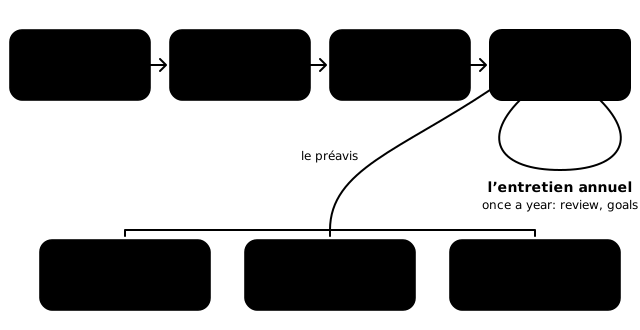
| la période d’essai | probation period | either side can leave easily |
| les ressources humaines | HR | said les RH [lay air-ASH] |
The key verbs
- L’entreprise va embaucher vingt personnes cette année. — The company is going to hire twenty people this year. (recruter is a more formal synonym.)
- Après dix ans, il a été licencié pour motif économique. — After ten years, he was made redundant (laid off for economic reasons).
- Elle a démissionné pour créer sa propre entreprise. — She resigned to start her own company. (Noun: la démission.)
- J’ai enfin décroché un CDI ! — I finally landed a permanent contract! (décrocher = to land, to get hold of)
- Mon préavis est de deux mois. — My notice period is two months.
Careful
- Wrong: J’ai été tiré la semaine dernière.
- Right: J’ai été licencié la semaine dernière.
- Why: Tirer means to pull or to shoot — not “to fire” someone. Neutral: licencier; casual: se faire virer (“J’ai été viré”). For “I applied”, see The 50 classic mistakes (postuler, never “appliquer”).
42.2 Salaire, horaires et congés — pay, hours and leave
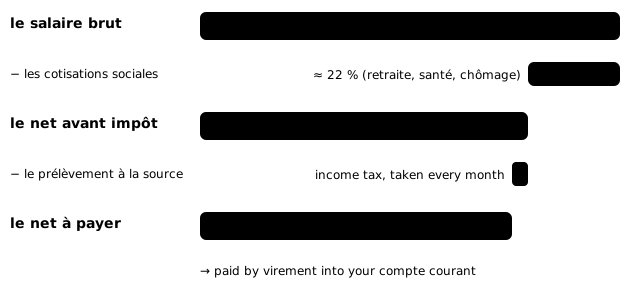
French employees read their fiche de paie (payslip) carefully, because there is a big gap between the figure in the contract and the money that arrives.
| French | English | Collocation |
|---|---|---|
| le salaire brut | gross salary | 40 000 € brut par an |
| le salaire net | take-home pay | toucher son salaire |
| les cotisations | social contributions | taken from the gross |
| la fiche de paie | payslip | also le bulletin de salaire |
| la prime | bonus | une prime de fin d’année |
| une augmentation | pay rise | demander une augmentation |
| le SMIC | minimum wage | être payé au SMIC [SMEEK] |
| les heures supplémentaires | overtime | faire des heures sup |
| les congés payés | paid holiday | poser ses congés |
| les RTT | extra days off | réduction du temps de travail |
| le télétravail | remote work | être en télétravail |
| l’entretien annuel | annual review | fixer des objectifs |
Le salaire or la paie?
Le salaire is the amount you earn. La paie is the act and system of paying: la fiche de paie, le service paie (payroll), le jour de paie. Civil servants get un traitement; doctors and lawyers get des honoraires.
- Je gagne 2 500 euros net par mois. — I earn 2,500 euros a month after contributions.
- En France, on a droit à cinq semaines de congés payés par an. — In France, you are entitled to five weeks of paid holiday a year.
- Je suis en télétravail deux jours par semaine. — I work from home two days a week. (Verb: télétravailler.)
- Lors de mon entretien annuel, j’ai demandé une augmentation. — At my annual review, I asked for a pay rise.
Careful
- Wrong: Je fais 3 000 euros par mois.
- Right: Je gagne 3 000 euros par mois.
- Why: English “I make $3,000” is a calque. French gagne (earns). Also: toucher (to receive) — “Je touche mon salaire le 28.”
Careful
- Wrong: J’ai trois semaines de vacances payées.
- Right: J’ai trois semaines de congés payés.
- Why: The legal word is les congés. You poser des congés (book leave) in order to partir en vacances.
42.3 La santé — how the French system works
French healthcare runs on three layers: the public Assurance maladie (everyone calls it la Sécu), a private top-up called la mutuelle, and your own doctor. Know these words and the system makes sense.
| French | English | What it means in practice |
|---|---|---|
| le médecin traitant | registered GP | your declared doctor; you are reimbursed better |
| le généraliste | general practitioner | vs le spécialiste |
| la consultation | appointment, visit | prendre rendez-vous pour une consultation |
| l’ordonnance | prescription | le médecin prescrit des médicaments |
| la carte Vitale | health insurance card | green chip card; shows you are insured |
| la mutuelle | top-up health insurance | often paid partly by the employer |
| le remboursement | reimbursement | être remboursé à 70 % |
| le tiers payant | no up-front payment | the pharmacy is paid directly |
| l’arrêt maladie | sick leave | also l’arrêt de travail |
| les indemnités journalières | daily sick pay | paid while you are off sick |
| les urgences | A&E, emergency room | always plural: aller aux urgences |
- Il faut déclarer un médecin traitant pour être bien remboursé. — You need to register a GP to be properly reimbursed.
- Vous avez votre carte Vitale et votre attestation de mutuelle ? — Do you have your Vitale card and your top-up insurance certificate? (what the receptionist asks)
- Le médecin m’a mis en arrêt maladie pour une semaine. — The doctor signed me off sick for a week.
- Avec le tiers payant, je n’avance pas les frais. — With direct billing, I don’t pay up front. (avancer les frais = to pay and be refunded later)
Sick leave in one line
The doctor gives you un arrêt de travail; you send it to your employer and to the Assurance maladie within 48 hours; you then receive des indemnités journalières.
42.4 Symptoms and illnesses beyond A2
You already know j’ai mal à la tête and j’ai de la fièvre. To describe a problem precisely to a doctor, you need these.
| French | English |
|---|---|
| J’ai des vertiges. | I feel dizzy. |
| J’ai la nausée / J’ai envie de vomir. | I feel sick (nauseous). |
| J’ai des courbatures. | I ache all over. |
| J’ai le nez bouché. | My nose is blocked. |
| Ça me démange. | It itches. |
| J’ai des boutons / une éruption cutanée. | I have spots / a rash. |
| Ça me lance. | It throbs (sharp, pulsing pain). |
| une douleur aiguë / sourde | a sharp / dull pain |
| Je suis enrhumé(e). / J’ai un rhume. | I have a cold. |
| J’ai la grippe. | I have the flu. |
| Je me suis fait une entorse à la cheville. | I sprained my ankle. |
| Je suis essoufflé(e). | I’m out of breath. |
- Depuis hier, j’ai des vertiges quand je me lève. — Since yesterday, I’ve felt dizzy when I stand up.
- C’est une douleur sourde, ici, en bas du dos. — It’s a dull pain, here, in my lower back.
- Le médecin m’a prescrit des antibiotiques pour mon angine. — The doctor prescribed antibiotics for my throat infection.
Faux ami: une angine
Une angine is a throat infection (tonsillitis), very common and not serious. The heart condition “angina” is une angine de poitrine. Don’t panic if a French colleague says “j’ai une angine”!
Careful
- Wrong: J’ai cassé ma jambe au ski.
- Right: Je me suis cassé la jambe au ski.
- Why: With your own body, French uses a reflexive verb + le/la/les, not “my”: je me suis foulé la cheville, elle s’est coupé le doigt. See Reflexive verbs.
Careful
- Wrong: Je vais à la pharmacie acheter des drogues.
- Right: Je vais à la pharmacie acheter des médicaments.
- Why: La drogue means illegal drugs only. Medicine = un médicament; a pill = un comprimé.
42.5 L’argent et la banque — money and banking
To rent a flat or be paid in France you need a French bank account and its RIB (relevé d’identité bancaire): a slip with your IBAN that landlords and employers always ask for.
| French | English | Collocation |
|---|---|---|
| le compte courant | current account | ouvrir un compte |
| le relevé de compte | bank statement | consulter ses relevés |
| un virement | bank transfer | faire un virement |
| un prélèvement | direct debit | un prélèvement automatique |
| le découvert | overdraft | être à découvert |
| les frais bancaires | bank charges | payer des frais |
| un distributeur | cash machine | retirer de l’argent |
| un prêt immobilier | mortgage | emprunter sur 25 ans |
| le taux d’intérêt | interest rate | un taux fixe / variable |
| la mensualité | monthly repayment | rembourser par mensualités |
| l’épargne | savings | épargner, un livret A |
| les impôts | taxes (income tax) | payer ses impôts |
| la déclaration de revenus | tax return | faire sa déclaration |
- Je vous fais un virement ce soir, vous pouvez m’envoyer votre RIB ? — I’ll transfer the money tonight — can you send me your bank details?
- Le loyer est prélevé le 5 de chaque mois. — The rent is taken by direct debit on the 5th of each month. (Noun: un prélèvement.)
- Je suis à découvert depuis une semaine. — I’ve been overdrawn for a week. (Casual: je suis dans le rouge.)
- Nous avons obtenu un prêt immobilier à un taux de 3 %. — We got a mortgage at a 3% rate.
- Depuis 2019, les impôts sont prélevés à la source. — Since 2019, income tax has been deducted at source (from your pay).
Careful
- Wrong: Tu peux m’emprunter 20 euros ?
- Right: Tu peux me prêter 20 euros ?
- Why: prêter à = to lend (give); emprunter à = to borrow (take). “J’ai emprunté 20 euros à Paul” = Paul lent them to me.
Careful
- Wrong: Je sauve de l’argent pour l’été.
- Right: J’économise pour l’été. / Je mets de l’argent de côté.
- Why: Sauver = to rescue a life. Money: économiser, épargner, mettre de côté.
Careful
- Wrong: Je paie beaucoup de taxes sur mon salaire.
- Right: Je paie beaucoup d’impôts sur mon salaire.
- Why: Les impôts = taxes on income and wealth (l’impôt sur le revenu). Une taxe = a tax on a thing or service: la TVA (VAT), la taxe foncière.
42.6 Le logement — renting a flat
Renting in a French city is competitive. The landlord wants a file (un dossier) with payslips, a CDI if possible, and often un garant — someone who will pay if you don’t.
| French | English | Note |
|---|---|---|
| le loyer | rent (the money) | payer son loyer |
| les charges | service charges | water, heating, building |
| charges comprises (CC) | bills included | vs hors charges (HC) |
| la caution | deposit; guarantee | legal term: le dépôt de garantie |
| le bail | lease | plural les baux [luh BYE, lay BOH] |
| l’état des lieux | check-in / check-out inspection | d’entrée, de sortie |
| le préavis | notice | 1 month (furnished) to 3 (unfurnished) |
| un / une locataire | tenant | vs le propriétaire (landlord) |
| la colocation | flat-share | un / une coloc = flatmate |
| un studio · un T2 | studio · one-bedroom flat | T2 = 2 main rooms |
| un meublé | furnished flat | vs un logement vide |
| l’assurance habitation | home insurance | compulsory for tenants |
- Le loyer est de 850 euros charges comprises. — The rent is 850 euros including service charges.
- On a fait l’état des lieux et signé le bail le même jour. — We did the inspection and signed the lease on the same day.
- Le propriétaire ne veut pas me rendre ma caution à cause d’une tache sur la moquette. — The landlord won’t give back my deposit because of a stain on the carpet.
- Je suis en colocation avec deux étudiantes. — I share a flat with two (female) students.
Louer works both ways
Je loue un studio = I rent a studio (I’m the tenant). Je loue mon studio à un étudiant = I rent it out (I’m the landlord). Context and à tell you which.
Careful
- Wrong: La location est de 800 euros par mois.
- Right: Le loyer est de 800 euros par mois.
- Why: La location is the act of renting (une voiture de location, un appartement en location); the monthly sum is le loyer. For “location” = place, see Cognates & false friends.
42.7 Collocations — the verbs that go with the nouns
Cover the right-hand column and test yourself: can you find the verb?
| Theme | Noun | Natural verb |
|---|---|---|
| Travail | une candidature | envoyer, déposer |
| Travail | un entretien | passer, décrocher |
| Travail | sa démission | donner, présenter |
| Travail | des congés | poser, prendre |
| Santé | un rendez-vous | prendre, annuler |
| Santé | un médicament | prescrire, prendre |
| Santé | les soins | se faire rembourser |
| Argent | un prêt | demander, obtenir, rembourser |
| Argent | un compte | ouvrir, clôturer, approvisionner |
| Argent | ses revenus | déclarer |
| Logement | un appartement | visiter, louer, chercher |
| Logement | son préavis | donner, envoyer |
- Il faut approvisionner ton compte avant le prélèvement. — You need to put money into your account before the direct debit.
- J’ai donné mon préavis : je quitte l’appartement fin juin. — I’ve given notice: I’m leaving the flat at the end of June.
42.8 In real life — four short scenes
Read and listen. Notice how many words from this chapter appear in a few lines.
À l’agence immobilière
- — L’appartement est toujours disponible ? Quel est le montant du loyer ? — Is the flat still available? How much is the rent?
- — 720 euros hors charges, plus 60 euros de charges. On demande un garant et trois fiches de paie. — 720 euros excluding charges, plus 60 euros of charges. We ask for a guarantor and three payslips.
Au bureau
- — Ma période d’essai se termine vendredi. Ensuite, je passe en CDI. — My probation period ends on Friday. After that, I go onto a permanent contract.
Chez le médecin
- — Je vous fais une ordonnance et un arrêt de trois jours. Vous avez une mutuelle ? — I’ll write you a prescription and a three-day sick note. Do you have top-up insurance?
Au téléphone avec la banque
- — Votre prélèvement a été rejeté parce que votre compte était à découvert. — Your direct debit was rejected because your account was overdrawn.
À retenir
- At this level, learn verb + noun together: signer un bail, faire un virement, poser des congés. The collocation is what makes you sound natural.
- Le salaire is the amount you earn. La paie is the act and system of paying: la fiche de paie, le service paie (payroll), *le…
- The doctor gives you un arrêt de travail; you send it to your employer and to the Assurance maladie within 48 hours; you then receive des indemnités journalières.
- Je loue un studio = I rent a studio (I’m the tenant). Je loue mon studio à un étudiant = I rent it out (I’m the landlord). Context and à tell you which.
- You can now handle your own life in French. Go on to Society & the world to talk about everyone else’s: elections, the climate, the media and the economy.
42.9 Practice — Work, health & money
Exercise 1
A permanent employment contract is…
- un CDI
- un CDD
- un stage
- un intérim
Answer
un CDI
CDI = contrat à durée indéterminée (no end date). CDD has a fixed end date.
Exercise 2
The monthly sum you pay your landlord is…
- le loyer
- la location
- la caution
- le bail
Answer
le loyer
le loyer = the rent money. La location = the act of renting; la caution = deposit; le bail = lease.
Exercise 3
« J'ai une angine » means…
- I have a throat infection
- I have a heart problem
- I have a headache
- I have a broken arm
Hint: faux ami
Answer
I have a throat infection
une angine = throat infection. The heart condition is une angine de poitrine.
Exercise 4
Je ___ 2 800 euros net par mois. (I earn)
Answer
gagne
gagner = to earn. Not « je fais », a calque of English 'I make'.
Exercise 5
Tu peux me ___ ton vélo ce week-end ? (lend)
Answer
prêter
prêter = to lend; emprunter = to borrow.
Exercise 6
Je me suis ___ la cheville en courant. (sprained)
Hint: se fouler
Answer
foulé
se fouler la cheville; no agreement on foulé: the direct object (la cheville) comes after the verb, and se is indirect.
Exercise 7
Tap the wrong word.
Je sauve de l'argent pour acheter une voiture.
Answer
Wrong word: sauve.
Corrected: J'économise pour acheter une voiture.
sauver = to rescue. For money: économiser, épargner, mettre de côté.
Exercise 8
Tap the wrong word.
Je paie beaucoup de taxes sur mon salaire.
Answer
Wrong word: taxes.
Corrected: Je paie beaucoup d'impôts sur mon salaire.
Income tax = les impôts. Une taxe is on goods or property (la TVA, la taxe foncière).
Exercise 9
Match the French to the English.
| A | B |
|---|---|
| un virement | overdraft |
| un prélèvement | savings |
| le découvert | bank transfer |
| l'épargne | direct debit |
Answer
un virement — bank transfer; un prélèvement — direct debit; le découvert — overdraft; l'épargne — savings
faire un virement, un prélèvement automatique, être à découvert, l'épargne.
Exercise 10
Put the words in order.
Words: mis / maladie / Le / en / arrêt / m'a / médecin
Answer
Le médecin m'a mis en arrêt maladie
mettre quelqu'un en arrêt maladie = to sign someone off sick.
Exercise 11
How much does the flat cost per month in total?
Read this aloud or have someone read it to you:
Bonjour, je vous appelle pour l'appartement de la rue Pasteur. C'est un deux-pièces meublé de quarante mètres carrés. Le loyer est de sept cent cinquante euros, plus cinquante euros de charges. Il faut un mois de dépôt de garantie et un garant. La visite est possible jeudi à dix-huit heures.
- 800 euros
- 750 euros
- 700 euros
- 850 euros
Answer
800 euros
Transcript: “Bonjour, je vous appelle pour l'appartement de la rue Pasteur. C'est un deux-pièces meublé de quarante mètres carrés. Le loyer est de sept cent cinquante euros, plus cinquante euros de charges. Il faut un mois de dépôt de garantie et un garant. La visite est possible jeudi à dix-huit heures.”
750 € de loyer + 50 € de charges = 800 € par mois.
Exercise 12
What does the agency require?
Read this aloud or have someone read it to you:
Bonjour, je vous appelle pour l'appartement de la rue Pasteur. C'est un deux-pièces meublé de quarante mètres carrés. Le loyer est de sept cent cinquante euros, plus cinquante euros de charges. Il faut un mois de dépôt de garantie et un garant. La visite est possible jeudi à dix-huit heures.
- a deposit and a guarantor
- three payslips only
- a permanent contract
- nothing
Answer
a deposit and a guarantor
Transcript: “Bonjour, je vous appelle pour l'appartement de la rue Pasteur. C'est un deux-pièces meublé de quarante mètres carrés. Le loyer est de sept cent cinquante euros, plus cinquante euros de charges. Il faut un mois de dépôt de garantie et un garant. La visite est possible jeudi à dix-huit heures.”
un mois de dépôt de garantie et un garant.
Exercise 13
Why is the bank calling?
Read this aloud or have someone read it to you:
Bonjour madame, je vous appelle parce que votre compte est à découvert de cent vingt euros depuis trois jours. Le prélèvement de votre mutuelle a été rejeté. Pouvez-vous faire un virement aujourd'hui pour régulariser la situation ?
- The account is overdrawn
- She won a prize
- Her loan was approved
- Her card was stolen
Answer
The account is overdrawn
Transcript: “Bonjour madame, je vous appelle parce que votre compte est à découvert de cent vingt euros depuis trois jours. Le prélèvement de votre mutuelle a été rejeté. Pouvez-vous faire un virement aujourd'hui pour régulariser la situation ?”
à découvert de cent vingt euros = 120 € overdrawn; the mutuelle direct debit was rejected.
Exercise 14
How many days a week can the speaker work from home?
Read this aloud or have someone read it to you:
J'ai une grande nouvelle : j'ai enfin décroché un CDI ! Ma période d'essai dure trois mois, et je pourrai télétravailler deux jours par semaine. Le salaire est un peu plus bas qu'avant, mais il y a une prime en fin d'année.
- two
- three
- none
- five
Answer
two
Transcript: “J'ai une grande nouvelle : j'ai enfin décroché un CDI ! Ma période d'essai dure trois mois, et je pourrai télétravailler deux jours par semaine. Le salaire est un peu plus bas qu'avant, mais il y a une prime en fin d'année.”
télétravailler deux jours par semaine. (The probation period is three months.)
Exercise 15
What does the doctor give the patient?
Read this aloud or have someone read it to you:
Depuis trois jours, j'ai de la fièvre, des courbatures partout et je tousse beaucoup. — Bon, c'est sûrement la grippe. Je vous fais une ordonnance et un arrêt de travail de cinq jours.
- a prescription and five days of sick leave
- an X-ray
- a referral to A&E
- nothing, just rest
Answer
a prescription and five days of sick leave
Transcript: “Depuis trois jours, j'ai de la fièvre, des courbatures partout et je tousse beaucoup. — Bon, c'est sûrement la grippe. Je vous fais une ordonnance et un arrêt de travail de cinq jours.”
une ordonnance + un arrêt de travail de cinq jours; diagnosis: la grippe.
Exercise 16
Write what you hear.
Dictation. Have someone read the sentence aloud, then write it down.
Nous avons signé le bail et fait l'état des lieux.
Answer
Nous avons signé le bail et fait l'état des lieux.
le bail (lease), l'état des lieux (inspection); signé and fait are invariable here (avoir, object after).
Exercise 17
Write what you hear.
Dictation. Have someone read the sentence aloud, then write it down.
Elle a démissionné pour créer sa propre entreprise.
Answer
Elle a démissionné pour créer sa propre entreprise.
démissionner → elle a démissionné; sa propre entreprise (entreprise is feminine).
Exercise 18
Say it aloud.
Je voudrais poser une semaine de congés en août
Answer
Say: Je voudrais poser une semaine de congés en août
poser des congés = to book leave; 'congés' is always plural.
Next step
You can now handle your own life in French. Go on to Society & the world to talk about everyone else’s: elections, the climate, the media and the economy.