Chapter 20: Reflexive verbs
les verbes pronominaux
In English you “get up”, “wash”, “get dressed”. In French you raise yourself (se lever), wash yourself (se laver), dress yourself (s’habiller). These verbs with se are everywhere — even your name is one: je m’appelle… This chapter shows how they work, what else se can mean, and how to use them in every kind of sentence.
- 1How they work: verb + matching pronoun
- 2The daily routine
- 3With or without se: the meaning changes
- 4Each other: the reciprocal meaning
- 5Idiomatic pronominal verbs: learn them as new words
- 6Ça se dit: the passive meaning
- 7In negatives, questions and with infinitives
- 8In the past: always with être (a preview)
- 9In real life: a morning at home
masculinefeminineplural
In one line
A pronominal verb carries a pronoun that matches the subject: je me lève, tu te lèves, il se lève. The pronoun goes before the verb.
- Je m’appelle Priya. — My name is Priya. (literally: I call myself Priya) [zhuh ma-PɛL]
- Je me lève à six heures. — I get up at six. [zhuhm LɛV]
- On se voit demain ? — Shall we see each other tomorrow? / See you tomorrow? [õ suh vwa duh-Mɛ̃]
20.1 How they work: verb + matching pronoun
In the dictionary these verbs are listed with se (or s’ before a vowel): se laver, s’appeler. When you conjugate, se changes to match the subject. The verb itself is conjugated normally.
| Subject | se lever (get up) | s’habiller (get dressed) |
|---|---|---|
| je | je me lève | je m’habille |
| tu | tu te lèves | tu t’habilles |
| il / elle / on | il se lève | elle s’habille |
| nous | nous nous levons | nous nous habillons |
| vous | vous vous levez | vous vous habillez |
| ils / elles | ils se lèvent | elles s’habillent |
Yes, nous nous and vous vous look strange — the first is the subject, the second is the reflexive pronoun. In speech, people often avoid nous nous by using on: on se lève.
- Comment tu t’appelles ? — What’s your name? [ko-mã tew ta-PɛL]
- Nous nous habillons vite le lundi. — We get dressed quickly on Mondays. [noo noo‿za-bee-YÕ]
- Vous vous appelez comment ? — What is your name? (polite)
Careful
- Wrong: Je se lève à sept heures.
- Right: Je me lève à sept heures.
- Why: Se is only the dictionary form (and the form for il/elle/ils). With je, the pronoun is me.
20.2 The daily routine
Most everyday-routine verbs are reflexive in French. This is the best set to learn first, because you can practise it every single morning.
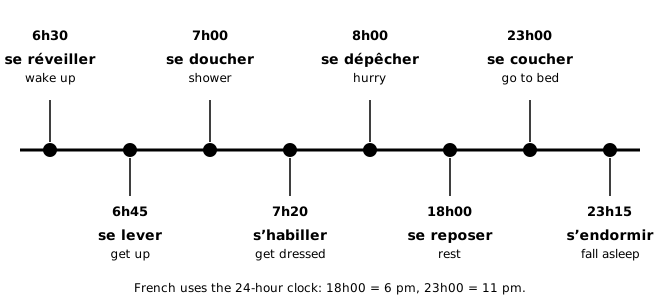
- Je me réveille à six heures et demie. — I wake up at half past six. [zhuhm ray-VAY]
- Il se douche et il se rase. — He showers and shaves. [eel suh DOOSH]
- Dépêche-toi, on est en retard ! — Hurry up, we’re late! [day-pɛsh-TWA]
- Les enfants se couchent à neuf heures. — The children go to bed at nine. [suh KOOSH]
- Je me brosse les dents après le petit-déjeuner. — I brush my teeth after breakfast.
- Elle se lave les mains. — She washes her hands.
Body parts take le / la / les
With a reflexive verb, the body part takes the article, not “my/her”: je me brosse les dents, elle se coupe les cheveux. The me / se already says whose.
Careful
- Wrong: Je me lave mes mains.
- Right: Je me lave les mains.
- Why: Saying “whose” twice (me + mes) sounds wrong in French. English and Hindi both say “my hands / apne haath”; French says “the hands to myself”.
20.3 With or without se: the meaning changes
Many verbs exist in both forms. Without se, you do the action to someone or something else. With se, the action comes back to you.
| Without se | With se |
|---|---|
| Je lave la voiture. I wash the car. |
Je me lave. I wash (myself). |
| Il couche le bébé. He puts the baby to bed. |
Il se couche. He goes to bed. |
| Elle appelle sa mère. She calls her mother. |
Elle s’appelle Anne. Her name is Anne. |
| Je promène le chien. I walk the dog. |
Je me promène. I go for a walk. |
| Le film m’ennuie. The film bores me. |
Je m’ennuie. I’m bored. |
| Il arrête la voiture. He stops the car. |
La voiture s’arrête. The car stops. |
- Le dimanche, on se promène au parc. — On Sundays we go for a walk in the park. [suh pro-MɛN]
- Je m’ennuie ici. On s’en va ? — I’m bored here. Shall we leave? [zhuh mã-NWEE]
Careful
- Wrong: Je suis ennuyé. (meaning “I’m bored”)
- Right: Je m’ennuie.
- Why: English “I’m bored” is an adjective; French uses the reflexive verb. Je suis ennuyé means “I’m bothered / embarrassed”.
20.4 Each other: the reciprocal meaning
With a plural subject (nous, vous, ils, on), se can mean each other. The verb is the same; the context tells you which meaning.
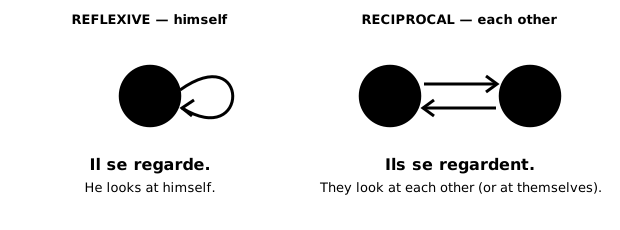
- Ils s’aiment depuis le lycée. — They have loved each other since high school. [eel SɛM]
- On s’écrit tous les jours. — We write to each other every day.
- Mes frères se disputent tout le temps. — My brothers argue (with each other) all the time.
- Vous vous connaissez ? — Do you know each other?
- On se tutoie ? — Shall we say “tu” to each other? — the moment you switch from vous to tu [õ suh tew-TWA]
To remove any doubt, add l’un l’autre (“one another”): Ils se regardent l’un l’autre.
20.5 Idiomatic pronominal verbs: learn them as new words
Some verbs change meaning completely with se, or exist only with it. There is no “myself” here — just learn them as vocabulary.
| Pronominal verb | Meaning | Compare |
|---|---|---|
| s’en aller | to leave, go away | aller = to go |
| se rendre compte (de) | to realise | rendre = to give back |
| se souvenir de | to remember | only pronominal |
| se tromper | to be wrong, make a mistake | tromper = to deceive |
| se passer | to happen | passer = to pass |
| s’entendre (avec) | to get along (with) | entendre = to hear |
| se débrouiller | to manage, cope | only pronominal (in this sense) |
| s’occuper de | to take care of | occuper = to occupy |
| se mettre à | to start (doing) | mettre = to put |
| s’inquiéter | to worry | inquiéter = to worry sb |
| se servir de | to use | servir = to serve |
- Qu’est-ce qui se passe ? — What’s happening? / What’s going on? [kɛs-kee suh PAS]
- Je ne me souviens pas de son nom. — I don’t remember his/her name.
- Tu te rends compte ? Il a tout oublié ! — Can you believe it? (lit. do you realise?) He forgot everything!
- Pardon, je me suis trompé de numéro. — Sorry, I dialled the wrong number.
- Ne t’inquiète pas, je me débrouille. — Don’t worry, I can manage.
- Je m’entends très bien avec ma belle-sœur. — I get on very well with my sister-in-law.
Learn them with se
Always learn these verbs in the se form and with their preposition: se souvenir de, s’occuper de, se mettre à. Dropping se often gives a different verb.
Careful
- Wrong: Je souviens de toi.
- Right: Je me souviens de toi.
- Why: Souvenir alone is a noun (a memory, a souvenir). The verb only exists as se souvenir de. (Synonym without se: je me rappelle ton nom / careful: se rappeler takes no de.)
20.6 Ça se dit: the passive meaning
With a thing as subject, se often has a passive meaning: “it is said”, “it is done”, “it is eaten”. This is very common for rules, habits and instructions — where English uses a passive or “you”.
- Ça ne se dit pas. — You don’t say that. / That isn’t said. [sa nuh suh dee PA]
- Ça ne se fait pas ! — That isn’t done! / That’s not acceptable!
- Comment ça s’écrit ? — How do you spell that? (lit. how is it written?) [ko-mã sa say-KREE]
- Le français se parle sur cinq continents. — French is spoken on five continents.
- Ce vin se boit frais. — This wine is drunk chilled.
- Ça se voit ! — It shows! / That’s obvious!
Thing + se = passive
When the subject is a thing, se + verb usually means “is done”: ça se mange = it can be eaten, ça se dit = people say it.
20.7 In negatives, questions and with infinitives
Negative: ne + pronoun + verb + pas
The pronoun stays glued to the verb; ne … pas wraps around both.
- Je ne me lève pas tôt le week-end. — I don’t get up early at the weekend.
- Ils ne s’entendent plus. — They don’t get on any more.
Careful
- Wrong: Je me ne lève pas.
- Right: Je ne me lève pas.
- Why: Ne comes first, then the whole pronoun + verb block. Nothing goes between me and lève.
Questions
- Tu te couches à quelle heure ? — What time do you go to bed? (everyday)
- Est-ce que vous vous souvenez de moi ? — Do you remember me?
- À quelle heure vous levez-vous ? — What time do you get up? (formal inversion: the reflexive pronoun stays in front)
With an infinitive: the pronoun still matches the subject
- Je vais me coucher. — I’m going to bed.
- Nous devons nous dépêcher. — We must hurry.
- Tu veux t’asseoir ? — Do you want to sit down? [tew vuh ta-SWAR]
Careful
- Wrong: Je vais se reposer.
- Right: Je vais me reposer.
- Why: The infinitive keeps a pronoun that matches the subject je. Only the dictionary form says se.
Commands
Positive commands put the pronoun after the verb, and te becomes toi: Lève-toi ! Asseyez-vous. Dépêchons-nous ! Negative commands keep it in front: Ne te lève pas ! Ne vous inquiétez pas. More in Giving instructions.
20.8 In the past: always with être (a preview)
In the passé composé, every pronominal verb uses être, never avoir. The pronoun goes before être, and the participle usually agrees with the subject.
| Subject | se lever — passé composé |
|---|---|
| je | je me suis levé(e) |
| tu | tu t’es levé(e) |
| il / elle | il s’est levé / elle s’est levée |
| nous | nous nous sommes levé(e)s |
| vous | vous vous êtes levé(e)(s) |
| ils / elles | ils se sont levés / elles se sont levées |
- Ce matin, elle s’est réveillée en retard. — This morning she woke up late.
- On s’est bien amusés hier soir ! — We had a great time last night!
- Je ne me suis pas rendu compte de l’heure. — I didn’t realise what time it was.
Careful
- Wrong: Je m’ai levé à sept heures.
- Right: Je me suis levé à sept heures.
- Why: Pronominal verbs always take être in compound tenses.
One trap for later
If a direct object comes after the verb, there is no agreement: Elle s’est lavée. but Elle s’est lavé les mains. The full rules are in The past: passé composé.
20.9 In real life: a morning at home
- — Arjun, lève-toi ! Il est sept heures et quart ! — — Arjun, get up! It’s quarter past seven!
- — Oui, oui… je me lève. Je me suis couché tard. — — Yes, yes… I’m getting up. I went to bed late.
- — Dépêche-toi, le bus passe à huit heures. Tu te douches maintenant ? — — Hurry up, the bus comes at eight. Are you showering now?
- — Non, je me suis douché hier soir. Je m’habille et j’arrive. — — No, I showered last night. I’ll get dressed and I’m coming.
- — Et ne t’en va pas sans ton déjeuner ! — — And don’t leave without your lunch!
À retenir
- A pronominal verb carries a pronoun that matches the subject: je me lève, tu te lèves, il se lève. The pronoun goes before the verb.
- With a reflexive verb, the body part takes the article, not “my/her”: je me brosse les dents, elle se coupe les cheveux. The me / se already says whose.
- Always learn these verbs in the se form and with their preposition: se souvenir de, s’occuper de, se mettre à. Dropping se often gives a different verb.
- When the subject is a thing, se + verb usually means “is done”: ça se mange = it can be eaten, ça se dit = people say it.
- Tomorrow morning, narrate your routine out loud as you do it: je me réveille, je me lève, je me douche… Tonight, tell it in the past: je me suis réveillé(e)… — and then read The past: passé composé.
20.10 Practice — Reflexive verbs
Exercise 1
Tu ___ appelles comment ?
- te
- t'
- se
- s'
Answer
t'
tu → te, and te before a vowel → t'.
Exercise 2
Nous ___ levons à six heures.
- se
- nous
- nos
- vous
Answer
nous
nous + nous + verb: nous nous levons.
Exercise 3
Which sentence means 'I'm bored'?
- Je suis ennuyé.
- Je m'ennuie.
- J'ennuie.
- Je suis ennui.
Answer
Je m'ennuie.
'I'm bored' = the reflexive verb s'ennuyer: je m'ennuie.
Exercise 4
Ils s'écrivent tous les jours. This means:
- They write to themselves.
- They write to each other.
- They are written.
- They write a lot.
Answer
They write to each other.
With a plural subject, se often means 'each other' (reciprocal).
Exercise 5
Ça ne se fait pas means:
- It doesn't work.
- That isn't done / not acceptable.
- He doesn't do it.
- It's not finished.
Answer
That isn't done / not acceptable.
Thing + se = passive: 'that is not done'.
Exercise 6
Je vais ___ coucher. (I'm going to bed.)
Hint: match the subject
Answer
me
With an infinitive the pronoun still matches je → me.
Exercise 7
Elle se brosse ___ dents.
Hint: body part
Answer
les
Body parts take the article: les dents, not ses dents.
Exercise 8
Hier, elle s'est ___ (réveiller) à six heures.
Hint: être + agreement
Answer
réveillée / reveillee
Pronominal verbs use être; the participle agrees with elle: réveillée.
Exercise 9
Je ne ___ souviens pas de son adresse.
Answer
me
se souvenir de → je me souviens; ne before the pronoun.
Exercise 10
Tap the wrong word.
Je se lève tôt le lundi.
Answer
Wrong word: se.
Corrected: Je me lève tôt le lundi.
With je the pronoun is me.
Exercise 11
Tap the wrong word.
Hier je m'ai couché à minuit.
Answer
Wrong word: m'ai.
Corrected: Hier je me suis couché à minuit.
Pronominal verbs always take être: je me suis couché.
Exercise 12
Tap the wrong word.
Je me lave mes mains.
Answer
Wrong word: mes.
Corrected: Je me lave les mains.
With a reflexive verb, body parts take les, not mes.
Exercise 13
Put the words in order: I don't get up early.
Words: tôt / Je / me / ne / pas / lève
Answer
Je ne me lève pas tôt
ne + pronoun + verb + pas.
Exercise 14
Put the words in order: What's going on?
Words: qui / Qu'est-ce / se / passe
Answer
Qu'est-ce qui se passe
se passer = to happen.
Exercise 15
Match the verb to its meaning.
| A | B |
|---|---|
| se rendre compte | to leave |
| se tromper | to manage |
| s'en aller | to realise |
| se débrouiller | to be wrong |
Answer
se rendre compte — to realise; se tromper — to be wrong; s'en aller — to leave; se débrouiller — to manage
Idiomatic pronominal verbs must be learned as new words.
Exercise 16
Say it aloud.
Je me lève à six heures tous les jours
Answer
Say: Je me lève à six heures tous les jours
je me lève: zhuhm LɛV — the e of me almost disappears.
Exercise 17
Say it aloud.
Ne t'inquiète pas je me débrouille
Answer
Say: Ne t'inquiète pas je me débrouille
A very useful reassuring line.
Next step
Tomorrow morning, narrate your routine out loud as you do it: je me réveille, je me lève, je me douche… Tonight, tell it in the past: je me suis réveillé(e)… — and then read The past: passé composé.