Chapter 60: Final test
L’examen final
Forty questions, one for (almost) every chapter, in the order of the book: sounds first, then the foundations, the big grammar machine, speaking, vocabulary, writing and culture. It is not an official exam — it is a map of your gaps. Every wrong answer points to exactly one or two chapters to reopen.
- 1How the test works
- 2What the test covers
- 3Warm-up — say these aloud first
- 4Four traps to avoid on the way
- 5Your score — what it means
- 6Where did you go wrong? Reopen this chapter
- 7After the test — a one-week repair plan
masculinefeminine
How to use this test
Do it in one sitting, without looking back at the chapters. Write down the number of every question you miss — then use the table in section 6 to see which chapter to reopen.
60.1 How the test works
The test mixes all six question types you have met in the book: multiple choice, fill the gap, spot the mistake, put the words in order, match the pairs, and say it aloud. The spoken questions use your microphone if your browser allows it; if not, say the line aloud anyway and be honest with yourself.
- Time: about 45 minutes. Do not stop to look things up.
- Paper: keep a notebook open and write the numbers of the questions you miss.
- Voice: read every French sentence in your head with its sounds — liaison, nasals, silent letters.
- Retake: do it again in a week. The second score is the one that counts.
Read the hint only after you try
Answer first, then check the hint. A guess you correct teaches you more than an answer you copy.
60.2 What the test covers
The questions follow the seven Parts of the book. Part 3 (Construire) has the most, because it is where most marks are lost in real exams: pronouns, past tenses, the subjunctive.
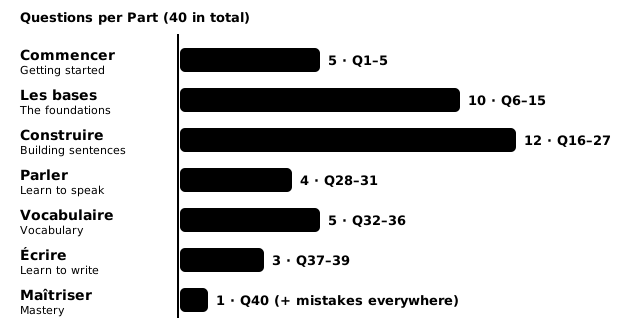
The weighting
More than half the test (22 of 40) is grammar from Parts 2 and 3 — the skeleton of every sentence you will ever say.
60.3 Warm-up — say these aloud first
Ten sentences from across the book. Listen, repeat each one twice, then start the test. If any of them feels strange, note the chapter in brackets.
- Les‿enfants sont‿au jardin. — The children are in the garden. (Silent letters & liaison)
- Il a quatre-vingt-dix-sept ans. — He is ninety-seven. (Numbers, dates & time · Être & avoir)
- Je n’ai pas de voiture, mais j’ai un vélo. — I don’t have a car, but I have a bike. (Articles · Saying no)
- Tu en veux ? — Oui, j’en veux deux. — Do you want some? — Yes, I want two. (Y, en & pronoun order)
- Quand j’étais petit, j’habitais à Chennai. — When I was little, I lived in Chennai. (Imparfait vs passé composé)
- Il faut que tu viennes avec nous. — You have to come with us. (The subjunctive)
- Si j’avais su, je serais venu plus tôt. — If I had known, I would have come earlier. (Advanced compound tenses)
- Bah, du coup, on y va ou quoi ? — Well, so, are we going or what? (Real spoken French)
- J’ai la flemme de sortir, il pleut des cordes. — I can’t be bothered to go out, it’s pouring. (Idioms & expressions)
- Je vous prie d’agréer, Madame, l’expression de mes salutations distinguées. — Yours faithfully. (Messages, letters & emails)
- Néanmoins, cette démarche suscite de nombreuses questions. — Nevertheless, this approach raises many questions. (Word building & advanced words)
- À Pondichéry, on voit encore des noms de rue en français. — In Pondicherry you still see street names in French. (Culture & the francophone world)
60.4 Four traps to avoid on the way
These are not in the test — but they are the slips that most often make a learner change a right answer into a wrong one. Read them once, then start.
Classic traps
- Wrong: Je suis fini.
- Right: J’ai fini.
-
Why: Je suis fini means "I am done for". Finishing something takes avoir.
-
Wrong: J’attends pour le bus.
- Right: J’attends le bus.
-
Why: attendre, chercher, écouter, regarder take a direct object — no "for", "at" or "to".
-
Wrong: Si j’aurais su…
- Right: Si j’avais su…
-
Why: Never the conditional right after si (= if). Si + imparfait / plus-que-parfait.
-
Wrong: Il pleut des chats et des chiens.
- Right: Il pleut des cordes.
- Why: Idioms do not travel word for word. French rain falls in "ropes".
60.5 Your score — what it means
Count one point per question. The bands below are a rough guide to which level you are building on — only an official exam gives you a certified level (see DELF, DALF & your level).
| Score | What it suggests | What to do next |
|---|---|---|
| 36–40 | A solid B2 foundation | Work on C1 material: Literary & formal French, Arguing & presenting, Word building & advanced words; try DELF B2 / DALF C1 sample papers. |
| 28–35 | Around B1, heading to B2 | Reopen only the chapters of the questions you missed (section 6), then retake the test in a week. |
| 18–27 | Around A2, heading to B1 | Redo Part 3 Construire in order, with each chapter’s quiz twice. |
| 0–17 | A1–A2 | No problem — start again from How to use this book and go through Part 2 Les bases slowly, out loud. |
Speaking counts double in real life
If you missed the three spoken questions (Q2, Q4, Q20), give them extra time: reopen Pronunciation clinic before anything else.
60.6 Where did you go wrong? Reopen this chapter
Find each question you missed. The chapter named on the right is where the answer is taught.
Part 1 — Commencer (Q1–5)
| Q | Tests | Reopen |
|---|---|---|
| 1 | accents and their sounds | Alphabet & accents |
| 2 | u vs ou (spoken) | The sounds of French · Pronunciation clinic |
| 3 | liaison in les amis | Silent letters & liaison |
| 4 | a polite request at the bakery (spoken) | Hello, please, thank you · Everyday French |
| 5 | 99 = quatre-vingt-dix-neuf | Numbers, dates & time |
Part 2 — Les bases (Q6–15)
| Q | Tests | Reopen |
|---|---|---|
| 6 | gender of problème | Nouns, gender & plurals |
| 7 | partitive du | Articles |
| 8 | age with avoir | Être & avoir · The 50 most common mistakes |
| 9 | mangeons | Present tense: -er verbs |
| 10 | ils vont | Present tense: the rest |
| 11 | ne… jamais + de | Saying no |
| 12 | pourquoi / parce que | Asking questions |
| 13 | meilleure (agreement + comparative) | Adjectives · Comparing |
| 14 | mon amie | My, your, this, that |
| 15 | au Japon / en France | Prepositions & places |
Part 3 — Construire (Q16–27)
| Q | Tests | Reopen |
|---|---|---|
| 16 | je le lui donne | Object pronouns · Y, en & pronoun order |
| 17 | elle s’est levée | Reflexive verbs · The past: passé composé |
| 18 | background vs event | Imparfait vs passé composé |
| 19 | nous partirons | The future |
| 20 | ne t’inquiète pas (spoken) | Giving instructions |
| 21 | dont | Relative pronouns |
| 22 | si + imparfait → conditionnel | Conditional & si clauses |
| 23 | bien que + subjonctif | The subjunctive · Linking words |
| 24 | plus-que-parfait | Advanced compound tenses |
| 25 | future in the past: viendrait | Passive & reported speech |
| 26 | gérondif en faisant | Gérondif & participles |
| 27 | passé simple | Literary & formal French |
Parts 4–7 — Parler, Vocabulaire, Écrire, Maîtriser (Q28–40)
| Q | Tests | Reopen |
|---|---|---|
| 28 | emergency numbers | Travel & emergencies |
| 29 | à mon avis | Conversation & opinions |
| 30 | chais pas, bagnole, boulot, meuf | Real spoken French · Registers & slang |
| 31 | Ne quittez pas on the phone | Work, phone & interviews |
| 32 | body, home, clothes, seasons | Core vocabulary by theme |
| 33 | tu me manques | The 100 essential verbs |
| 34 | librairie ≠ library | Cognates & false friends · The 50 most common mistakes |
| 35 | poser un lapin | Idioms & expressions |
| 36 | changer → changement | Word building & advanced words |
| 37 | a / à | Spelling & punctuation |
| 38 | formal letter closing | Messages, letters & emails |
| 39 | amorce, problématique, plan, ouverture | Essays & structured writing · Arguing & presenting |
| 40 | septante | Culture & the francophone world |
| All | your overall score and next exam | DELF, DALF & your level · How to use this book |
60.7 After the test — a one-week repair plan
Do not reread the whole book. Reopen only what the table told you, and use the chapter quizzes, which are short enough to do every day.
| Day | What to do |
|---|---|
| 1 | List the chapters from section 6. Read the first one and do its quiz. |
| 2–4 | One or two chapters a day; redo yesterday’s quiz before starting a new one. |
| 5 | Say every say example of your weakest chapter aloud — twice. |
| 6 | Write five sentences using what you repaired; check them against the chapters. |
| 7 | Retake this final test. Compare the two scores. |
À retenir
- Do it in one sitting, without looking back at the chapters. Write down the number of every question you miss — then use the table in section 6 to see which chapter to reopen.
- Answer first, then check the hint. A guess you correct teaches you more than an answer you copy.
- More than half the test (22 of 40) is grammar from Parts 2 and 3 — the skeleton of every sentence you will ever say.
- If you missed the three spoken questions (Q2, Q4, Q20), give them extra time: reopen Pronunciation clinic before anything else.
- Write your score and the date in your notebook. Fix the chapters from section 6 this week, then retake the test — and when you score 36 or more twice, book your next exam (see DELF, DALF & your level). Bravo et bonne…
60.8 Final test — the whole book
Exercise 1
Q1 · Match each accent to its sound.
| A | B |
|---|---|
| é | s, as in garçon |
| è | oh, as in hôtel |
| ç | ay, as in café |
| ô | eh, as in mère |
Answer
é — ay, as in café; è — eh, as in mère; ç — s, as in garçon; ô — oh, as in hôtel
é is closed [e], è is open [ɛ], ç is always [s], ô is a closed [o]. See Alphabet & accents.
Exercise 2
Q2 · Say it aloud: u and ou in one line.
Toute la rue a vu le loup
Answer
Say: Toute la rue a vu le loup
toute, loup = ou [u]; rue, vu = u [y]: say ee with rounded lips. See The sounds of French.
Exercise 3
Q3 · How do you pronounce « les amis »?
- lay-ah-MEE
- lay-zah-MEE
- less-ah-MEE
- lay-sah-MEE
Hint: liaison
Answer
lay-zah-MEE
The silent s of les is pronounced z before a vowel: les‿amis. See Silent letters & liaison.
Exercise 4
Q4 · At the bakery — say it politely.
Bonjour Madame, je voudrais une baguette, s'il vous plaît
Answer
Say: Bonjour Madame, je voudrais une baguette, s'il vous plaît
Bonjour first, then je voudrais (not je veux), then s'il vous plaît. See Hello, please, thank you.
Exercise 5
Q5 · 99 = quatre-vingt-___
Hint: 4 × 20 + 19
Answer
dix-neuf / dix neuf
quatre-vingt-dix-neuf = 80 + 19. See Numbers, dates & time.
Exercise 6
Q6 · C'est ___ problème difficile.
- un
- une
- la
- des
Hint: Words in -ème from Greek
Answer
un
le problème, le système, le thème are masculine despite the final -e. See Nouns, gender & plurals.
Exercise 7
Q7 · Le matin, je mange ___ pain. (some bread)
Answer
du
An unspecified amount of a masculine noun: du pain. See Articles.
Exercise 8
Q8 · Tap the wrong word.
Mon frère est vingt-cinq ans.
Answer
Wrong word: est.
Corrected: Mon frère a vingt-cinq ans.
French has its age: avoir 25 ans. See Être & avoir.
Exercise 9
Q9 · Nous ___ (manger) au restaurant ce soir.
Hint: Keep the g soft
Answer
mangeons
-ger verbs keep an e before -ons: nous mangeons. See Present tense: -er verbs.
Exercise 10
Q10 · Ils ___ au cinéma ce soir. (aller)
- vont
- allent
- vas
- allons
Answer
vont
aller: je vais, tu vas, il va, nous allons, vous allez, ils vont. See Present tense: the rest.
Exercise 11
Q11 · Put the words in order: I never eat meat.
Words: mange / viande / Je / de / jamais / ne
Answer
Je ne mange jamais de viande
ne + verb + jamais, and de (not de la) after a negation. See Saying no.
Exercise 12
Q12 · ___ apprends-tu le français ? — Parce que je veux vivre à Montréal.
- Pourquoi
- Comment
- Quand
- Où
Answer
Pourquoi
The answer parce que (because) matches pourquoi (why). See Asking questions.
Exercise 13
Q13 · Cette pizza est ___ que l'autre.
- meilleure
- plus bonne
- meilleur
- mieux
Hint: bon → ?
Answer
meilleure
bon becomes meilleur, and agrees with pizza (feminine): meilleure. mieux is the adverb. See Adjectives and Comparing.
Exercise 14
Q14 · Tap the wrong word.
Ma amie Sophie arrive demain.
Answer
Wrong word: Ma.
Corrected: Mon amie Sophie arrive demain.
Before a vowel sound, ma becomes mon, even for a feminine noun: mon amie. See My, your, this, that.
Exercise 15
Q15 · Tap the wrong word.
Cet été, je vais en Japon.
Answer
Wrong word: en.
Corrected: Cet été, je vais au Japon.
Masculine countries take au (au Japon, au Canada); feminine ones take en (en France, en Inde). See Prepositions & places.
Exercise 16
Q16 · Je donne le livre à Paul → replace both with pronouns.
Words: le / lui / donne / Je
Answer
Je le lui donne
Order: le / la / les before lui / leur. See Object pronouns and Y, en & pronoun order.
Exercise 17
Q17 · Ce matin, elle s'est ___ (lever) à six heures.
Hint: être + agreement
Answer
levée / levee
Reflexive verbs take être, and the participle agrees: elle s'est levée. See Reflexive verbs and The past: passé composé.
Exercise 18
Q18 · Je ___ la télé quand le téléphone a sonné.
- regardais
- ai regardé
- regarde
- regarderai
Answer
regardais
The action in progress (the scene) is in the imparfait; the interruption (the event) in the passé composé. See Imparfait vs passé composé.
Exercise 19
Q19 · Demain, nous ___ (partir) à huit heures. (futur simple)
Answer
partirons
Futur simple = infinitive + -ons: partirons. See The future.
Exercise 20
Q20 · Tell a friend not to worry.
Ne t'inquiète pas, tout va bien
Answer
Say: Ne t'inquiète pas, tout va bien
Negative imperative of a reflexive verb: the pronoun stays in front — ne t'inquiète pas. See Giving instructions.
Exercise 21
Q21 · C'est le livre ___ je t'ai parlé.
- dont
- que
- qui
- où
Hint: parler de…
Answer
dont
parler de quelque chose → dont replaces de + noun. See Relative pronouns.
Exercise 22
Q22 · Si j'avais le temps, je ___ (voyager) plus souvent.
Answer
voyagerais
si + imparfait → conditionnel présent: je voyagerais. See Conditional & si clauses.
Exercise 23
Q23 · Bien qu'il ___ fatigué, il continue à travailler.
- soit
- est
- sera
- était
Answer
soit
bien que always takes the subjunctive: qu'il soit. See The subjunctive and Linking words.
Exercise 24
Q24 · Quand je suis arrivé, le film ___ déjà commencé.
- avait
- a
- aura
- aurait
Answer
avait
An action before another past action: plus-que-parfait, il avait commencé. See Advanced compound tenses.
Exercise 25
Q25 · Il a dit : « Je viendrai demain. » → Il a dit qu'il ___ le lendemain.
Hint: future in the past
Answer
viendrait
After a past reporting verb, the future becomes the conditional: viendrait; demain becomes le lendemain. See Passive & reported speech.
Exercise 26
Q26 · Il s'est blessé ___ du vélo. (while riding)
- en faisant
- en fait
- pour faire
- faisant en
Answer
en faisant
Gérondif = en + present participle: en faisant = while doing. See Gérondif & participles.
Exercise 27
Q27 · Match the passé simple (novels) to the passé composé (speech).
| A | B |
|---|---|
| il fut | ils ont fait |
| elle alla | nous avons eu |
| ils firent | il a été |
| nous eûmes | elle est allée |
Answer
il fut — il a été; elle alla — elle est allée; ils firent — ils ont fait; nous eûmes — nous avons eu
You must recognise the passé simple to read novels. See Literary & formal French.
Exercise 28
Q28 · Emergency numbers in France.
| A | B |
|---|---|
| 15 | pompiers (fire brigade) |
| 17 | European emergency number |
| 18 | SAMU (medical emergency) |
| 112 | police |
Answer
15 — SAMU (medical emergency); 17 — police; 18 — pompiers (fire brigade); 112 — European emergency number
15 doctor, 17 police, 18 fire, 112 anywhere in Europe. See Travel & emergencies.
Exercise 29
Q29 · À mon ___, c'est une excellente idée. (opinion)
Answer
avis
À mon avis = in my opinion (never « dans mon opinion »). See Conversation & opinions.
Exercise 30
Q30 · Match spoken or slang French to standard French.
| A | B |
|---|---|
| chais pas | travail |
| bagnole | femme |
| boulot | je ne sais pas |
| meuf | voiture |
Answer
chais pas — je ne sais pas; bagnole — voiture; boulot — travail; meuf — femme
chais pas is fast speech; bagnole and boulot are familier; meuf is verlan for femme. See Real spoken French and Registers & slang.
Exercise 31
Q31 · On the phone, « Ne quittez pas » means…
- Hold the line
- Don't leave the building
- Don't quit your job
- Stay seated
Answer
Hold the line
Ne quittez pas = please hold. See Work, phone & interviews.
Exercise 32
Q32 · Match the French to the English.
| A | B |
|---|---|
| le genou | coat |
| la cuisine | summer |
| le manteau | knee |
| l'été | kitchen |
Answer
le genou — knee; la cuisine — kitchen; le manteau — coat; l'été — summer
Body, home, clothes and seasons. See Core vocabulary by theme.
Exercise 33
Q33 · How do you say « I miss you »?
- Tu me manques
- Je te manque
- Je manque toi
- Je te rate
Answer
Tu me manques
With manquer, the person who is missed is the subject: tu me manques = you are missing to me. See The 100 essential verbs.
Exercise 34
Q34 · Tap the word that is a false friend here.
Je vais à la librairie pour emprunter des livres.
Answer
Wrong word: librairie.
Corrected: Je vais à la bibliothèque pour emprunter des livres.
une librairie is a bookshop; a library is une bibliothèque. See Cognates & false friends.
Exercise 35
Q35 · « Il m'a posé un lapin » means…
- He stood me up
- He gave me a rabbit
- He played a trick on me
- He made me laugh
Answer
He stood me up
poser un lapin à quelqu'un = to not turn up to a date. See Idioms & expressions.
Exercise 36
Q36 · changer (to change) → le ___ (a change)
Hint: a common noun suffix
Answer
changement
verb stem + -ment makes many masculine nouns: changement, développement. See Word building & advanced words.
Exercise 37
Q37 · Tap the spelling mistake.
Hier, elle est allée a Lyon.
Answer
Wrong word: a.
Corrected: Hier, elle est allée à Lyon.
Can you say « avait » instead? No → it is the preposition à. See Spelling & punctuation.
Exercise 38
Q38 · The best ending for a formal letter:
- Veuillez agréer, Madame, Monsieur, l'expression de mes salutations distinguées.
- Gros bisous et à bientôt !
- Merci, à plus !
- Salut et bonne journée !
Answer
Veuillez agréer, Madame, Monsieur, l'expression de mes salutations distinguées.
The formule de politesse repeats the opening (Madame, Monsieur). See Messages, letters & emails.
Exercise 39
Q39 · Match each part of a French essay to its job.
| A | B |
|---|---|
| l'amorce | tells the reader the parts |
| la problématique | widens the topic at the very end |
| l'annonce du plan | catches the reader's attention |
| l'ouverture | the question the essay answers |
Answer
l'amorce — catches the reader's attention; la problématique — the question the essay answers; l'annonce du plan — tells the reader the parts; l'ouverture — widens the topic at the very end
Introduction: amorce, problématique, annonce du plan; conclusion: bilan, ouverture. See Essays & structured writing.
Exercise 40
Q40 · In France 70 is soixante-dix. In Belgium and Switzerland people say…
- septante
- soixante-dix
- huitante
- septante-dix
Answer
septante
Belgium and Switzerland: septante (70) and nonante (90); some Swiss cantons also say huitante (80). See Culture & the francophone world.
Next step
Write your score and the date in your notebook. Fix the chapters from section 6 this week, then retake the test — and when you score 36 or more twice, book your next exam (see DELF, DALF & your level). Bravo et bonne continuation !