Chapter 12: Saying no
La négation
English says “not” once. Written French says it twice: ne before the verb and pas after it, like two slices of bread around a sandwich. Swap pas for another word and you get “never”, “nothing”, “nobody”, “no longer”. This chapter shows the whole family, where each piece goes, and the little word si that English does not have.
- 1The ne… pas sandwich
- 2The other negative words
- 3Rien, personne, jamais on their own
- 4Where the pieces go
- 5Pas de, and the ne… que exception
- 6Si — “yes” to a negative question
- 7In speech, ne often disappears
- 8Mistakes learners really make
- 9In real life — at the hotel desk
In one line
Put ne (n’ before a vowel) before the conjugated verb and pas after it: je ne parle pas, je n’aime pas.
12.1 The ne… pas sandwich
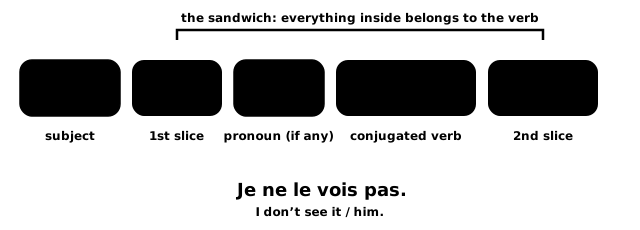
- Je ne parle pas allemand. — I don’t speak German. [zhuh nuh parl pa-zal-MÃ]
- Il n’aime pas le froid. — He doesn’t like the cold. (n’ before a vowel) [eel nem pa luh FRWA]
- Nous ne sommes pas prêts. — We’re not ready. [noo nuh som pa PREH]
- Ce n’est pas grave. — It doesn’t matter. / No problem. [suh neh pa GRAV]
- Vous n’habitez pas ici ? — You don’t live here? [voo na-bee-TAY pa-zee-SEE]
No “do” in French
English adds “do / does” to make a negative. French does not: “I don’t eat” is simply je ne mange pas.
12.2 The other negative words
Keep ne and replace pas with another word:
| Negation | Meaning | Example |
|---|---|---|
| ne … jamais | never | Je ne fume jamais. |
| ne … plus | no longer, not any more | Il n’habite plus ici. |
| ne … rien | nothing, not anything | Je ne vois rien. |
| ne … personne | nobody, not anyone | Je ne connais personne. |
| ne … pas encore | not yet | Elle n’est pas encore là. |
| ne … aucun(e) | not a single, no … at all | Je n’ai aucune idée. |
| ne … ni … ni | neither … nor | Il ne boit ni thé ni café. |
| ne … nulle part | nowhere | Je ne trouve mes clés nulle part. |
| ne … que | only (not really negative) | Je n’ai que dix euros. |
- Je ne bois jamais d’alcool. — I never drink alcohol. [zhuh nuh bwa zha-MEH dal-KOL]
- Il ne travaille plus chez Renault. — He doesn’t work at Renault any more. (plus here: the s is silent) [eel nuh tra-VAÏ PLEW shay ruh-NOH]
- Désolé, je ne comprends rien. — Sorry, I don’t understand anything. [zhuh nuh kõ-PRÃ RYɛ̃]
- Elle ne connaît personne à Paris. — She doesn’t know anyone in Paris. [el nuh ko-NEH per-SON]
- Je n’ai aucune idée. — I have no idea. (aucun / aucune agrees with the noun, always singular) [zhuh nay o-KEWN ee-DAY]
- Je n’aime ni le thé ni le café. — I like neither tea nor coffee. (le stays after aimer)
- Il ne boit ni thé ni café. — He drinks neither tea nor coffee. (du/de la disappear after ni)
- Nous n’avons que deux jours à Paris. — We only have two days in Paris. [noo na-võ kuh duh ZHOOR]
Swap the second slice
ne stays; replace pas with jamais (never), plus (no more), rien (nothing), personne (nobody), aucun (none), que (only).
Combining negatives
Unlike English, French happily stacks negative words — the meaning stays negative:
- Je ne dis plus rien. — I’m not saying anything any more.
- Il ne voit jamais personne. — He never sees anyone.
- Je ne reviendrai plus jamais ici ! — I will never come back here again! (future tense)
12.3 Rien, personne, jamais on their own
Rien and personne can be the subject of the sentence. Then they come first, and ne follows them — there is no pas.
- Personne ne répond. — Nobody is answering. [per-SON nuh ray-PÕ]
- Rien n’est simple. — Nothing is simple. [RYɛ̃ neh Sɛ̃PL]
- Aucun train ne part ce soir. — No train leaves tonight.
In short answers, they work alone, without ne:
- — Qu’est-ce que tu veux ? — Rien, merci. — What do you want? — Nothing, thanks.
- — Qui est là ? — Personne. — Who’s there? — Nobody.
- — Tu fumes ? — Jamais ! — Do you smoke? — Never!
- — Je n’aime pas le poisson. — Moi non plus. — I don’t like fish. — Me neither. (moi aussi = me too, for positive sentences)
- — Qui veut du thé ? — Pas moi ! — Who wants tea? — Not me!
Never ne + pas + rien
pas and rien / personne / jamais do not go together: je ne vois rien, not “je ne vois pas rien”.
12.4 Where the pieces go
In compound tenses (passé composé)
In the past tense j’ai mangé, the conjugated verb is the helper ai. So the sandwich wraps the helper only: je n’ai pas mangé. Most negative words follow this rule. But personne, aucun, que, nulle part go after the past participle. (The passé composé itself is in The past: passé composé.)
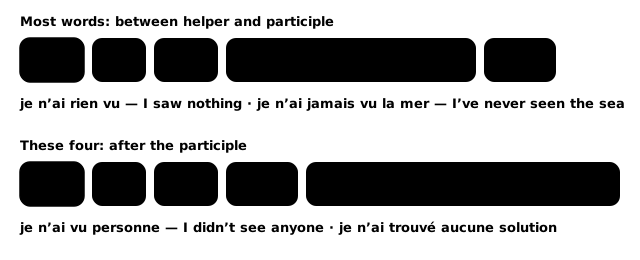
- Je n’ai pas mangé. — I haven’t eaten. / I didn’t eat. [zhuh nay pa mã-ZHAY]
- Elle n’est pas encore arrivée. — She hasn’t arrived yet. [el neh pa-zã-KOR a-ree-VAY]
- Il n’a rien dit. — He didn’t say anything. [eel na ryɛ̃ DEE]
- Nous n’avons vu personne. — We didn’t see anyone. [noo na-võ vew per-SON]
With an infinitive: ne pas together
To make an infinitive negative, put ne pas (or ne jamais, ne rien, ne plus) together before it. You see this on every French sign.
- Ne pas fumer. — No smoking. (sign) [nuh pa few-MAY]
- Je préfère ne pas répondre. — I’d rather not answer.
- Le médecin me dit de ne plus manger de sucre. — The doctor tells me not to eat sugar any more.
- Attention à ne rien oublier ! — Be careful not to forget anything!
With a modal verb + infinitive
The sandwich goes around the conjugated verb: je ne peux pas venir (I can’t come). Compare je peux ne pas venir = I’m allowed not to come.
- Je ne veux pas partir. — I don’t want to leave. [zhuh nuh vuh pa par-TEER]
- Tu ne dois pas le dire. — You mustn’t say it.
Position
Compound tense: je n’ai pas vu, but je n’ai vu personne. Infinitive: ne pas + infinitive together (ne pas fumer).
12.5 Pas de, and the ne… que exception
After a negative, un, une, des, du, de la become de / d’ (full explanation in Articles). Le, la, les do not change, and être keeps its article.
- Je n’ai pas de voiture. — I don’t have a car.
- Il n’y a plus d’œufs. — There are no eggs left. [eel nya plew DUH]
- Ce n’est pas un hôtel, c’est une auberge. — It’s not a hotel, it’s a hostel. (être keeps un)
ne… que means “only”, so it is not really negative: the article does not change.
- Je ne bois que du thé. — I only drink tea. (du stays)
- Il n’a que des amis français. — He only has French friends.
12.6 Si — “yes” to a negative question
French has three answer words. Oui answers a positive question. To say “yes” and contradict a negative question, French uses si. English has to say “Yes, I do!”
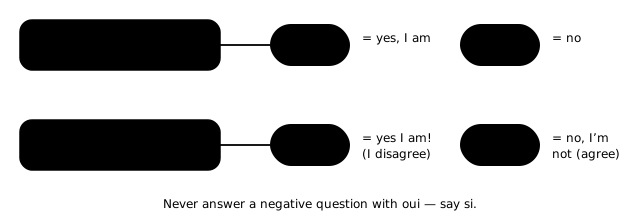
- — Tu ne viens pas ? — Si, j’arrive ! — Aren’t you coming? — Yes, I’m coming! [SEE zha-REEV]
- — Vous ne parlez pas anglais ? — Si, un peu. — You don’t speak English? — Yes I do, a little.
- — Il n’a pas compris ? — Non, il n’a rien compris. — He didn’t understand? — No, he didn’t understand anything.
Si, not oui
To answer “yes” to a negative question (tu ne viens pas ?), say si — oui would sound wrong.
12.7 In speech, ne often disappears
In relaxed spoken French, people very often drop ne and keep only the second word. The negative is still clear because pas, rien, jamais carry it. You will hear this everywhere — but keep ne when you write and in formal speaking.
| Written / careful | Everyday speech | English |
|---|---|---|
| Je ne sais pas. | Je sais pas. (often “chais pas”) | I don’t know. |
| Ce n’est pas grave. | C’est pas grave. | Never mind. |
| Il n’y a personne. | Y a personne. | There’s nobody. |
| Je n’ai rien compris. | J’ai rien compris. | I didn’t get anything. |
- C’est pas grave, t’inquiète. — No big deal, don’t worry. (very casual) [seh pa GRAV tɛ̃-KYET]
Much more on this in Real spoken French.
12.8 Mistakes learners really make
Negation traps
- Wrong: Je pas parle français.
- Right: Je ne parle pas français.
-
Why: pas goes after the verb, and ne before it. Hindi puts nahin before the verb — French does not.
-
Wrong: Je ne pas aime le lait.
- Right: Je n’aime pas le lait.
-
Why: The verb goes inside the sandwich, and ne → n’ before a vowel.
-
Wrong: Je ne vois pas rien.
- Right: Je ne vois rien.
-
Why: rien replaces pas. Never use both.
-
Wrong: Je n’ai personne vu.
- Right: Je n’ai vu personne.
-
Why: personne goes after the past participle (unlike rien: je n’ai rien vu).
-
Wrong: Je n’ai pas des frères.
- Right: Je n’ai pas de frères.
-
Why: After a negative, des → de.
-
Wrong: — Tu n’as pas faim ? — Oui, j’ai faim.
- Right: — Tu n’as pas faim ? — Si, j’ai faim.
-
Why: Contradicting a negative question needs si.
-
Wrong: Je ne veux pas ne partir.
- Right: Je ne veux pas partir.
- Why: One sandwich only, around the conjugated verb.
12.9 In real life — at the hotel desk
- — Bonsoir, je n’ai pas de réservation. Vous avez une chambre ? — Good evening, I don’t have a booking. Do you have a room?
- — Désolé, il ne reste plus de chambres doubles. Je n’ai qu’une chambre simple. — Sorry, there are no double rooms left. I only have a single room.
- — Ce n’est pas grave. Le petit-déjeuner n’est pas compris ? — That’s fine. Breakfast isn’t included?
- — Si, il est compris. Et il n’y a jamais de bruit la nuit, c’est très calme. — Yes, it is included. And there’s never any noise at night, it’s very quiet.
- — Parfait. Je ne veux rien d’autre, merci ! — Perfect. I don’t want anything else, thank you!
À retenir
- Put ne (n’ before a vowel) before the conjugated verb and pas after it: je ne parle pas, je n’aime pas.
- English adds “do / does” to make a negative. French does not: “I don’t eat” is simply je ne mange pas.
- ne stays; replace pas with jamais (never), plus (no more), rien (nothing), personne (nobody), aucun (none), que (only).
- Compound tense: je n’ai pas vu, but je n’ai vu personne. Infinitive: ne pas + infinitive together (ne pas fumer).
- To answer “yes” to a negative question (tu ne viens pas ?), say si — oui would sound wrong.
- You can say no; now learn to ask in Asking questions. Try today: make three true negative sentences about yourself with jamais, plus and rien.
12.10 Practice — Negation
Exercise 1
Make it negative: J'aime le fromage.
- Je n'aime pas le fromage.
- Je ne pas aime le fromage.
- Je n'aime pas de fromage.
- Je aime pas le fromage.
Answer
Je n'aime pas le fromage.
n' + verb + pas; le does not change after aimer.
Exercise 2
'I never eat meat.'
- Je ne mange jamais de viande.
- Je ne mange pas jamais de viande.
- Je jamais mange viande.
- Je ne mange jamais la viande.
Answer
Je ne mange jamais de viande.
ne … jamais, and de la → de after a negative.
Exercise 3
— Tu ne travailles pas demain ? — ___, je travaille !
- Oui
- Si
- Non
- Pas
Answer
Si
Contradicting a negative question = si.
Exercise 4
'I didn't see anybody.'
- Je n'ai personne vu.
- Je n'ai vu personne.
- Je n'ai pas vu personne.
- Personne je n'ai vu.
Answer
Je n'ai vu personne.
personne goes after the past participle.
Exercise 5
___ ne comprend cette règle.
- Rien
- Personne
- Jamais
- Aucun
Hint: Nobody understands…
Answer
Personne
personne as subject: Personne ne comprend.
Exercise 6
Il n'habite ___ à Lyon. (any more)
Answer
plus
ne … plus = no longer.
Exercise 7
Je n'ai ___ dit. (nothing)
Hint: before the participle
Answer
rien
ne … rien, placed before the participle: je n'ai rien dit.
Exercise 8
Nous n'avons ___ dix minutes. (only)
Answer
que / qu'
ne … que = only.
Exercise 9
Je préfère ___ sortir ce soir. (not to go out)
Hint: negative infinitive: two words
Answer
ne pas
ne pas go together before an infinitive.
Exercise 10
Tap the wrong word.
Je ne vois pas rien.
Answer
Wrong word: pas.
Corrected: Je ne vois rien.
rien replaces pas.
Exercise 11
Tap the wrong word.
Il n'y a pas des tomates.
Answer
Wrong word: des.
Corrected: Il n'y a pas de tomates.
des → de after a negative.
Exercise 12
Match the French to the English.
| A | B |
|---|---|
| ne … jamais | nothing |
| ne … plus | nobody |
| ne … rien | only |
| ne … personne | never |
| ne … que | no longer |
Answer
ne … jamais — never; ne … plus — no longer; ne … rien — nothing; ne … personne — nobody; ne … que — only
Keep ne, change the second word.
Exercise 13
Put the words in order.
Words: français / Je / parle / ne / bien / pas
Answer
Je ne parle pas bien français
ne + verb + pas + the rest.
Exercise 14
Put the words in order.
Words: arrivée / n'est / Elle / pas / encore
Answer
Elle n'est pas encore arrivée
ne … pas encore wraps the helper est.
Exercise 15
Say it aloud.
Je ne comprends rien
Answer
Say: Je ne comprends rien
ne … rien = nothing.
Exercise 16
Answer with si.
Si je parle un peu français
Answer
Say: Si je parle un peu français
Si contradicts the negative question 'Tu ne parles pas français ?'
Exercise 17
Say it the casual way.
C'est pas grave
Answer
Say: C'est pas grave
Spoken French drops ne; write ce n'est pas grave.
Next step
You can say no; now learn to ask in Asking questions. Try today: make three true negative sentences about yourself with jamais, plus and rien.