Chapter 16: My, your, this, that
Possessifs et démonstratifs
Mon livre, ma maison, mes amis; ce livre, cette maison, ces amis. Words for “my” and “this” work like articles: they agree with the noun that follows. The big surprise for English speakers — but not for Hindi speakers — is that “his” and “her” agree with the thing, not with the owner.
- 1My, your, his, her: possessive adjectives
- 2Mon amie: the vowel rule
- 3Mine, yours: possessive pronouns
- 4À moi, à toi: “it belongs to…”
- 5This, that: ce, cet, cette, ces
- 6This one, that one: celui, celle, ceux, celles
- 7Mistakes learners really make
- 8In real life — in a clothes shop
masculinefeminineplural
In one line
Possessives and demonstratives agree with the noun that follows, not with the owner: sa voiture = his car or her car.
16.1 My, your, his, her: possessive adjectives
| Owner | + masc. noun | + fem. noun | + plural |
|---|---|---|---|
| je (my) | mon frère | ma sœur | mes parents |
| tu (your) | ton frère | ta sœur | tes parents |
| il / elle (his, her, its) | son frère | sa sœur | ses parents |
| nous (our) | notre frère | notre sœur | nos parents |
| vous (your) | votre frère | votre sœur | vos parents |
| ils / elles (their) | leur frère | leur sœur | leurs parents |
- Mon père est médecin et ma mère est avocate. — My father is a doctor and my mother is a lawyer. [mõ PEHR … ma MEHR]
- Où sont tes clés ? — Where are your keys? [oo sõ tay KLAY]
- Notre maison est petite, mais nos voisins sont adorables. — Our house is small, but our neighbours are lovely. [NOTR meh-ZÕ … noh vwa-Zɛ̃]
- C’est votre passeport, madame ? — Is this your passport, madam? (vous = polite “your”) [VOTR pas-POR]
- Les Dubois adorent leur chien et leurs chats. — The Dubois love their dog and their cats. (leur = one thing, leurs = several) [luhr SHYɛ̃ ay luhr SHA]
His or her? The thing decides
In English, “his” and “her” depend on the owner. In French, son / sa / ses depend on the thing owned. So sa voiture can mean his car or her car — voiture is feminine, that’s all. Hindi works the same way: uska beta, uski beti — uska/uski follows the child, not the parent.
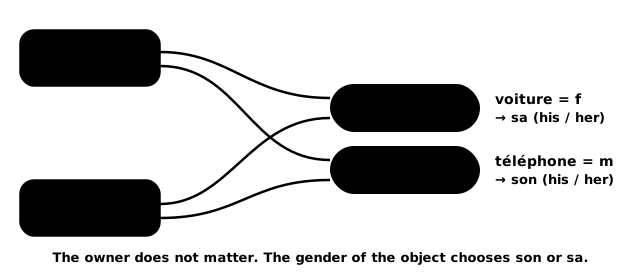
- Paul cherche sa voiture. — Paul is looking for his car.
- Marie cherche son téléphone. — Marie is looking for her phone.
- Le chat mange dans sa gamelle. — The cat is eating from its bowl. (son/sa also = its)
The thing decides
son / sa / ses agree with the thing owned: son frère = his or her brother; sa sœur = his or her sister.
16.2 Mon amie: the vowel rule
Before a feminine noun that starts with a vowel or silent h, ma, ta, sa would clash with the vowel. So French uses mon, ton, son instead — with a liaison. The noun is still feminine.
- mon‿amie Léa — my (female) friend Léa — not “ma amie” [mõ-na-MEE]
- ton‿école, son‿adresse, mon‿histoire — your school, his/her address, my story [tõ-nay-KOL · sõ-na-DRES · mõ-nees-TWAR]
- Mon‿idée est simple. — My idea is simple. (idée is still feminine: simple, not a masculine form)
But an adjective in between changes everything: ma meilleure amie (meilleure starts with a consonant).
- C’est ma meilleure amie. — She’s my best friend. [ma meh-YUHR a-MEE]
mon before a vowel
ma, ta, sa become mon, ton, son before a vowel sound: mon amie, ton école, son histoire — the noun stays feminine.
16.3 Mine, yours: possessive pronouns
A possessive pronoun replaces “possessive + noun”: mon livre → le mien (mine). It takes an article and agrees with the thing, just like the adjective.
| Owner | Masc. sg / fem. sg | Masc. pl / fem. pl |
|---|---|---|
| mine | le mien / la mienne | les miens / les miennes |
| yours (tu) | le tien / la tienne | les tiens / les tiennes |
| his, hers | le sien / la sienne | les siens / les siennes |
| ours | le nôtre / la nôtre | les nôtres |
| yours (vous) | le vôtre / la vôtre | les vôtres |
| theirs | le leur / la leur | les leurs |
- Ce n’est pas ton stylo, c’est le mien. — It’s not your pen, it’s mine. [luh MYɛ̃]
- Ma valise est bleue. Et la tienne ? — My suitcase is blue. And yours? [la TYEN]
- Leurs enfants sont plus âgés que les nôtres. — Their children are older than ours. [lay NOHTR]
- J’ai oublié mon parapluie. Je peux prendre le vôtre ? — I forgot my umbrella. Can I take yours? [luh VOHTR]
notre / le nôtre — hear the hat
The adjective notre, votre has no accent and a short o [NOTR]. The pronoun le nôtre, le vôtre has a circumflex and a long, closed o [NOHTR]. And the article contracts: Je pense aux miens (à + les miens).
16.4 À moi, à toi: “it belongs to…”
The simplest way to say who owns something is être à + a person or stressed pronoun (moi, toi, lui, elle, nous, vous, eux, elles). This is very common in speech.
- — À qui est ce sac ? — Il est à moi. — Whose bag is this? — It’s mine. [a KEE eh suh SAK … eel eh-ta MWA]
- Ces lunettes sont à Pierre. — These glasses are Pierre’s. (French has no ’s)
- C’est sa voiture à elle, pas à lui. — It’s her car, not his. (à elle / à lui removes the doubt of sa)
- Un appartement à nous, enfin ! — A flat of our own, at last!
16.5 This, that: ce, cet, cette, ces
| Before a consonant | Before a vowel / silent h | |
|---|---|---|
| Masculine | ce livre [suh] | cet homme, cet arbre [SET] |
| Feminine | cette femme [SET] | cette école [SET] |
| Plural | ces livres [SAY] | ces‿enfants [say-zã-FÃ] |
Ce means both “this” and “that”. Cet exists only so that the masculine flows into a vowel — it sounds exactly like cette.
- Combien coûte ce pull ? — How much is this jumper? [kõ-byɛ̃ koot suh PEWL]
- Cet hôtel est très calme. — This hotel is very quiet. [seh-to-TEL]
- J’adore cette chanson ! — I love this song! [zha-DOR set shã-SÕ]
- Ces chaussures sont trop petites. — These shoes are too small. [say shoh-SEWR]
Time words: ce matin, cette semaine
- ce matin, cet après-midi, ce soir — this morning, this afternoon, this evening / tonight [suh ma-Tɛ̃ · seh-ta-preh-mee-DEE · suh SWAR]
- cette semaine, cette année, ce week-end — this week, this year, this weekend
ce, cet, cette, ces
ce + masculine, cet + masculine vowel, cette + feminine, ces + plural: ce livre, cet ami, cette rue, ces gens.
This one here, that one there: -ci and -là
To contrast “this” and “that”, add -ci (here, near) or -là (there, further) to the noun. In everyday speech, -là is used much more, even for near things.
- Je préfère cette robe-ci à cette robe-là. — I prefer this dress to that dress. [set rob-SEE a set rob-LA]
- À ce moment-là, j’habitais à Pune. — At that time, I was living in Pune. (-là for past time)
16.6 This one, that one: celui, celle, ceux, celles
The demonstrative pronoun replaces “ce + noun”. It agrees with the noun it replaces, and it never stands alone: it needs -ci / -là, de + owner, or a relative clause (qui / que).
- — Quel gâteau tu veux ? — Celui-ci, au chocolat. — Which cake do you want? — This one, the chocolate one. [suh-lwee-SEE]
- Ma chambre est petite ; celle de ma sœur est grande. — My room is small; my sister’s is big. [SEL duh ma SUHR]
- Ces photos sont belles, mais je préfère celles-là. — These photos are nice, but I prefer those. [sel-LA]
- Ceux qui veulent venir sont les bienvenus. — Those who want to come are welcome. [SUH kee vuhl vuh-NEER]
- Ce n’est pas mon train, c’est celui de 10 heures. — It’s not my train, it’s the 10 o’clock one.
For a vague “this / that” with no noun, use ça (spoken) or cela / ceci (written): Ça, c’est super ! — Je veux ça.
celui needs a tail
celui, celle, ceux, celles replace ce + noun and are followed by -ci/-là, de + owner, or qui/que: celle de Paul, celui-ci.
16.7 Mistakes learners really make
Possessive and demonstrative traps
- Wrong: Elle aime son mère. (her mother)
- Right: Elle aime sa mère.
-
Why: mère is feminine → sa. The owner (she) does not matter.
-
Wrong: Il cherche sa passeport. (he, so “sa”?)
- Right: Il cherche son passeport.
-
Why: passeport is masculine → son, whoever owns it.
-
Wrong: Ma amie s’appelle Riya.
- Right: Mon amie s’appelle Riya.
-
Why: Before a vowel, ma → mon (the noun stays feminine).
-
Wrong: Ce homme est mon oncle.
- Right: Cet homme est mon oncle.
-
Why: Masculine + vowel or silent h → cet.
-
Wrong: Ils aiment leurs maison.
- Right: Ils aiment leur maison.
-
Why: One house → leur (no s). Several houses → leurs maisons.
-
Wrong: C’est le livre de moi.
- Right: C’est mon livre. / Il est à moi. / C’est le mien.
-
Why: Three correct ways to show ownership — “de moi” is not one of them.
-
Wrong: Je préfère celle.
- Right: Je préfère celle-ci.
- Why: celle needs a tail: -ci / -là, de…, or qui / que.
16.8 In real life — in a clothes shop
- — Bonjour, je cherche un cadeau pour ma mère. — Hello, I’m looking for a present for my mother.
- — Ces écharpes sont très jolies. Vous aimez celle-ci, en soie ? — These scarves are very pretty. Do you like this one, in silk?
- — Elle est belle, mais je préfère celle-là, la rouge. C’est sa couleur préférée. — It’s nice, but I prefer that one, the red one. It’s her favourite colour.
- — Excellent choix. Oh, ce parapluie, il est à vous ? — Excellent choice. Oh, this umbrella — is it yours?
- — Non, ce n’est pas le mien. Le mien est noir. C’est peut-être celui de cette dame ? — No, it’s not mine. Mine is black. Perhaps it’s that lady’s?
À retenir
- Possessives and demonstratives agree with the noun that follows, not with the owner: sa voiture = his car or her car.
- son / sa / ses agree with the thing owned: son frère = his or her brother; sa sœur = his or her sister.
- ma, ta, sa become mon, ton, son before a vowel sound: mon amie, ton école, son histoire — the noun stays feminine.
- ce + masculine, cet + masculine vowel, cette + feminine, ces + plural: ce livre, cet ami, cette rue, ces gens.
- celui, celle, ceux, celles replace ce + noun and are followed by -ci/-là, de + owner, or qui/que: celle de Paul, celui-ci.
- Last stop of the foundations: little words of place and time in Prepositions & places. Today, point at five things around you and say ce / cet / cette / ces + noun, then “c’est le mien / la mienne”.
16.9 Practice — Possessives & demonstratives
Exercise 1
Rahul aime ___ sœur. (his sister)
- son
- sa
- ses
- leur
Answer
sa
sœur is feminine → sa, even though Rahul is a man.
Exercise 2
___ amie Chloé arrive demain. (my)
- Ma
- Mon
- Mes
- M'
Hint: vowel
Answer
Mon
Before a vowel, ma → mon: mon amie.
Exercise 3
___ arbre est très vieux. (this)
- Ce
- Cet
- Cette
- Ces
Answer
Cet
Masculine + vowel → cet.
Exercise 4
Ce n'est pas ta valise, c'est ___. (mine)
- le mien
- la mienne
- les miennes
- ma
Hint: valise is feminine
Answer
la mienne
valise (f, sg) → la mienne.
Exercise 5
Les enfants rangent ___ jouets. (their toys)
- leur
- leurs
- ses
- son
Answer
leurs
Several toys → leurs.
Exercise 6
Je n'aime pas ___ chanson. (this)
Answer
cette
chanson is feminine → cette.
Exercise 7
Ma voiture est blanche, ___ de Paul est noire.
Hint: the one of
Answer
celle
voiture (f) → celle de Paul.
Exercise 8
— À qui est ce livre ? — Il est à ___. (me)
Answer
moi
être à + stressed pronoun: à moi.
Exercise 9
Ce sont nos billets ? — Oui, ce sont les ___. (ours)
Answer
nôtres / notres
les nôtres, with a circumflex in the pronoun.
Exercise 10
Tap the wrong word.
Elle cherche son clés.
Answer
Wrong word: son.
Corrected: Elle cherche ses clés.
clés is plural → ses.
Exercise 11
Tap the wrong word.
Ce homme est très gentil.
Answer
Wrong word: Ce.
Corrected: Cet homme est très gentil.
Silent h → cet.
Exercise 12
Match the French to the English.
| A | B |
|---|---|
| celui-ci | Paul's ones (m pl) |
| celle-là | mine (m) |
| ceux de Paul | this one (m) |
| le mien | that one (f) |
Answer
celui-ci — this one (m); celle-là — that one (f); ceux de Paul — Paul's ones (m pl); le mien — mine (m)
Pronouns agree with the noun they replace.
Exercise 13
Put the words in order.
Words: robe-ci / cette / préfère / Je
Answer
Je préfère cette robe-ci
cette + noun + -ci.
Exercise 14
Put the words in order.
Words: moi / parapluie / Ce / est / à
Answer
Ce parapluie est à moi
être à + stressed pronoun shows ownership.
Exercise 15
Say it aloud — make the liaison.
Mon amie habite dans cet immeuble
Answer
Say: Mon amie habite dans cet immeuble
mon‿amie, cet‿immeuble: both link with the next vowel.
Exercise 16
Say it aloud.
Ce n'est pas le mien c'est le tien
Answer
Say: Ce n'est pas le mien c'est le tien
le mien [MYɛ̃], le tien [TYɛ̃].
Exercise 17
'Those who work hard' =
- Celles qui travaillent dur
- Ceux qui travaillent dur
- Ces qui travaillent dur
- Celui qui travaillent dur
Answer
Ceux qui travaillent dur
ceux (m pl / mixed) + qui.
Next step
Last stop of the foundations: little words of place and time in Prepositions & places. Today, point at five things around you and say ce / cet / cette / ces + noun, then “c’est le mien / la mienne”.