Chapter 28: Conditional & si clauses
Le conditionnel
The conditional is the "would" of French: je voudrais (I would like), tu devrais (you should), si j’avais le temps, je voyagerais (if I had time, I would travel). It makes you polite, lets you give advice gently, and opens the door to dreams and regrets. Best news: if you know the future tense, you already know 90% of its forms.
- 1Forming the conditional
- 2Being polite
- 3Advice, suggestions and wishes
- 4Imagining and hypothesising
- 5The three si patterns
- 6The golden rule: no conditional after si
- 7The journalist’s conditional
- 8In real life — the lottery question
The formula
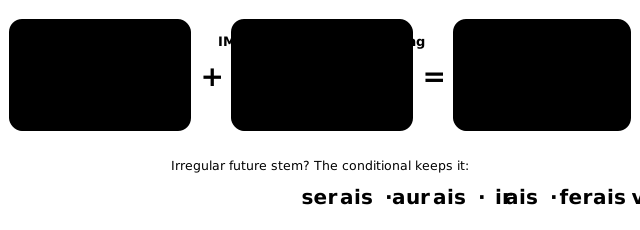
Conditional = future stem + imparfait endings (-ais, -ais, -ait, -ions, -iez, -aient): parler- + -ais → je parlerais.
28.1 Forming the conditional
Take the infinitive (the same stem as the future — see The future). For -re verbs drop the final e: prendre → prendr-. Then add the endings you already know from the imparfait.
| parler | finir | prendre | |
|---|---|---|---|
| je | parlerais | finirais | prendrais |
| tu | parlerais | finirais | prendrais |
| il / elle / on | parlerait | finirait | prendrait |
| nous | parlerions | finirions | prendrions |
| vous | parleriez | finiriez | prendriez |
| ils / elles | parleraient | finiraient | prendraient |
The irregular stems (same as the future)
| Verb | Stem | je… | Verb · stem |
|---|---|---|---|
| être | ser- | je serais | venir · viendr- |
| avoir | aur- | j’aurais | tenir · tiendr- |
| aller | ir- | j’irais | voir · verr- |
| faire | fer- | je ferais | envoyer · enverr- |
| pouvoir | pourr- | je pourrais | courir · courr- |
| vouloir | voudr- | je voudrais | mourir · mourr- |
| devoir | devr- | je devrais | recevoir · recevr- |
| savoir | saur- | je saurais | falloir · il faudrait |
| acheter | achèter- | j’achèterais | valoir · il vaudrait |
| appeler | appeller- | j’appellerais | payer · paier- / payer- |
- Nous irions bien à la mer. — We’d happily go to the seaside.
- Ils seraient ravis de vous voir. — They would be delighted to see you.
- Tu saurais réparer ça ? — Would you know how to fix this?
-rai or -rais? Future or conditional?
je parlerai (I will speak) and je parlerais (I would speak) sound almost the same — many people pronounce them identically. In writing, the s changes the meaning. Test: replace with nous — nous parlerons (future) vs nous parlerions (conditional).
One pair you can actually hear: nous courions (imparfait, one r) vs nous courrions (conditional, double r held longer). Same with mourions / mourrions.
28.2 Being polite
The conditional softens a request, exactly like English "would" and "could". In a shop, a hotel or an email, it is the difference between sounding demanding and sounding courteous. Hindi does the same with dijiye vs do, or kya aap… sakte hain.
- Je voudrais un aller-retour pour Lyon, s’il vous plaît. — I would like a return ticket to Lyon, please.
- J’aimerais réserver une table pour deux. — I’d like to book a table for two.
- Pourriez-vous m’aider, s’il vous plaît ? — Could you help me, please?
- Auriez-vous un stylo à me prêter ? — Would you have a pen you could lend me?
- Ça vous dérangerait de fermer la fenêtre ? — Would you mind closing the window?
- Tu pourrais baisser la musique ? — Could you turn the music down?
Three polite starters
Je voudrais… (I’d like), Pourriez-vous… ? (Could you…?), Est-ce que ce serait possible de… ? (Would it be possible to…?) — these three cover most requests.
Careful
- Wrong: Bonjour, je veux une baguette.
- Right: Bonjour, je voudrais une baguette, s’il vous plaît.
- Why: Je veux is grammatically fine but sounds like a child demanding. In a shop, use je voudrais (or je vais prendre…).
28.3 Advice, suggestions and wishes
devoir in the conditional means should / ought to. pouvoir gives could. Together with a few fixed phrases, they let you advise without ordering.
- Tu devrais te reposer un peu. — You should rest a bit.
- Vous devriez consulter un médecin. — You ought to see a doctor.
- À ta place, je dirais la vérité. — If I were you, I’d tell the truth.
- Il vaudrait mieux partir avant la pluie. — It would be better to leave before the rain.
- On pourrait manger indien ce soir ? — We could eat Indian tonight? (a suggestion)
- Tu ferais mieux de te taire. — You’d better keep quiet.
- J’adorerais vivre à Paris. — I would love to live in Paris.
For advice about the past — you should have — French uses the past conditional: Tu aurais dû me le dire. (You should have told me.) It is built in Advanced compound tenses; here, just learn j’aurais dû (I should have) and j’aurais pu (I could have) as phrases.
28.4 Imagining and hypothesising
The conditional describes a world that is not real — a dream, a supposition, a "what if".
- Dans un monde idéal, personne ne travaillerait le dimanche. — In an ideal world, nobody would work on Sundays.
- Avec un million d’euros, j’achèterais une maison en Bretagne. — With a million euros, I’d buy a house in Brittany.
- Prends un parapluie, au cas où il pleuvrait. — Take an umbrella, in case it rains.
- Il m’a dit qu’il viendrait à huit heures. — He told me he would come at eight. (the future seen from the past)
au cas où + conditional
au cas où (in case) is followed by the conditional, not the present: au cas où tu aurais faim. That last example — il a dit qu’il viendrait — is the "future in the past", covered in Passive & reported speech.
Careful
- Wrong: Quand j’étais petit, je jouerais au cricket tous les soirs.
- Right: Quand j’étais petit, je jouais au cricket tous les soirs.
- Why: English "would" can describe a past habit ("I would play"). French uses the imparfait for that, never the conditional. See Imparfait vs passé composé.
28.5 The three si patterns
si (if) introduces a condition. French has three standard patterns, depending on how real the condition is. Learn them as fixed pairs of tenses — they almost never vary.
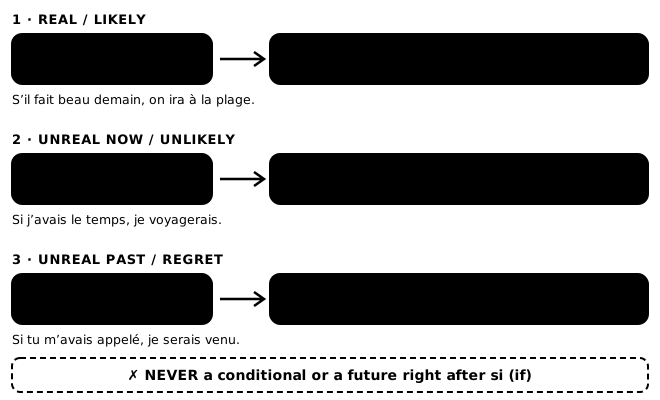
Pattern 1 — real or likely
- Si tu viens, on ira au cinéma. — If you come, we’ll go to the cinema.
- S’il pleut, je reste à la maison. — If it rains, I stay at home.
- Si tu as faim, sers-toi. — If you’re hungry, help yourself.
Pattern 2 — unreal now, or unlikely
- Si j’étais toi, je refuserais. — If I were you, I would refuse.
- Si nous habitions à Paris, nous sortirions plus souvent. — If we lived in Paris, we would go out more often.
- Qu’est-ce que tu ferais si tu gagnais au loto ? — What would you do if you won the lottery?
Pattern 3 — unreal past (regret)
- Si j’avais su, je ne serais pas venu. — If I had known, I wouldn’t have come.
- Si nous étions partis plus tôt, nous n’aurions pas raté le train. — If we had left earlier, we wouldn’t have missed the train.
Mixed patterns
Logic can cross the timeline: a past condition with a present result, or a permanent condition with a past result. The si side still never takes the conditional.
- Si j’avais pris le TGV, je serais déjà à Marseille. — If I had taken the TGV, I would already be in Marseille (now).
- Si elle était plus prudente, elle n’aurait pas eu cet accident. — If she were a more careful person, she wouldn’t have had that accident.
Order and spelling
The si clause can come first (then add a comma) or second. si elides only before il / ils: s’il, s’ils — but si elle, si on, si un… stay whole.
28.6 The golden rule: no conditional after si
This is the most famous mistake in French — so common among native children that there is a playground rhyme against it: « Les scies n’aiment pas les raies » (a pun: si doesn’t like -rais). English "if I would" is also wrong, so think of it as the same rule.
Careful
- Wrong: Si j’aurais su, je serais resté.
- Right: Si j’avais su, je serais resté.
- Why: After si = "if": present, imparfait or plus-que-parfait only. The conditional goes in the other clause.
Careful
- Wrong: Si tu viendras demain, je te montrerai.
- Right: Si tu viens demain, je te montrerai.
- Why: No future after si either — pattern 1 uses the present, even about tomorrow.
Careful
- Wrong: Si j’ai plus d’argent, j’achèterais une voiture.
- Right: Si j’avais plus d’argent, j’achèterais une voiture.
- Why: Conditional in the result → imparfait in the si clause. The two halves come as a pair.
The one exception: si = whether
When si means whether (an indirect question), any tense can follow — including the conditional: Je me demande s’il accepterait. (I wonder whether he would accept.) Il m’a demandé si je viendrais. Test: if you can say "whether" in English, the rule does not apply.
- Je ne sais pas s’il voudrait nous accompagner. — I don’t know whether he would want to come with us.
- Même s’il pleuvait, je sortirais. — Even if it rained, I would go out. (même si follows the same rule as si)
28.7 The journalist’s conditional
Newspapers and TV news use the conditional for information that is not confirmed: "reportedly", "allegedly", "is said to". Hindi news uses a phrase for the same idea: bataya ja raha hai ki…. Often it comes with selon or d’après (according to).
- Selon la police, le suspect aurait quitté le pays. — According to the police, the suspect has reportedly left the country.
- D’après nos informations, la ministre serait sur le point de démissionner. — According to our sources, the minister is said to be about to resign.
- L’incendie aurait fait trois blessés. — The fire is reported to have injured three people.
- Le PDG serait prêt à négocier. — The CEO is apparently ready to negotiate.
Why it matters
Le ministre est malade is a fact. Le ministre serait malade is a rumour. Reading news without noticing this is like missing the word "allegedly" in English.
28.8 In real life — the lottery question
Qu’est-ce que tu ferais si…? is a classic conversation starter, and a favourite DELF B1 speaking topic.
- — Si tu gagnais au loto, qu’est-ce que tu ferais ? — If you won the lottery, what would you do?
- — D’abord, j’arrêterais de travailler. Ensuite, je ferais le tour du monde. — First, I’d stop working. Then I’d travel round the world.
- — Tu ne t’ennuierais pas, sans travail ? — Wouldn’t you get bored, without work?
- — Peut-être. Dans ce cas, j’ouvrirais un petit restaurant à Pondichéry. — Maybe. In that case, I’d open a little restaurant in Pondicherry.
- — Et si tu n’avais pas joué ce jour-là, tu aurais regretté toute ta vie ! — And if you hadn’t played that day, you’d have regretted it all your life!
Careful
- Wrong: Pourrais-vous répéter, s’il vous plaît ?
- Right: Pourriez-vous répéter, s’il vous plaît ?
- Why: With vous the ending is -iez. pourrais belongs to je / tu.
À retenir
- Conditional = future stem + imparfait endings (-ais, -ais, -ait, -ions, -iez, -aient): parler- + -ais → je parlerais.
- Je voudrais… (I’d like), Pourriez-vous… ? (Could you…?), Est-ce que ce serait possible de… ? (Would it be possible to…?) — these three cover most requests.
- au cas où (in case) is followed by the conditional, not the present: au cas où tu aurais faim. That last example — il a dit qu’il viendrait — is the "future in the past", covered in Passive & reported speech.
- The si clause can come first (then add a comma) or second. si elides only before il / ils: s’il, s’ils — but si elle, si on, si un… stay whole.
- Write five sentences starting Si j’étais… (Si j’étais un animal, je serais…). Say them aloud. Then open The subjunctive — the other "unreal" mood of French.
28.9 Practice — Conditional & si clauses
Exercise 1
Je ___ un café, s'il vous plaît.
- veux
- voudrai
- voudrais
- voulais
Hint: The polite 'would like'
Answer
voudrais
Conditional of vouloir: je voudrais — the polite request.
Exercise 2
Si j'avais le temps, je ___ le piano.
- apprends
- apprendrai
- apprendrais
- apprenais
Answer
apprendrais
si + imparfait → conditionnel présent.
Exercise 3
Si tu ___ plus tôt, tu aurais vu le début du film.
- arrivais
- étais arrivé
- serais arrivé
- arriverais
Hint: Result is conditionnel passé
Answer
étais arrivé
Conditionnel passé in the result → plus-que-parfait after si.
Exercise 4
S'il fait beau samedi, nous ___ un pique-nique.
- ferions
- ferons
- faisions
- aurions fait
Answer
ferons
si + présent → futur (pattern 1).
Exercise 5
Selon le journal, l'acteur ___ marié en secret.
- s'est
- se serait
- se sera
- se marie
Hint: Unconfirmed news
Answer
se serait
The journalistic conditional marks an unconfirmed fact: il se serait marié.
Exercise 6
Vous ___ (devoir) dormir davantage.
Hint: advice, vous
Answer
devriez
devoir → stem devr- + -iez: vous devriez = you should.
Exercise 7
Si j'étais riche, j'___ (avoir) une grande maison.
Hint: irregular stem aur-
Answer
aurais
avoir → aur- + -ais: j'aurais.
Exercise 8
Nous ___ (aller) volontiers avec vous.
Hint: stem ir-
Answer
irions
aller → ir- + -ions: nous irions.
Exercise 9
Prends ton pull, au cas où il ___ (faire) froid.
Hint: au cas où + conditional
Answer
ferait
au cas où is followed by the conditional: il ferait.
Exercise 10
Tap the wrong word.
Si j'aurais su, je serais resté chez moi.
Answer
Wrong word: j'aurais.
Corrected: Si j'avais su, je serais resté chez moi.
Never a conditional after si (if): use the plus-que-parfait, j'avais su.
Exercise 11
Tap the wrong word.
Si tu viendras demain, on ira au marché.
Answer
Wrong word: viendras.
Corrected: Si tu viens demain, on ira au marché.
No future after si: si + présent → futur.
Exercise 12
Tap the wrong word.
Quand j'étais enfant, je mangerais chez ma grand-mère le dimanche.
Answer
Wrong word: mangerais.
Corrected: Quand j'étais enfant, je mangeais chez ma grand-mère le dimanche.
English 'would' for a past habit = imparfait in French.
Exercise 13
Match the si clause to its result.
| A | B |
|---|---|
| Si tu viens, | on irait au parc. |
| Si tu venais, | on serait allés au parc. |
| Si tu étais venu, | on ira au parc. |
Answer
Si tu viens, — on ira au parc.; Si tu venais, — on irait au parc.; Si tu étais venu, — on serait allés au parc.
présent → futur; imparfait → conditionnel; plus-que-parfait → conditionnel passé.
Exercise 14
Match the infinitive to its conditional (je).
| A | B |
|---|---|
| être | je verrais |
| faire | je saurais |
| voir | je serais |
| savoir | je ferais |
Answer
être — je serais; faire — je ferais; voir — je verrais; savoir — je saurais
The conditional keeps the irregular future stems: ser-, fer-, verr-, saur-.
Exercise 15
Put the words in order: If I were you, I would accept.
Words: j'accepterais / toi / Si / j'étais
Answer
Si j'étais toi j'accepterais
si + imparfait (j'étais) → conditional (j'accepterais).
Exercise 16
Put the words in order: Could you help me please?
Words: vous / Pourriez-vous / s'il / m'aider / plaît
Answer
Pourriez-vous m'aider s'il vous plaît
Inversion with the conditional of pouvoir: pourriez-vous.
Exercise 17
Say it aloud.
Qu'est-ce que tu ferais si tu gagnais au loto
Answer
Say: Qu'est-ce que tu ferais si tu gagnais au loto
Pattern 2: si + imparfait (gagnais) with the conditional (ferais).
Exercise 18
Say it aloud.
Je voudrais réserver une table pour deux
Answer
Say: Je voudrais réserver une table pour deux
The polite request: je voudrais + infinitive.
Next step
Write five sentences starting Si j’étais… (Si j’étais un animal, je serais…). Say them aloud. Then open The subjunctive — the other "unreal" mood of French.