Chapter 31: Passive & reported speech
Passif et discours indirect
Two ways of changing perspective. The passive moves the focus from who acts to what is affected: the bridge was built in 1890. Reported speech retells someone else’s words: he said he would come. Both are everywhere in news, work emails and storytelling — and both have a few precise rules that English speakers tend to get wrong.
- 1Building the passive
- 2The passive in every tense
- 3par or de?
- 4How French avoids the passive
- 5Reported speech: the basic verbs
- 6Concordance des temps — the tense shift
- 7Time and place words shift too
- 8Indirect questions and commands
- 9In real life — passing on a message
The passive in one line
Passive = être (in any tense) + past participle, which agrees with the subject. The doer, if mentioned, comes after par.
31.1 Building the passive
The object of the active sentence becomes the subject. The verb becomes être + participle, and the old subject (the "agent") moves to the end with par — or disappears.
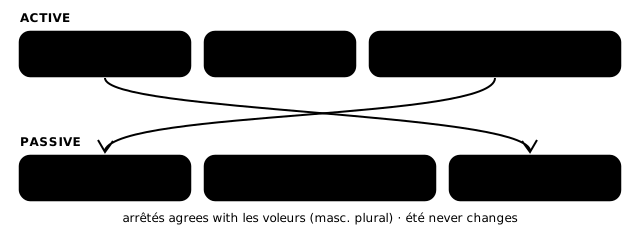
- Ce roman a été écrit par Victor Hugo. — This novel was written by Victor Hugo.
- Toutes les places ont été vendues en une heure. — All the seats were sold in an hour.
- Les résultats seront publiés lundi. — The results will be published on Monday. (no agent needed)
31.2 The passive in every tense
To put the passive in any tense, put être in that tense. The participle stays the same and keeps agreeing. Here with la maison (feminine):
| Tense | Passive | English |
|---|---|---|
| présent | La maison est construite. | is built |
| passé composé | La maison a été construite. | was / has been built |
| imparfait | La maison était construite. | was (being) built |
| plus-que-parfait | La maison avait été construite. | had been built |
| futur proche | La maison va être construite. | is going to be built |
| futur simple | La maison sera construite. | will be built |
| futur antérieur | La maison aura été construite. | will have been built |
| conditionnel | La maison serait construite. | would be built |
| conditionnel passé | La maison aurait été construite. | would have been built |
| subjonctif | … que la maison soit construite. | (that it) be built |
Don’t confuse two 'est + participle'
Elle est partie is the passé composé of an être verb (she has left). Elle **est invitée is a present passive (she is invited). Test: can you add "par quelqu’un"? Then it is passive.
- Le pont avait été détruit pendant la guerre. — The bridge had been destroyed during the war.
- Il faut que le dossier soit envoyé avant vendredi. — The file must be sent before Friday.
Careful
- Wrong: Les maisons ont été construit en 1950.
- Right: Les maisons ont été construites en 1950.
- Why: In the passive, the final participle agrees with the subject (les maisons → feminine plural). été itself never agrees.
31.3 par or de?
par introduces the agent of a concrete action. de is used with verbs of feeling and of description or state, where nobody really "does" anything.
| de — feeling, state | par — action |
|---|---|
| aimé, adoré, détesté de | attaqué, mordu, arrêté par |
| respecté, craint, connu de | construit, écrit, organisé par |
| entouré, couvert, rempli de | détruit, réparé, signé par |
- Cette professeure est aimée de tous ses élèves. — This teacher is loved by all her students.
- La table était couverte de livres. — The table was covered with books.
- La ville est entourée de montagnes. — The town is surrounded by mountains. (a state)
- Le bâtiment a été entouré par la police. — The building was surrounded by the police. (an action)
- Le facteur a été mordu par un chien. — The postman was bitten by a dog.
After de, the article often drops
couvert de neige, rempli d’eau, entouré d’arbres — "some / any" articles disappear after this de, just like after beaucoup de.
31.4 How French avoids the passive
French uses the passive much less than English. When the agent is unknown or unimportant, it usually prefers one of three other structures.
a) on + active verb — the most common
- On m’a volé mon portefeuille. — My wallet was stolen. (lit. someone stole my wallet from me)
- Ici, on parle français et anglais. — French and English are spoken here.
b) se faire + infinitive — something happens to you
- Il s’est fait renverser par une voiture. — He got knocked down by a car.
- Elle s’est fait voler son sac dans le métro. — She had her bag stolen on the metro.
c) the pronominal passive — general truths and habits
- Le français se parle sur cinq continents. — French is spoken on five continents.
- Ce vin se boit frais. — This wine is drunk chilled.
- Ça ne se fait pas. — That isn’t done. / That’s not polite.
- Ça se prononce comment ? — How is that pronounced?
'I was told' ≠ 'j’ai été dit'
Only a direct object can become a passive subject. Verbs built with à quelqu’un — dire à, demander à, donner à, permettre à, conseiller à, répondre à — cannot. Use on: On m’a dit…, On lui a demandé…
Careful
- Wrong: J’ai été dit que la réunion était annulée.
- Right: On m’a dit que la réunion était annulée.
- Why: dire à quelqu’un: the person is an indirect object, so it cannot become the passive subject. English "I was told / I was asked / I was given" all go through on.
Careful
- Wrong: Elle a été donnée un cadeau.
- Right: On lui a donné un cadeau. / Un cadeau lui a été donné.
- Why: Only the thing given (the direct object) can be the passive subject.
31.5 Reported speech: the basic verbs
In discours indirect you retell what someone said, without quotation marks. Three families of verbs introduce it, and pronouns and possessives change to fit the new speaker.
| Reporting… | Structure | Example |
|---|---|---|
| a statement | dire / expliquer / répondre que | Il dit qu’il est fatigué. |
| a yes/no question | demander si | Elle demande si tu viens. |
| a "what" question | demander ce que / ce qui | Il demande ce que tu veux. |
| a question word | demander où / quand / pourquoi… | Elle demande où tu habites. |
| an order, a request | dire / demander de + infinitif | Il me dit de partir. |
- « Je suis fatigué. » → Il dit qu’il est fatigué. — "I’m tired." → He says he’s tired.
- « Ta sœur est là. » → Elle me dit que ma sœur est là. — "Your sister is here." → She tells me my sister is here. (ta → ma)
When the reporting verb is in the present or the future (il dit que, il dira que), the tenses do not change. When it is in a past tense (il a dit que, il disait que), they shift — that is the next section.
31.6 Concordance des temps — the tense shift
After a past reporting verb, every tense moves one step back into the past, just like "is → was", "will → would" in English. French is stricter about it than spoken English.
| Shift | Direct | Reported (Il a dit…) |
|---|---|---|
| présent → imparfait | « Je suis malade. » | qu’il était malade. |
| passé composé → plus-que-parfait | « J’ai fini. » | qu’il avait fini. |
| futur → conditionnel | « Je viendrai. » | qu’il viendrait. |
| futur proche → aller (imparfait) + inf. | « Je vais partir. » | qu’il allait partir. |
| futur antérieur → cond. passé | « J’aurai fini. » | qu’il aurait fini. |
| imparfait, PQP, conditionnel → no change | « J’étais content. » | qu’il était content. |
| impératif → de + infinitif | « Viens ! » | de venir. |
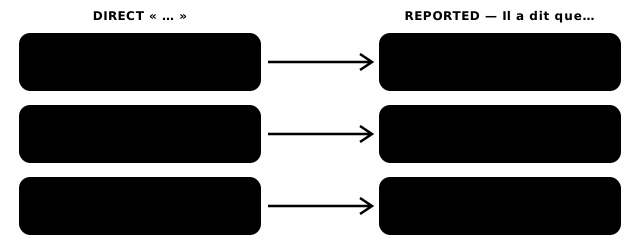
- « Je travaille à Lyon. » → Elle a dit qu’elle travaillait à Lyon. — "I work in Lyon." → She said she worked in Lyon.
- « Nous avons gagné ! » → Ils ont annoncé qu’ils avaient gagné. — "We’ve won!" → They announced they had won.
- « Je t’appellerai. » → Il m’a promis qu’il m’appellerait. — "I’ll call you." → He promised he would call me.
Still true? You may keep the present
For a general truth or something still true now, French may keep the original tense: Il m’a dit qu’il habite à Pune (and he still does). The shift is always correct; keeping is a choice.
31.7 Time and place words shift too
If the moment of speaking is over, words like demain or ici no longer make sense from the new point of view. They change to words relative to that day.
| Direct | Reported | English |
|---|---|---|
| aujourd’hui | ce jour-là | that day |
| hier | la veille | the day before |
| avant-hier | l’avant-veille | two days before |
| demain | le lendemain | the next day |
| après-demain | le surlendemain | two days later |
| maintenant | à ce moment-là, alors | then, at that moment |
| ce matin / ce soir | ce matin-là / ce soir-là | that morning / evening |
| la semaine prochaine | la semaine suivante | the following week |
| la semaine dernière | la semaine précédente | the previous week |
| il y a deux jours | deux jours plus tôt | two days earlier |
| dans deux jours | deux jours plus tard | two days later |
| ici | là | there |
- « Je pars demain. » → Il a dit qu’il partait le lendemain. — "I’m leaving tomorrow." → He said he was leaving the next day.
- « Je l’ai vu hier. » → Elle a expliqué qu’elle l’avait vu la veille. — "I saw him yesterday." → She explained she had seen him the day before.
31.8 Indirect questions and commands
An indirect question is not a question any more: no question mark, no inversion, no est-ce que. Just the question word (or si) + normal word order.
| Direct question | Indirect (Il m’a demandé…) |
|---|---|
| « Tu viens ? » / « Est-ce que tu viens ? » | si je venais. |
| « Qu’est-ce que tu veux ? » / « Que veux-tu ? » | ce que je voulais. |
| « Qu’est-ce qui se passe ? » | ce qui se passait. |
| « Où habites-tu ? » | où j’habitais. |
| « Pourquoi pleures-tu ? » | pourquoi je pleurais. |
| « Qui est-ce ? » | qui c’était. |
- Le douanier m’a demandé si j’avais quelque chose à déclarer. — The customs officer asked me if I had anything to declare.
- Je me demande ce qui lui est arrivé. — I wonder what happened to him.
- Elle voulait savoir quand nous partions. — She wanted to know when we were leaving.
Commands → de + infinitive
- « Taisez-vous ! » → Le prof nous a dit de nous taire. — "Be quiet!" → The teacher told us to be quiet.
- « Ne touche pas ! » → Il m’a dit de ne pas toucher. — "Don’t touch!" → He told me not to touch. (ne pas together before the infinitive)
- « Tu peux m’aider ? » → Elle m’a demandé de l’aider. — "Can you help me?" → She asked me to help her.
Careful
- Wrong: Il m’a demandé est-ce que j’étais libre.
- Right: Il m’a demandé si j’étais libre.
- Why: A yes/no question becomes si in reported speech. est-ce que disappears.
Careful
- Wrong: Elle m’a demandé où habitais-je.
- Right: Elle m’a demandé où j’habitais.
- Why: No inversion in an indirect question: subject + verb, as in a normal statement.
Careful
- Wrong: Il m’a dit que je viens tout de suite.
- Right: Il m’a dit de venir tout de suite.
- Why: An order ("Viens !") is reported with de + infinitive, not que.
31.9 In real life — passing on a message
At work you constantly report what others said. Here, Arjun passes on a phone call to his manager.
- — M. Dubois a appelé. Il a dit qu’il serait en retard. — Mr Dubois called. He said he would be late. (« Je serai en retard. »)
- — Il a demandé si la réunion pouvait commencer à onze heures. — He asked whether the meeting could start at eleven. (« Est-ce que la réunion peut… ? »)
- — Il voulait aussi savoir ce que vous pensiez de sa proposition. — He also wanted to know what you thought of his proposal.
- — Et il m’a demandé de vous transmettre ses excuses. — And he asked me to pass on his apologies.
- — Merci. Le contrat a-t-il été signé ? — Thanks. Has the contract been signed? (passive question)
À retenir
- Passive = être (in any tense) + past participle, which agrees with the subject. The doer, if mentioned, comes after par.
- couvert de neige, rempli d’eau, entouré d’arbres — "some / any" articles disappear after this de, just like after beaucoup de.
- Only a direct object can become a passive subject. Verbs built with à quelqu’un — dire à, demander à, donner à, permettre à, conseiller à, répondre à — cannot. Use on: On m’a dit…, On lui a demandé…
- For a general truth or something still true now, French may keep the original tense: Il m’a dit qu’il habite à Pune (and he still does). The shift is always correct; keeping is a choice.
- Retell yesterday’s conversation with a friend in reported speech — five sentences with il/elle a dit que and il/elle m’a demandé si. Then move on to Gérondif & participles.
31.10 Practice — Passive & reported speech
Exercise 1
Ce château ___ au XVIe siècle.
- a construit
- a été construit
- est construit par
- s'est construit par
Hint: Passive, passé composé
Answer
a été construit
Passive passé composé: a été + participle.
Exercise 2
Cette chanteuse est admirée ___ tout le monde.
- par
- de
- à
- pour
Hint: A feeling
Answer
de
Verbs of feeling (aimer, admirer, respecter) usually take de.
Exercise 3
"I was told to wait."
- J'ai été dit d'attendre.
- On m'a dit d'attendre.
- Je me suis dit d'attendre.
- J'étais dit d'attendre.
Answer
On m'a dit d'attendre.
dire à quelqu'un cannot be passive with the person as subject → on m'a dit.
Exercise 4
« Je viendrai. » → Il a dit qu'il ___.
- viendra
- viendrait
- venait
- est venu
Answer
viendrait
After a past reporting verb, the future becomes the conditional.
Exercise 5
« Qu'est-ce que tu fais ? » → Elle m'a demandé ___ je faisais.
- qu'est-ce que
- ce que
- si
- que
Answer
ce que
qu'est-ce que becomes ce que in an indirect question.
Exercise 6
« J'ai perdu mes clés. » → Il a dit qu'il ___ ses clés.
Hint: passé composé → ?
Answer
avait perdu
passé composé → plus-que-parfait: avait perdu.
Exercise 7
« Tu es prête ? » → Il m'a demandé ___ j'étais prête.
Answer
si
A yes/no question is reported with si.
Exercise 8
« Fermez la porte ! » → Elle nous a dit ___ fermer la porte.
Answer
de
Commands → de + infinitive.
Exercise 9
« Je pars demain. » → Il a dit qu'il partait ___.
Hint: the next day
Answer
le lendemain
demain → le lendemain when the moment has passed.
Exercise 10
Les lettres ont été ___ (écrire) à la main.
Hint: agreement: les lettres
Answer
écrites
Passive participle agrees with the subject: feminine plural → écrites.
Exercise 11
Tap the wrong word.
Il m'a demandé où habitais-je.
Answer
Wrong word: habitais-je.
Corrected: Il m'a demandé où j'habitais.
No inversion in an indirect question.
Exercise 12
Tap the wrong word.
La ville est entourée par montagnes.
Answer
Wrong word: par.
Corrected: La ville est entourée de montagnes.
A state or description → de (and no article).
Exercise 13
Tap the wrong word.
Elle m'a dit que je ferme la fenêtre.
Answer
Wrong word: que.
Corrected: Elle m'a dit de fermer la fenêtre.
An order is reported with de + infinitive.
Exercise 14
Match the direct word to its reported form.
| A | B |
|---|---|
| hier | ce jour-là |
| demain | là |
| aujourd'hui | la veille |
| ici | le lendemain |
Answer
hier — la veille; demain — le lendemain; aujourd'hui — ce jour-là; ici — là
Time and place words shift to the point of view of that day.
Exercise 15
Match the tense shift.
| A | B |
|---|---|
| présent | conditionnel |
| passé composé | de + infinitif |
| futur | imparfait |
| impératif | plus-que-parfait |
Answer
présent — imparfait; passé composé — plus-que-parfait; futur — conditionnel; impératif — de + infinitif
After a past reporting verb, each tense steps back.
Exercise 16
Put the words in order: French is spoken here.
Words: on / parle / français / Ici
Answer
Ici on parle français
French prefers on + active verb to a passive.
Exercise 17
Put the words in order: She asked me if I was free.
Words: Elle / j'étais / m'a / libre / demandé / si
Answer
Elle m'a demandé si j'étais libre
demander si + imparfait after a past verb.
Exercise 18
Say it aloud.
Il a dit qu'il serait en retard
Answer
Say: Il a dit qu'il serait en retard
futur (je serai) → conditionnel (il serait).
Exercise 19
Say it aloud.
Ça se prononce comment
Answer
Say: Ça se prononce comment
The pronominal passive: ça se prononce = how is it pronounced.
Next step
Retell yesterday’s conversation with a friend in reported speech — five sentences with il/elle a dit que and il/elle m’a demandé si. Then move on to Gérondif & participles.