Chapter 41: Core vocabulary by theme
Le vocabulaire de base
These are the words you will use every single day: your family, your home, what you eat and wear, your body, the weather and the town around you. Every noun comes with its article and its colour — blue = masculine, pink = feminine, violet = plural — because in French a noun without its gender is only half learned.
- 1Learn every noun with its article
- 2La famille — the family
- 3La maison — home and rooms
- 4Manger et boire — food and drink
- 5Le corps — the body
- 6Les vêtements et les couleurs — clothes and colours
- 7Le temps et les saisons — weather and seasons
- 8La ville — the city
- 9In real life — a postcard from Lyon
masculinefeminineplural
41.1 Learn every noun with its article
Every French noun is either masculine or feminine — even a table, a shirt or the rain. The gender changes the article (le/la, un/une), the adjectives and the pronouns. If you learn only "maison", you will have to guess later. If you learn "la maison", the gender comes for free.
The golden rule
Never learn a bare noun. Learn la chaise, le lit — the article is part of the word.
When the article hides the gender
Before a vowel, le and la both become l’. So learn those words with un/une: un appartement, une école.
Hindi speakers: Hindi also has two genders, which is a real advantage — you already think in "masculine/feminine". But never copy the Hindi gender across. Kitaab is feminine in Hindi, but le livre is masculine; paani is masculine, but l’eau is feminine; chai is feminine, but le thé is masculine.
Some endings help: words in -tion, -té, -ette are mostly feminine; words in -ment, -age, -eau are mostly masculine. The full list is in Nouns, gender & plurals.
- La table est dans la cuisine. — The table is in the kitchen. [la TABL ay dã la kwee-ZEEN]
- Le problème, c’est le prix. — The problem is the price. [luh pro-BLEM say luh PREE]
Careful
- Wrong: La problème est simple.
- Right: Le problème est simple.
- Why: Words in -ème from Greek are masculine, even though they end in -e: le problème, le système, le thème.
Three habits that work
Say each word aloud with its article · stick labels on things at home (la porte, le frigo) · learn ten words a day and review them the next morning.
41.2 La famille — the family
| French | English | Sound |
|---|---|---|
| le père | father | [luh PEHR] |
| la mère | mother | [la MEHR] |
| les parents | parents | [lay pa-RÃ] |
| le frère | brother | [luh FREHR] |
| la sœur | sister | [la SUHR] |
| le fils | son | [luh FEESS] |
| la fille | daughter; girl | [la FEEY] |
| le mari | husband | [luh ma-REE] |
| la femme | wife; woman | [la FAM] |
| le grand-père | grandfather | [luh grã-PEHR] |
| la grand-mère | grandmother | [la grã-MEHR] |
| l’oncle (m) | uncle | [LÕKL] |
| la tante | aunt | [la TÃT] |
| le cousin / la cousine | cousin | [koo-Zɛ̃ / koo-ZEEN] |
| les enfants | children | [lay-zã-FÃ] |
Two words do double duty: la femme is both "woman" and "wife", and la fille is both "girl" and "daughter". Context tells you which. Hindi has separate words for every uncle (chacha, mama, tau, mausa…); French has just l’oncle. To be precise, say l’oncle du côté de mon père (my father’s side).
- J’ai deux frères et une sœur. — I have two brothers and a sister. [zhay duh FREHR ay ewn SUHR]
- Ma mère s’appelle Priya. — My mother is called Priya.
- Mon oncle habite à Lyon avec sa femme. — My uncle lives in Lyon with his wife.
- Nous sommes cinq dans ma famille. — There are five of us in my family.
Careful
- Wrong: Mon mère est professeur.
- Right: Ma mère est professeur.
- Why: "My" agrees with the noun (mère is feminine), not with the person speaking. A man also says ma mère. See My, your, this, that.
41.3 La maison — home and rooms
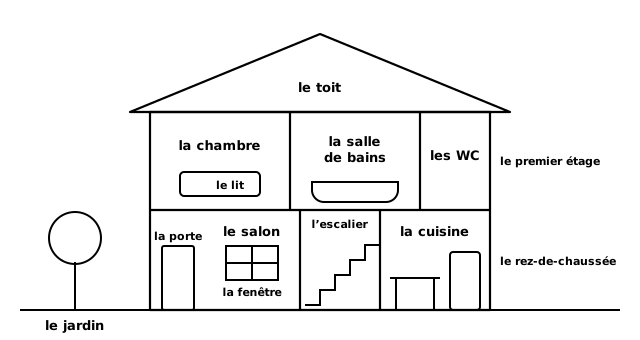
| French | English | Sound |
|---|---|---|
| la maison | house, home | [la may-ZÕ] |
| un appartement | flat, apartment | [ɛ̃-na-par-tuh-MÃ] |
| la chambre | bedroom | [la SHÃBR] |
| la cuisine | kitchen; cooking | [la kwee-ZEEN] |
| le salon | living room | [luh sa-LÕ] |
| la salle de bains | bathroom | [la sal duh Bɛ̃] |
| les toilettes (f) | toilet | [lay twa-LET] |
| la salle à manger | dining room | [la sal a mã-ZHAY] |
| le jardin | garden | [luh zhar-Dɛ̃] |
| la porte · la fenêtre | door · window | [PORT · fuh-NETR] |
| le lit · la chaise | bed · chair | [LEE · SHEZ] |
| le canapé · une armoire | sofa · wardrobe | [ka-na-PAY · ar-MWAR] |
| le frigo · la clé | fridge · key | [free-GO · KLAY] |
Which floor?
French counts floors like British English: le rez-de-chaussée = ground floor, le premier étage = the floor above it (an American "second floor").
- J’habite dans un appartement au troisième étage. — I live in a flat on the third floor.
- Il y a trois chambres dans la maison. — There are three bedrooms in the house. [eel-ya trwa SHÃBR]
- La cuisine est petite, mais le salon est grand. — The kitchen is small, but the living room is big.
Careful
- Wrong: Ce soir, je vais à ma maison.
- Right: Ce soir, je rentre à la maison / chez moi.
- Why: "Home" = à la maison or chez moi — never "à ma maison". See Prepositions & places for chez.
41.4 Manger et boire — food and drink
| French | English | Sound |
|---|---|---|
| le pain | bread | [luh Pɛ̃] |
| le beurre · le fromage | butter · cheese | [BUHR · fro-MAZH] |
| la viande | meat | [la VYÃD] |
| le poulet · le poisson | chicken · fish | [poo-LAY · pwa-SÕ] |
| un œuf → des œufs | an egg → eggs | [ɛ̃-NUHF → day-ZUH] |
| le riz · les légumes (m) | rice · vegetables | [REE · lay-GEWM] |
| les fruits (m) · la pomme | fruit · apple | [FRWEE · POM] |
| la pomme de terre | potato ("earth apple") | [la pom duh TEHR] |
| l’eau (f) | water | [LO] |
| le lait · le thé · le café | milk · tea · coffee | [LAY · TAY · ka-FAY] |
| le jus d’orange · le vin | orange juice · wine | [zhew do-RÃZH · Vɛ̃] |
| le sucre · le sel | sugar · salt | [SEWKR · SEL] |
The three meals
| France | English | Québec |
|---|---|---|
| le petit-déjeuner | breakfast | le déjeuner |
| le déjeuner | lunch | le dîner |
| le dîner | dinner | le souper |
When you eat or drink some of something, French uses du, de la, de l’ — the partitive. The details are in Articles; here, just copy the pattern.
- Le matin, je bois du thé avec du lait. — In the morning I drink tea with milk.
- Je voudrais un café et un croissant, s’il vous plaît. — I would like a coffee and a croissant, please.
- Je ne mange pas de viande : je suis végétarien. — I don’t eat meat: I’m vegetarian. (A woman says végétarienne.) [vay-zhay-ta-RYɛ̃]
Poisson or poison?
le poisson [pwa-SÕ] with a hard s = fish. le poison [pwa-ZÕ] with a z sound = poison. Order carefully!
41.5 Le corps — the body
| French | English | Sound |
|---|---|---|
| la tête | head | [la TET] |
| les cheveux (m) | hair (on the head) | [lay shuh-VUH] |
| un œil → les yeux | an eye → the eyes | [ɛ̃-NUHY → lay-ZYUH] |
| le nez · la bouche | nose · mouth | [NAY · BOOSH] |
| une oreille · les dents (f) | ear · teeth | [o-RAY · DÃ] |
| le cou · le dos | neck · back | [KOO · DO] |
| le bras · la main | arm · hand | [BRA · Mɛ̃] |
| le doigt · le ventre | finger · stomach | [DWA · VÃTR] |
| la jambe · le genou | leg · knee | [ZHÃB · zhuh-NOO] |
| le pied | foot | [luh PYAY] |
It hurts: avoir mal à
Pain = avoir mal à + the body part: j’ai mal à la tête, au dos, à l’oreille, aux dents.
- J’ai mal à la tête. — I have a headache. (literally: I have pain at the head) [zhay MAL a la TET]
- Mon père a mal au dos. — My father has backache.
- Elle a les yeux marron et les cheveux longs. — She has brown eyes and long hair.
- Je me lave les mains. — I wash my hands.
Notice: with body parts, French usually says the hand, not my hand — the owner is already clear (je me lave). See Reflexive verbs.
Careful
- Wrong: J’ai mal à ma tête.
- Right: J’ai mal à la tête.
- Why: With avoir mal à, use the article, not "my". The "j’" already says whose head it is.
41.6 Les vêtements et les couleurs — clothes and colours
| French | English | Sound |
|---|---|---|
| le pantalon | trousers (one pair) | [luh pã-ta-LÕ] |
| le jean · le short | jeans · shorts | [DJEEN · SHORT] |
| la chemise | shirt | [la shuh-MEEZ] |
| le tee-shirt · le pull | T-shirt · sweater | [tee-SHUHRT · PEWL] |
| la robe · la jupe | dress · skirt | [ROB · ZHEWP] |
| la veste · le manteau | jacket · coat | [VEST · mã-TO] |
| les chaussures (f) | shoes | [lay sho-SEWR] |
| les chaussettes (f) | socks | [lay sho-SET] |
| le chapeau · une écharpe | hat · scarf | [sha-PO · ay-SHARP] |
Two key verbs: porter = to wear (state), mettre = to put on (action).
- Aujourd’hui, je porte un jean et un pull bleu. — Today I’m wearing jeans and a blue sweater.
- Mets ton manteau, il fait froid ! — Put your coat on, it’s cold!
Careful
- Wrong: J’ai acheté des pantalons noirs. (meaning one pair)
- Right: J’ai acheté un pantalon noir.
- Why: English says "trousers, jeans, shorts" (plural); French counts one pair as one thing: un pantalon, un jean, un short.
Colours — and how they agree
| Masculine | Feminine | English |
|---|---|---|
| noir | noire | black |
| blanc | blanche | white |
| vert | verte | green |
| bleu | bleue | blue (same sound) |
| gris | grise | grey |
| violet | violette | purple |
| rouge · jaune · rose · beige | same | red · yellow · pink · beige |
| marron · orange | never change | brown · orange |
Colours come after the noun and agree
un pull vert · une jupe verte · des chaussures vertes — but marron and orange never change. More in Adjectives.
- Elle porte une robe rouge et des chaussures noires. — She is wearing a red dress and black shoes.
- J’aime ta chemise blanche. — I like your white shirt. [ta shuh-meez BLÃSH]
41.7 Le temps et les saisons — weather and seasons
French describes weather with il fait (literally "it makes"), with a few special verbs like il pleut, or with il y a (there is). The word le temps means both "weather" and "time".
- Quel temps fait-il ? — What’s the weather like? [kel tã feh-TEEL]
- Il fait beau. Il fait chaud. — The weather is nice. It’s hot. [eel feh BO · eel feh SHO]
- Il fait froid. Il fait mauvais. — It’s cold. The weather is bad. [feh FRWA · feh mo-VEH]
- Il pleut. Il neige. — It’s raining. It’s snowing. [eel PLUH · eel NEZH]
- Il y a du vent et des nuages. — It’s windy and cloudy. (there is wind and clouds)
- Il fait trente degrés à Delhi. — It’s thirty degrees in Delhi.
| Season | In … | English |
|---|---|---|
| le printemps | au printemps | spring |
| l’été (m) | en été | summer |
| l’automne (m) | en automne | autumn |
| l’hiver (m) | en hiver | winter |
| la mousson | pendant la mousson | monsoon |
- En Inde, la mousson commence en juin. — In India, the monsoon starts in June.
Careful
- Wrong: Il est froid aujourd’hui.
- Right: Il fait froid aujourd’hui.
- Why: Weather uses il fait. "Il est froid" means "he (or it, a thing) is cold" — like a cold plate or an unfriendly man.
Careful
- Wrong: Je suis froid.
- Right: J’ai froid.
- Why: A person has cold or heat: j’ai froid, j’ai chaud. "Je suis froid" means "I am a cold, unfriendly person". See Être & avoir.
Three weather owners
The weather: il fait froid. A thing: c’est froid. A person: j’ai froid.
41.8 La ville — the city
| French | English | Sound |
|---|---|---|
| la ville · la rue | town, city · street | [VEEL · REW] |
| la place · le parc | square · park | [PLASS · PARK] |
| le magasin · le marché | shop · market | [ma-ga-Zɛ̃ · mar-SHAY] |
| la boulangerie | bakery | [la boo-lã-zhuh-REE] |
| la pharmacie · la banque | chemist · bank | [far-ma-SEE · BÃK] |
| la gare | train station | [la GAR] |
| un arrêt de bus | bus stop | [a-reh duh BEWS] |
| un hôpital · une école | hospital · school | [o-pee-TAL · ay-KOL] |
| le musée | museum | [luh mew-ZAY] |
| le cinéma · le restaurant | cinema · restaurant | [see-nay-MA · res-to-RÃ] |
| la voiture · le vélo | car · bicycle | [vwa-TEWR · vay-LO] |
| le bus · le métro · le train | bus · underground · train | [BEWS · may-TRO · TRɛ̃] |
How you travel
Inside a vehicle: en voiture, en bus, en train. On top of it or on your feet: à vélo, à pied.
- La gare est près de la banque. — The station is near the bank.
- Je vais au marché à pied. — I walk to the market. (I go to the market on foot)
- Il y a une pharmacie dans cette rue ? — Is there a chemist’s in this street?
- On va au cinéma ce soir ? — Shall we go to the cinema tonight?
Careful
- Wrong: Je visite la musée du Louvre.
- Right: Je visite le musée du Louvre.
- Why: Most words in -ée are feminine (la journée), but le musée and le lycée are masculine. Learn them with their article.
Asking the way, buying bread and taking the metro are practised as full dialogues in Everyday French.
41.9 In real life — a postcard from Lyon
Ananya is staying with her aunt in France. Almost every theme of this chapter is in her card.
- Salut Rohan ! Je suis à Lyon chez ma tante. — Hi Rohan! I’m in Lyon at my aunt’s.
- Elle habite dans une grande maison avec un joli jardin. — She lives in a big house with a pretty garden.
- Ma chambre est au premier étage, à côté de la salle de bains. — My room is on the first floor, next to the bathroom.
- Ici, il fait froid et il pleut souvent, alors je porte mon gros manteau. — Here it’s cold and it often rains, so I wear my thick coat.
- Le matin, on mange du pain avec du beurre et de la confiture. — In the morning we eat bread with butter and jam.
- Demain, on va au marché et au musée. Bises, Ananya — Tomorrow we’re going to the market and the museum. Love, Ananya
À retenir
- Never learn a bare noun. Learn la chaise, le lit — the article is part of the word.
- Before a vowel, le and la both become l’. So learn those words with un/une: un appartement, <span…
- Say each word aloud with its article · stick labels on things at home (la porte, le frigo) · learn ten words a day and review them the next morning.
- Pain = avoir mal à + the body part: j’ai mal à la tête, au dos, à l’oreille, aux dents.
- un pull vert · une jupe verte · des chaussures vertes — but marron and orange never change. More in Adjectives.
- The weather: il fait froid. A thing: c’est froid. A person: j’ai froid.
41.10 Practice — Core vocabulary
Exercise 1
___ problème (the problem)
- le
- la
- les
- l'
Hint: -ème words from Greek
Answer
le
problème is masculine: le problème, le système.
Exercise 2
How do you say "It's cold" (the weather)?
- Il est froid
- Il fait froid
- J'ai froid
- Je suis froid
Answer
Il fait froid
Weather uses il fait.
Exercise 3
How do you say "I'm cold" (I feel cold)?
- Je suis froid
- Il fait froid
- J'ai froid
- Je fais froid
Answer
J'ai froid
A person has cold: avoir froid.
Exercise 4
___ mère s'appelle Anita. (My)
Hint: mère is feminine
Answer
Ma
ma + feminine noun: ma mère.
Exercise 5
J'ai mal ___ dos. (I have backache)
Hint: à + le
Answer
au
à + le dos = au dos.
Exercise 6
À Mumbai, il ___ beaucoup en juillet. (pleuvoir)
Hint: it rains
Answer
pleut
pleuvoir → il pleut.
Exercise 7
Tap the wrong word.
Elle porte une robe vert.
Answer
Wrong word: vert.
Corrected: Elle porte une robe verte.
robe is feminine, so the colour takes -e: verte.
Exercise 8
Tap the wrong word.
Mon mère habite à Delhi.
Answer
Wrong word: Mon.
Corrected: Ma mère habite à Delhi.
The possessive agrees with mère (feminine): ma.
Exercise 9
Tap the wrong word.
Ce matin, je suis froid.
Answer
Wrong word: suis.
Corrected: Ce matin, j'ai froid.
Feeling cold = avoir froid.
Exercise 10
Match the family words.
| A | B |
|---|---|
| le frère | uncle |
| la sœur | daughter |
| l'oncle | brother |
| la fille | sister |
Answer
le frère — brother; la sœur — sister; l'oncle — uncle; la fille — daughter
la fille also means girl.
Exercise 11
Match the rooms.
| A | B |
|---|---|
| la cuisine | living room |
| la chambre | bathroom |
| le salon | kitchen |
| la salle de bains | bedroom |
Answer
la cuisine — kitchen; la chambre — bedroom; le salon — living room; la salle de bains — bathroom
la chambre is a bedroom, not any room.
Exercise 12
Match the weather.
| A | B |
|---|---|
| Il pleut | It's windy |
| Il neige | The weather is nice |
| Il y a du vent | It's raining |
| Il fait beau | It's snowing |
Answer
Il pleut — It's raining; Il neige — It's snowing; Il y a du vent — It's windy; Il fait beau — The weather is nice
il fait, il pleut, il y a — three weather patterns.
Exercise 13
I bought ___ (one pair of trousers).
- un pantalon
- une pantalon
- des pantalons
- un pantalons
Answer
un pantalon
One pair of trousers is one masculine noun: un pantalon.
Exercise 14
___ printemps (in spring)
- en
- au
- à
- dans
Answer
au
au printemps, but en été, en automne, en hiver.
Exercise 15
Put the words in order.
Words: y / trois / la / chambres / Il / dans / maison / a
Answer
Il y a trois chambres dans la maison
il y a = there is / there are.
Exercise 16
Put the words in order.
Words: yeux / Elle / les / a / bleus
Answer
Elle a les yeux bleus
French uses avoir + les + body part + colour.
Exercise 17
Say it aloud.
J'ai deux frères et une sœur
Answer
Say: J'ai deux frères et une sœur
sœur sounds like [SUHR].
Exercise 18
Say it aloud.
Quel temps fait-il aujourd'hui
Answer
Say: Quel temps fait-il aujourd'hui
fait-il links as [feh-TEEL].
Next step
Nouns name the world; verbs make it move. Go on to The 100 essential verbs to learn the verbs you will use with all these words.