Chapter 17: Prepositions & places
Les prépositions
Prepositions are the small words that say where and when: in, on, at, to, from, since. French has fewer of them than English, so one French word often covers several English ones — à can mean “at”, “to” and “in”. The good news: the rules for cities, countries, transport and time are very regular once you see them laid out.
- 1Where is it? The place prepositions
- 2À, dans, chez: at, in, at someone’s place
- 3Cities and countries: à, en, au, aux
- 4Transport: en voiture, à pied
- 5Time: à, en, le, and the four duration words
- 6De: from, of, about — and what things are made of
- 7Mistakes learners really make
- 8In real life — asking the way
masculinefeminine
In one line
à + city, en + feminine country, au + masculine country, aux + plural country: à Paris, en France, au Japon, aux États-Unis.
17.1 Where is it? The place prepositions
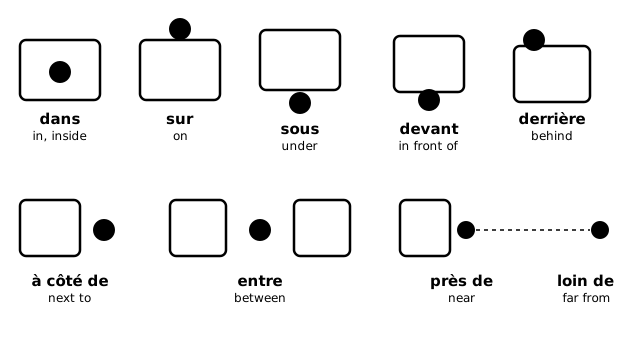
- Les clés sont dans mon sac. — The keys are in my bag. [dã mõ SAK]
- Le chat dort sur le canapé. — The cat is sleeping on the sofa. [sewr luh ka-na-PAY]
- Tes chaussures sont sous le lit. — Your shoes are under the bed. [soo luh LEE]
- Je t’attends devant le cinéma. — I’ll wait for you in front of the cinema. [duh-VÃ luh see-nay-MA]
- Le jardin est derrière la maison. — The garden is behind the house. [deh-RYEHR]
- La pharmacie est à côté de la banque, en face du parc. — The pharmacy is next to the bank, opposite the park. (de + le → du) [a ko-TAY duh la BÃK, ã FAS dew PARK]
- J’habite près de la gare, mais loin du centre. — I live near the station, but far from the centre. [preh duh la GAR … lwɛ̃ dew SÃTR]
- Le café est entre la poste et l’école. — The café is between the post office and the school. [ÃTR]
The “de” prepositions contract
près de, loin de, à côté de, en face de follow the article rules: près du parc (de + le), à côté des magasins (de + les), but près de la gare, près de l’école.
17.2 À, dans, chez: at, in, at someone’s place
Three words that English often translates as “at” or “in”:
| Word | Idea | Examples |
|---|---|---|
| à | a point on the map, a destination, a place by its function | à la gare, au bureau, à l’école, à la maison (at home) |
| dans | physically inside something with walls or limits | dans la cuisine, dans le train, dans la rue |
| chez | at or to someone’s home or shop — a person, not a place | chez moi, chez Paul, chez le dentiste |
- Je suis à la maison. — I’m at home. [zhuh swee a la meh-ZÕ]
- Il y a une araignée dans la maison ! — There’s a spider in the house! (inside the building)
- On dîne chez moi ce soir ? — Shall we have dinner at my place tonight? [shay MWA]
- Je vais chez le médecin, puis à la pharmacie. — I’m going to the doctor’s, then to the pharmacy. (person → chez; place → à)
- Mes parents habitent chez mon frère. — My parents live at my brother’s (house). Hindi: bhai ke ghar — chez does it in one word.
chez + person
Use chez with people, never with places: chez le boulanger, but à la boulangerie; chez moi, but à la maison.
17.3 Cities and countries: à, en, au, aux
To say “in” or “to” a place, the choice depends on what kind of place it is — and on the gender of the country (see Nouns, gender & plurals: most countries ending in -e are feminine).
| Place | in / to | from | Examples |
|---|---|---|---|
| city | à | de / d’ | à Paris, à Mumbai · de Lyon, d’Agra |
| feminine country | en | de / d’ | en France, en Inde, en Chine · de France, d’Inde |
| masc. country starting with a vowel | en | d’ | en Iran, en Irak, en Afghanistan · d’Iran |
| masculine country | au | du | au Japon, au Canada, au Brésil, au Mexique · du Japon |
| plural country | aux | des | aux États-Unis, aux Pays-Bas · des États-Unis |
- J’habite à Bangalore, en Inde. — I live in Bangalore, in India. [zha-BEET a bã-ga-LOR, ã-Nɛ̃D]
- Cet été, nous allons au Japon. — This summer, we’re going to Japan. [oh zha-PÕ]
- Mon cousin travaille aux États-Unis. — My cousin works in the United States. [oh-zay-ta-zew-NEE]
- Elle vient du Canada, et lui d’Italie. — She comes from Canada, and he from Italy. [dew ka-na-DA … dee-ta-LEE]
- Je rentre des Pays-Bas demain. — I’m coming back from the Netherlands tomorrow.
- Ils passent leurs vacances au Kerala. — They spend their holidays in Kerala. (regions follow the same rule: en Bretagne, en Californie, au Texas)
Countries
en + feminine (en France), au + masculine (au Japon), aux + plural (aux États-Unis); from: de France, du Japon, des États-Unis.
17.4 Transport: en voiture, à pied
An easy picture: if you sit inside it, use en. If you sit on it or use your own legs, use à.
| en (inside) | à (on top / on foot) |
|---|---|
| en voiture · en taxi | à pied (on foot) |
| en train · en métro · en bus | à vélo (by bike) |
| en avion · en bateau | à moto · à cheval · à trottinette |
- Je vais au travail en métro. — I go to work by metro. [ã may-TROH]
- On y va à pied ? C’est tout près. — Shall we walk there? It’s very close. [õ-nee va a PYAY]
- Ils voyagent en avion jusqu’à Delhi, puis en train. — They fly as far as Delhi, then take the train. [ã-na-VYÕ]
- Ma fille va à l’école à vélo. — My daughter cycles to school. (many people also say “en vélo”)
With a specific vehicle, use dans or the verb prendre: Je suis dans le bus (I’m on the bus), Je prends le train de 9 heures.
17.5 Time: à, en, le, and the four duration words
When?
| Use | French | English |
|---|---|---|
| clock time | à 8 heures, à midi | at 8 o’clock, at noon |
| month, year | en mai, en 2026 | in May, in 2026 |
| seasons | en été, en automne, en hiver — but au printemps | in summer, autumn, winter, spring |
| dates | le 14 juillet | on 14 July (no preposition) |
| days | lundi / le lundi | on Monday / on Mondays |
- Le cours commence à neuf heures. — The class starts at nine. [a nuh-VUHR]
- Je suis né en 1998, au printemps. — I was born in 1998, in spring. [oh prɛ̃-TÃ]
- Mon anniversaire, c’est le 3 mars. — My birthday is on 3 March.
How long, how far back? en, dans, pendant, depuis, il y a
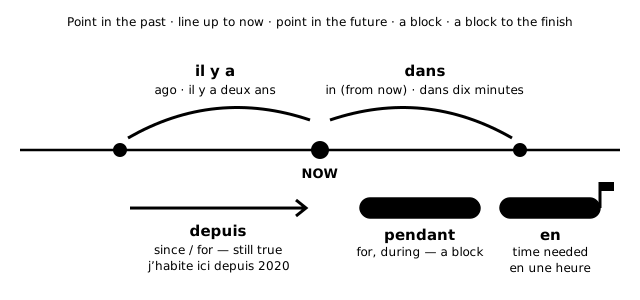
- Je suis arrivé en France il y a deux ans. — I arrived in France two years ago. (il y a + past tense) [eel-ya duh-ZÃ]
- J’habite ici depuis deux ans. — I have lived here for two years. (depuis + present — see Present tense: -er verbs) [duh-PWEE duh-ZÃ]
- Le film commence dans dix minutes. — The film starts in ten minutes (from now). [dã dee mee-NEWT]
- J’ai travaillé à Londres pendant trois ans. — I worked in London for three years. (finished — I don’t any more) [pã-DÃ trwa-ZÃ]
- Il a lu le livre en une semaine. — He read the book in a week. (it took him a week) [ã-newn suh-MEN]
- Pendant les vacances, on va à la mer. — During the holidays, we go to the seaside.
dans vs en
dans deux heures = two hours from now; en deux heures = it takes two hours. il y a = ago; depuis = still going.
17.6 De: from, of, about — and what things are made of
de is the most frequent French preposition. Its main jobs:
- Je viens de Kolkata. — I come from Kolkata. (origin)
- la voiture de mon père — my father’s car (belonging — no ’s in French)
- un professeur de français, une tasse de thé — a French teacher, a cup of tea (type, content)
- une tasse à thé, un sac en cuir — a teacup (purpose: à), a leather bag (material: en) [ɛ̃ sak ã KWEER]
- On parle de quoi ? — Du match d’hier. — What are we talking about? — Yesterday’s match. (parler de = talk about)
17.7 Mistakes learners really make
Preposition traps
- Wrong: J’habite en Paris.
- Right: J’habite à Paris.
-
Why: Cities take à. en is for (feminine) countries.
-
Wrong: Je vais à Canada.
- Right: Je vais au Canada.
-
Why: Masculine country → au (à + le).
-
Wrong: Je viens de la France.
- Right: Je viens de France.
-
Why: With feminine countries, “from” is just de (d’ before a vowel: d’Inde).
-
Wrong: Je vais à le médecin.
- Right: Je vais chez le médecin.
-
Why: To a person (doctor, hairdresser, friend) → chez.
-
Wrong: Je vais au bureau par voiture.
- Right: Je vais au bureau en voiture.
-
Why: Transport you sit in → en voiture, en train.
-
Wrong: Je pars en deux jours. (meaning: two days from now)
- Right: Je pars dans deux jours.
-
Why: From now → dans. en = the time something takes.
-
Wrong: J’ai visité Rome avant trois ans.
- Right: J’ai visité Rome il y a trois ans.
- Why: “Ago” = il y a, placed before the duration. (Hindi teen saal pehle tempts learners to say avant.)
17.8 In real life — asking the way
- — Excusez-moi, la gare, c’est loin d’ici ? — Excuse me, is the station far from here? [eks-kew-zay-MWA … seh lwɛ̃ dee-SEE]
- — Non, c’est à dix minutes à pied. Allez tout droit, puis tournez à gauche. — No, it’s ten minutes on foot. Go straight on, then turn left. [too DRWA … toor-nay a GOHSH]
- — La gare est en face de la poste, à côté d’un grand hôtel. — The station is opposite the post office, next to a big hotel.
- — Merci ! Et il y a un train pour Lyon dans une heure ? — Thanks! And is there a train to Lyon in an hour?
- — Oui, en général toutes les heures. Vous arrivez à Lyon en deux heures. — Yes, usually every hour. You get to Lyon in two hours (it takes two hours).
À retenir
- à + city, en + feminine country, au + masculine country, aux + plural country: à Paris, en France, au Japon, aux États-Unis.
- Use chez with people, never with places: chez le boulanger, but à la boulangerie; chez moi, but à la maison.
- en + feminine (en France), au + masculine (au Japon), aux + plural (aux États-Unis); from: de France, du Japon, des États-Unis.
- dans deux heures = two hours from now; en deux heures = it takes two hours. il y a = ago; depuis = still going.
- You have finished Les bases. Next comes Object pronouns — le, la, lui, leur — the first step of building longer sentences. Today, describe where five things in your room are, using sur, sous, devant, à côté de and entre.
17.9 Practice — Prepositions
Exercise 1
Je travaille ___ Londres.
- en
- à
- au
- dans
Hint: a city
Answer
à
Cities take à.
Exercise 2
Nous partons ___ Portugal.
- en
- à
- au
- aux
Hint: le Portugal
Answer
au
Masculine country → au.
Exercise 3
Elle habite ___ États-Unis.
- en
- au
- aux
- à
Answer
aux
Plural country → aux.
Exercise 4
Il vient ___ Japon.
- de
- du
- des
- d'
Hint: from + masculine country
Answer
du
From a masculine country → du (de + le).
Exercise 5
Je vais au bureau ___ pied.
- en
- à
- par
- sur
Answer
à
On foot = à pied.
Exercise 6
The train leaves in 5 minutes (from now).
- Le train part en cinq minutes.
- Le train part dans cinq minutes.
- Le train part pendant cinq minutes.
- Le train part depuis cinq minutes.
Answer
Le train part dans cinq minutes.
From now → dans.
Exercise 7
Mes grands-parents habitent ___ Inde.
Answer
en
Inde is feminine → en Inde.
Exercise 8
Ce soir, on dîne ___ Sophie.
Hint: at someone's place
Answer
chez
chez + person = at their home.
Exercise 9
Je suis arrivé ___ trois jours. (three days ago)
Hint: three words
Answer
il y a
ago = il y a + duration.
Exercise 10
Nous allons à la plage ___ été.
Hint: season
Answer
en
en été, en automne, en hiver — but au printemps.
Exercise 11
Tap the wrong word.
Je vais en Paris en avion.
Answer
Wrong word: en.
Corrected: Je vais à Paris en avion.
City → à. (en avion is correct.)
Exercise 12
Tap the wrong word.
Il habite près du la gare.
Answer
Wrong word: du.
Corrected: Il habite près de la gare.
gare is feminine: de la, not du.
Exercise 13
Match the French to the English.
| A | B |
|---|---|
| sur | in front of |
| sous | behind |
| devant | between |
| derrière | on |
| entre | under |
Answer
sur — on; sous — under; devant — in front of; derrière — behind; entre — between
The core place prepositions.
Exercise 14
Match the time words.
| A | B |
|---|---|
| il y a deux ans | two years from now |
| depuis deux ans | for two years (finished) |
| dans deux ans | two years ago |
| pendant deux ans | for two years (still now) |
Answer
il y a deux ans — two years ago; depuis deux ans — for two years (still now); dans deux ans — two years from now; pendant deux ans — for two years (finished)
Each word gives a different shape of time.
Exercise 15
Put the words in order.
Words: banque / en / la / face / La / de / poste / est
Answer
La banque est en face de la poste
en face de + place.
Exercise 16
Put the words in order.
Words: en / Je / vais / au / Canada / avion
Answer
Je vais au Canada en avion
au + masculine country; en + transport you sit in.
Exercise 17
Say where you are from.
Je viens d'Inde et j'habite à Paris
Answer
Say: Je viens d'Inde et j'habite à Paris
d'Inde (feminine country, vowel); à + city.
Exercise 18
Say it aloud.
La pharmacie est à côté de la banque
Answer
Say: La pharmacie est à côté de la banque
à côté de = next to.
Next step
You have finished Les bases. Next comes Object pronouns — le, la, lui, leur — the first step of building longer sentences. Today, describe where five things in your room are, using sur, sous, devant, à côté de and entre.